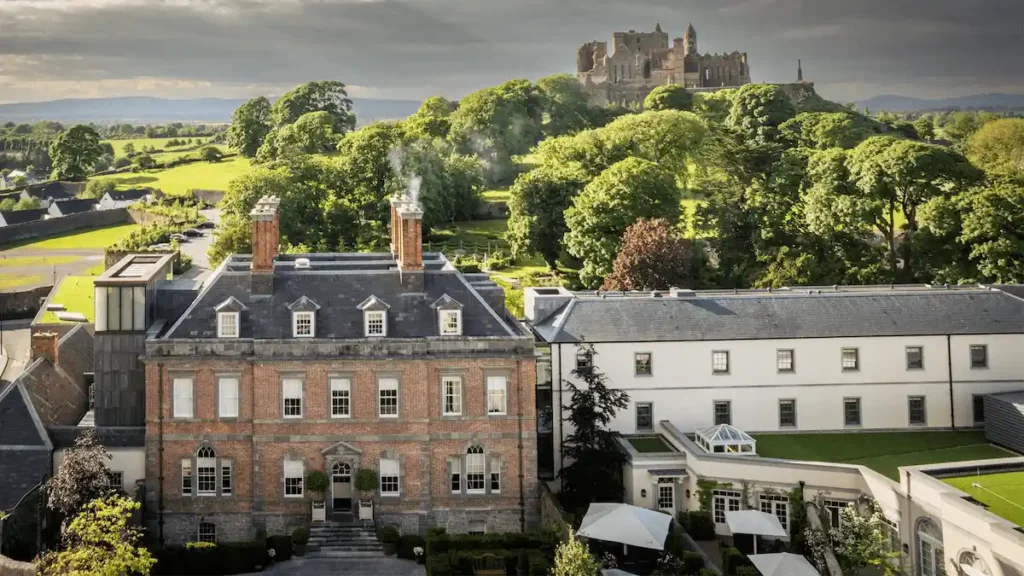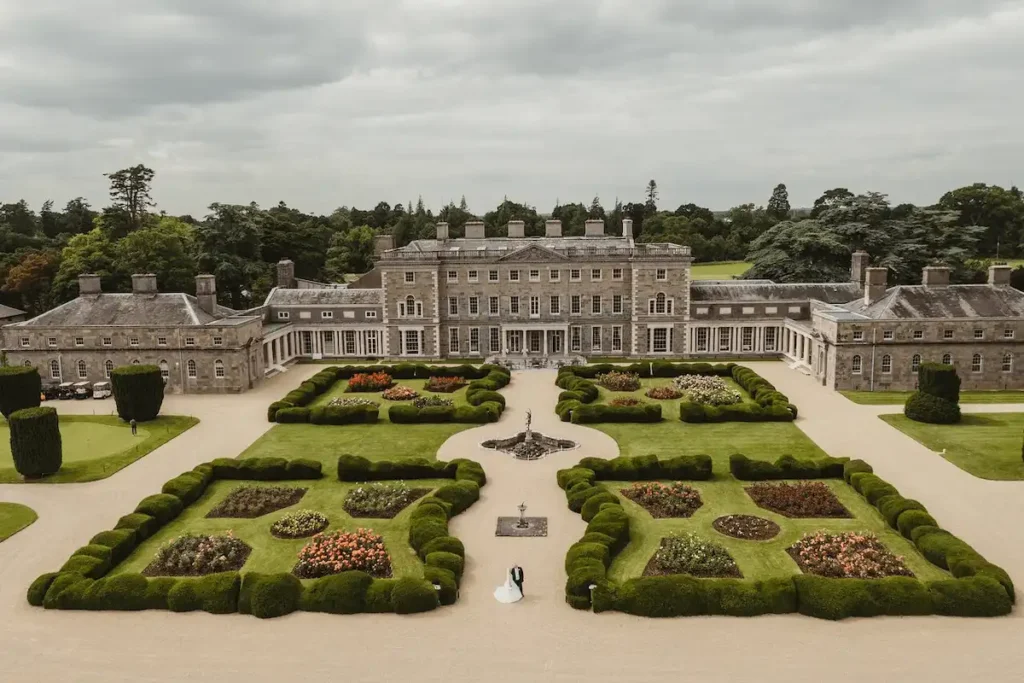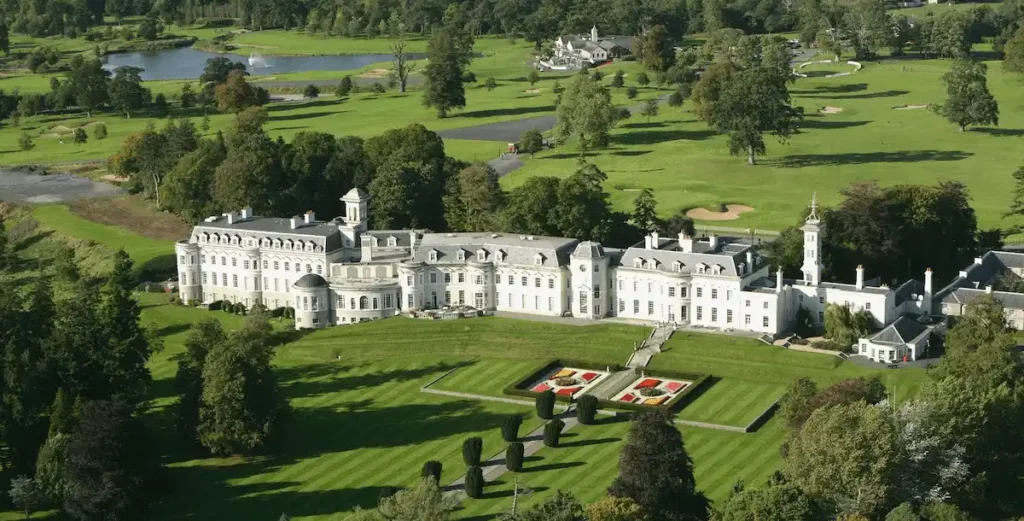
An aerial view of The K Club in Kildare, showing the 19th-century French-style Straffan House with its symmetrical stone pavilions and mansard roofs, surrounded by manicured lawns, formal gardens, and championship golf courses designed by Arnold Palmer.

The K Club: Where Barton Wine Dynasty Built Ireland’s French Château Command

The K Club occupies the 1832 French Second Empire mansion Hugh Barton commissioned after fleeing Revolutionary France—a Loire-style château transplanted to 550 Liffey acres where wine trade power became Irish landed authority. The estate’s symmetrical stone pavilions and mansard roofs established Ireland’s rarest architectural anomaly: a Bordeaux wine fortune’s territorial claim, now commanding championship golf […]

The K Club: Where Barton Wine Dynasty Built Ireland’s French Château Command Read More »

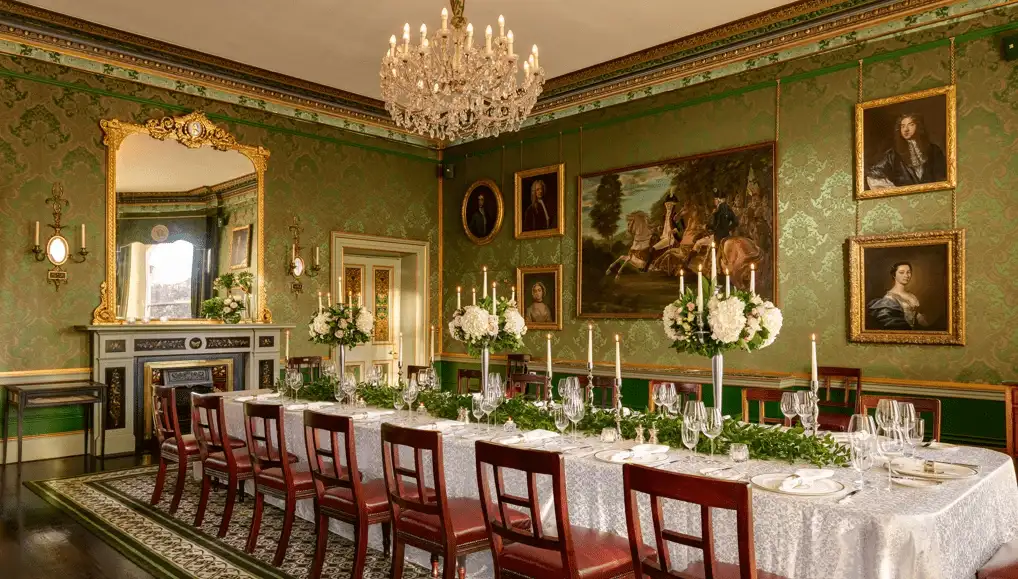
The historic Constitution Room at The Shelbourne Dublin, featuring green damask wallpaper, ornate gold-framed portraits, and the original table where the Irish Free State Constitution was drafted in 1922.

The Shelbourne Dublin: Where Ireland’s Constitution Was Written

The Shelbourne Dublin has occupied the commanding northern edge of St. Stephen’s Green since 1824, when three Georgian townhouses were unified under Martin Burke’s vision. This is not a hotel that borrowed prestige—it is the prestige. The 1867 Victorian expansion by architect John McCurdy introduced the red-brick and terracotta facade now flanked by four bronze

The Shelbourne Dublin: Where Ireland’s Constitution Was Written Read More »

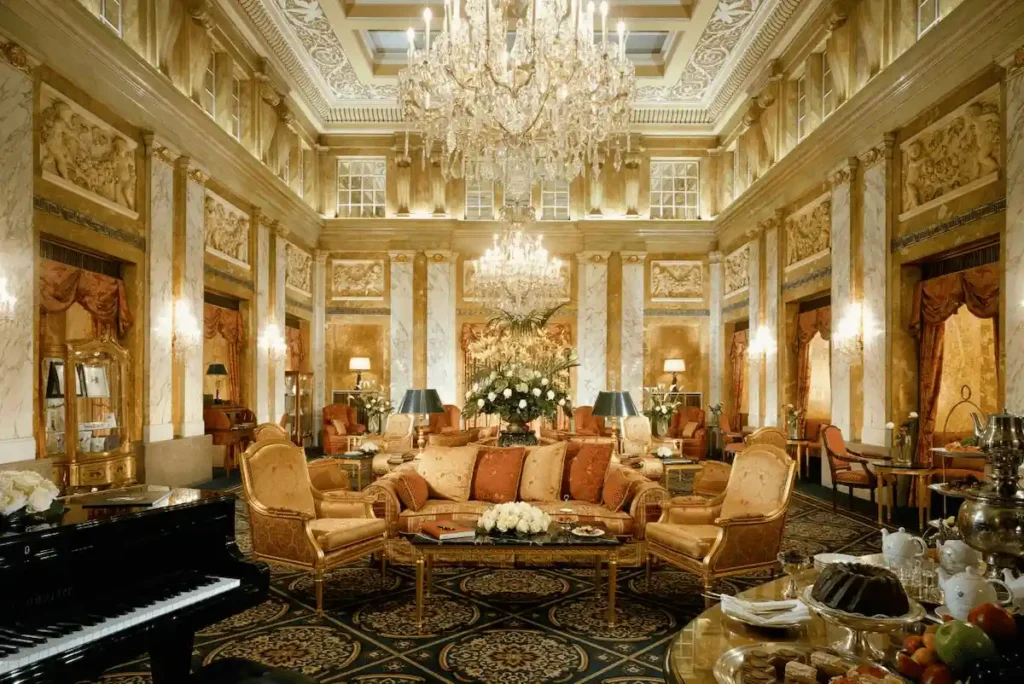
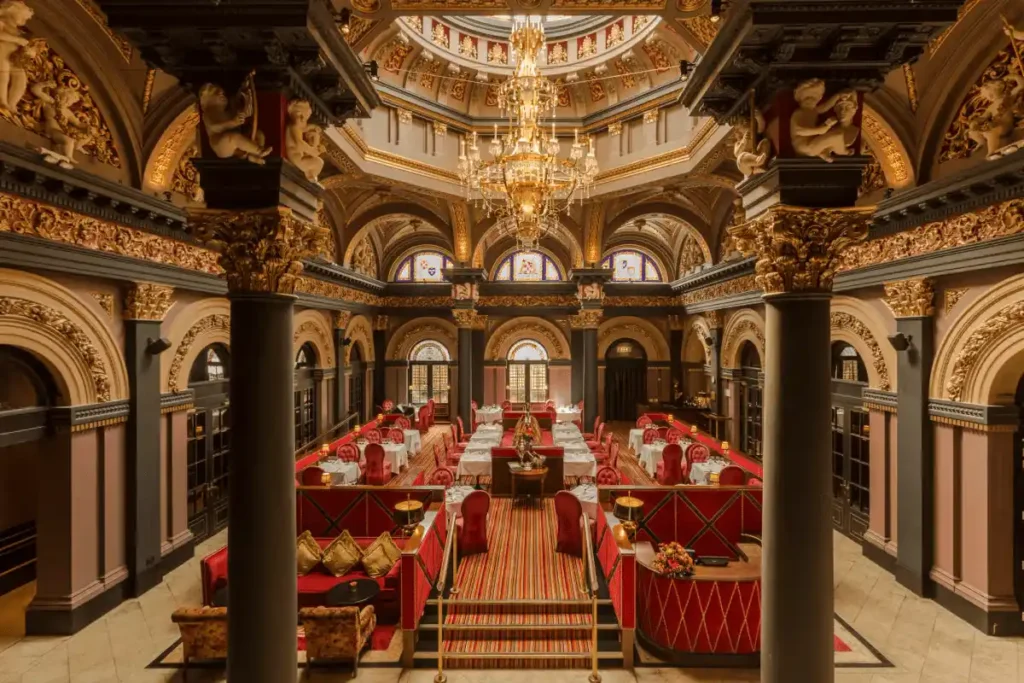
The opulent, double-height dining room at The Merrion Hotel in Dublin, featuring original 18th-century Rococo plasterwork by Robert West, ornate gold-leaf detailing, and a massive crystal chandelier in a building that served as the 1769 birthplace of the Duke of Wellington.

The Merrion Hotel Dublin: Where Wellington Was Born & Parliament Assembled

The Merrion Hotel commands four Grade I listed Georgian townhouses (Nos. 21–24 Upper Merrion Street) built in the 1760s by Lord Charles Stanley Monck. These structures served as the address of Ireland’s parliamentary elite before the Act of Union—nearly every resident until 1800 held a seat in the Irish Parliament. No. 24, formerly Mornington House,

The Merrion Hotel Dublin: Where Wellington Was Born & Parliament Assembled Read More »

The magnificent glass-domed thermal pool atrium at The Gainsborough Bath Spa, featuring classical Romanesque columns and mosaic flooring that highlight the building's 19th-century hospital heritage and its status as the UK's only hotel with private thermal spring access.

The Gainsborough Bath Spa: Britain’s Exclusive Thermal Access Seat

The Gainsborough Bath Spa occupies two Grade II listed Georgian buildings designed by John Pinch the elder in 1824, originally serving as the Royal United Hospital until 1932. This is the only hotel in the United Kingdom offering direct, private access to Bath’s natural thermal mineral waters—the same Roman springs that established the city as

The Gainsborough Bath Spa: Britain’s Exclusive Thermal Access Seat Read More »

An aerial perspective of The Royal Crescent Hotel & Spa in Bath, showcasing the sweeping honey-colored Georgian architecture of the 1775 crescent, the expansive Royal Victoria Park lawn, and a hot air balloon rising over the historic city.

The Royal Crescent Hotel & Spa: Prince Frederick’s 1775 Power Address

The Royal Crescent Hotel & Spa commands the centerpiece of John Wood the Younger’s 1775 Palladian achievement—No. 15 and No. 16, directly where Prince Frederick, Duke of York established royal residence. This is not merely accommodation within a historic building; this is inhabiting the literal seat of Georgian command, where 114 Ionic columns frame 47

The Royal Crescent Hotel & Spa: Prince Frederick’s 1775 Power Address Read More »

The grand Renaissance Revival-style red sandstone facade of The Caledonian Edinburgh, built in 1903 as a premier railway hotel, featuring three magnificent entrance arches that originally provided street-level access to the Princes Street Station platforms.

The Caledonian Edinburgh: Scotland’s 1903 Railway Command Centre Reborn as Castle-View Prestige

The Caledonian Edinburgh occupies Britain’s last surviving grand railway terminus hotel—a red sandstone fortress built in 1903 where station platforms once carried the Empire’s elite directly into Edinburgh’s social command structure. This is where the European Union’s founding agreement was drafted in 1992, where Hollywood royalty rode horses up marble staircases, and where today’s global

The Caledonian Edinburgh: Scotland’s 1903 Railway Command Centre Reborn as Castle-View Prestige Read More »

The historic white-harled facade of Prestonfield House in Edinburgh, featuring its signature 17th-century curvilinear gables and red outdoor umbrellas on the lush green lawns of its private 20-acre estate.

Prestonfield House Edinburgh: Where Benjamin Franklin Met Scotland’s Power Elite

Prestonfield House is not a hotel conversion; it is the 1687 seat of Edinburgh’s Lord Provost, designed by Sir William Bruce—architect of the Palace of Holyroodhouse—to receive royalty and shape diplomatic outcomes. The same Italian craftsmen who decorated the Crown’s chambers executed the plasterwork here. Benjamin Franklin walked these halls as a guest of the

Prestonfield House Edinburgh: Where Benjamin Franklin Met Scotland’s Power Elite Read More »

The double-height Grand Café at The Scotsman Hotel in Edinburgh, featuring original massive marble pillars, ornate Edwardian wood carvings, and crystal chandeliers in the building's former newspaper advertising hall.

The Scotsman Hotel Edinburgh: A Century of Editorial Command

The Scotsman Hotel occupies a monumental landmark commissioned in 1905 by The Scotsman newspaper, when architects James Miller and John Begg were tasked with constructing a media empire headquarters that served as a powerhouse of journalism until 2001. The resulting Edwardian Baroque fortress on North Bridge became Scotland’s most influential address for nearly a century,

The Scotsman Hotel Edinburgh: A Century of Editorial Command Read More »

The candlelit dining room of The Witchery by the Castle in Edinburgh, featuring dark oak-paneled walls with intricate carvings, a magnificent 17th-century painted timber ceiling, and red leather banquettes at tables set for fine dining.

The Witchery by the Castle: Where Edinburgh’s Elite Command the Royal Mile

At the gates of Edinburgh Castle, The Witchery by the Castle occupies Boswell’s Court—a Category A listed merchant’s house from 1595 where Thomas Lowthian carved his authority into stone. This is not a hotel that imitates history; it is history. Nine theatrical suites preserve the Gothic maximalism of Scotland’s aristocratic past, where 17th-century oak paneling

The Witchery by the Castle: Where Edinburgh’s Elite Command the Royal Mile Read More »

The grand Victorian sandstone facade of The Balmoral Hotel in Edinburgh, featuring its iconic 190-foot clock tower and ornate Scots Baronial architecture, situated at the prominent corner of Princes Street and North Bridge.

The Balmoral Hotel Edinburgh: Where Railway Power Became Royal Authority

The Balmoral Hotel stands as Edinburgh’s commanding railway monument—a 190-foot clock tower that has governed the city’s timekeeping since 1902, when the North British Railway Company built this sandstone fortress to anchor their empire at Scotland’s most strategic transport junction. From Queen Elizabeth the Queen Mother’s reserved corner table to the suite where J.K. Rowling

The Balmoral Hotel Edinburgh: Where Railway Power Became Royal Authority Read More »