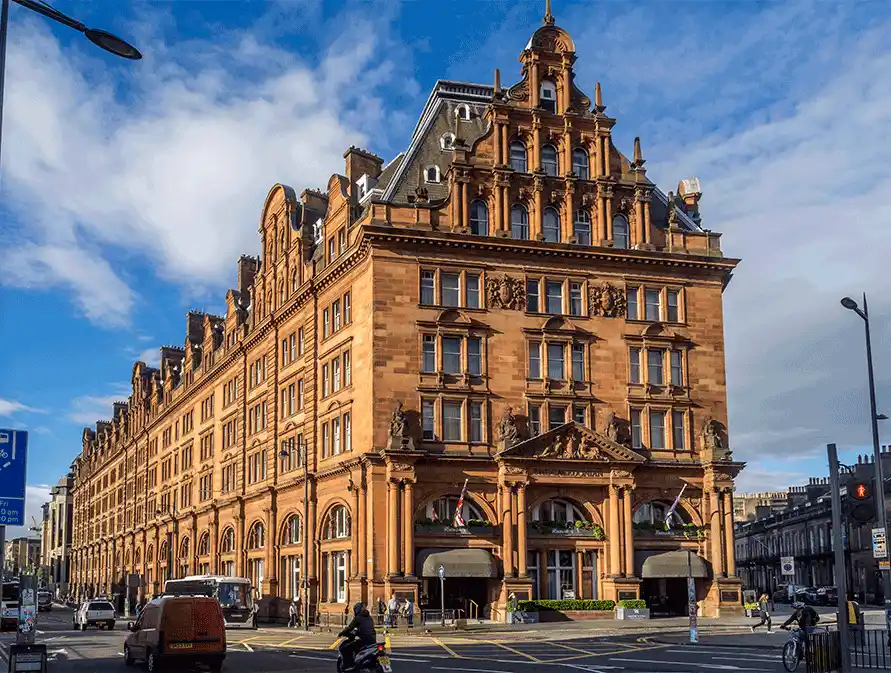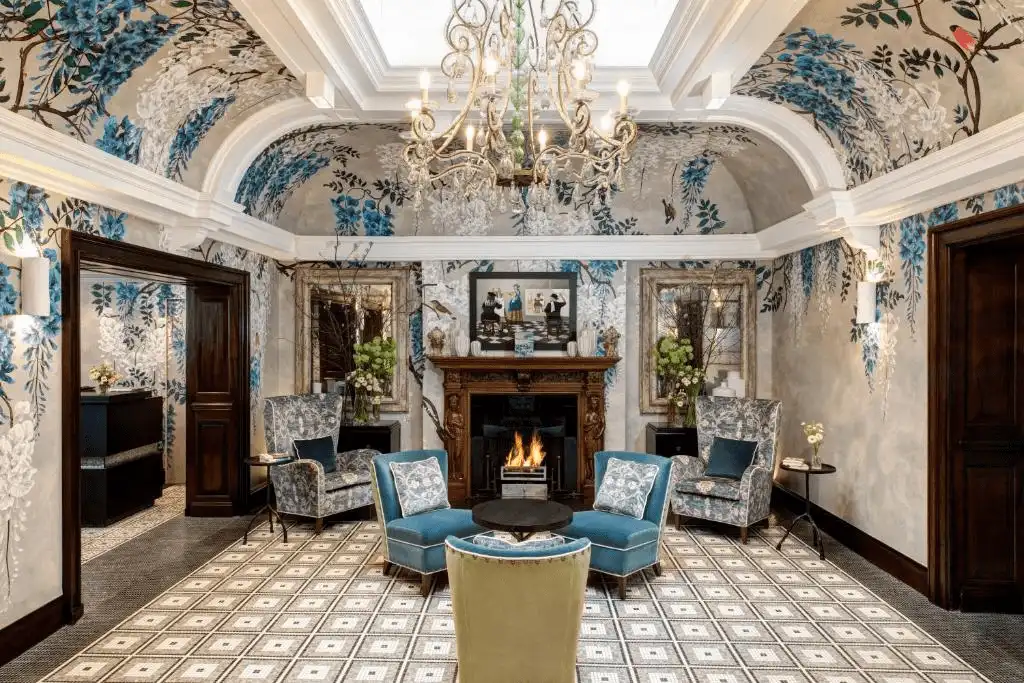
The light-filled reception lounge of Brown's Hotel London featuring vaulted white ceilings adorned with hand-painted blue wisteria murals, a grand crystal chandelier, and a traditional wood-burning fireplace surrounded by teal velvet wingback chairs.

Brown’s Hotel London: Where Britain’s Command Class Has Convened Since 1837

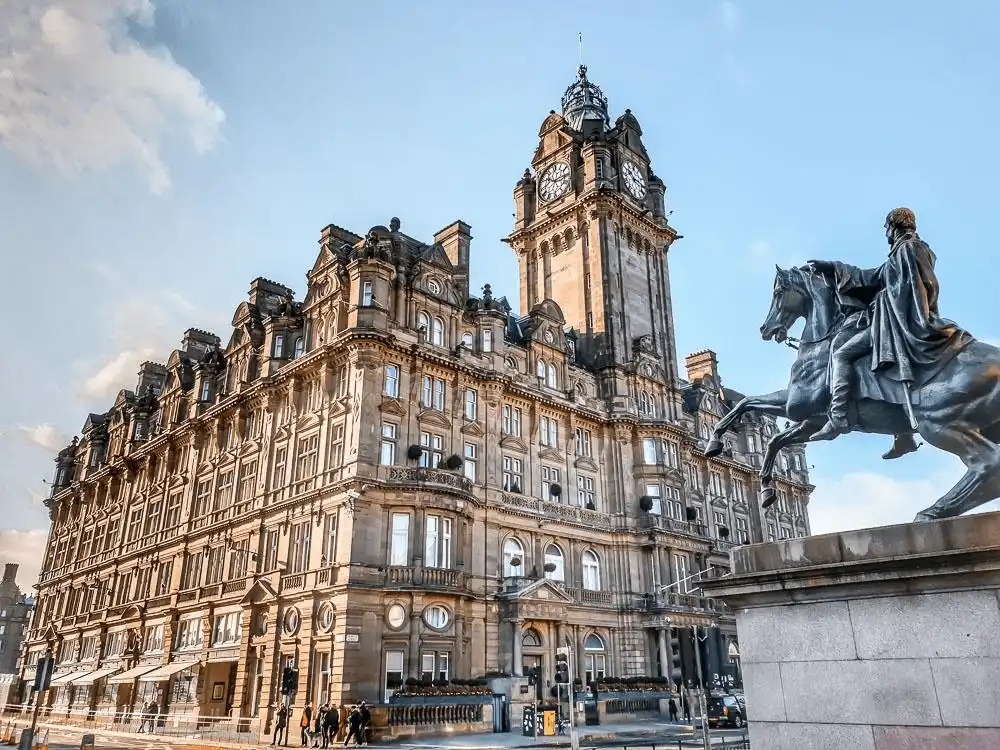
Brown’s Hotel London operates from 11 interconnected Georgian townhouses on Albemarle Street—the architectural footprint where Alexander Graham Bell demonstrated Britain’s first telephone transmission in 1876, where Rudyard Kipling drafted The Jungle Book, and where Queen Victoria held court outside Buckingham Palace. This is the original site of London’s first purpose-built hotel, established in 1837 by […]

Brown’s Hotel London: Where Britain’s Command Class Has Convened Since 1837 Read More »

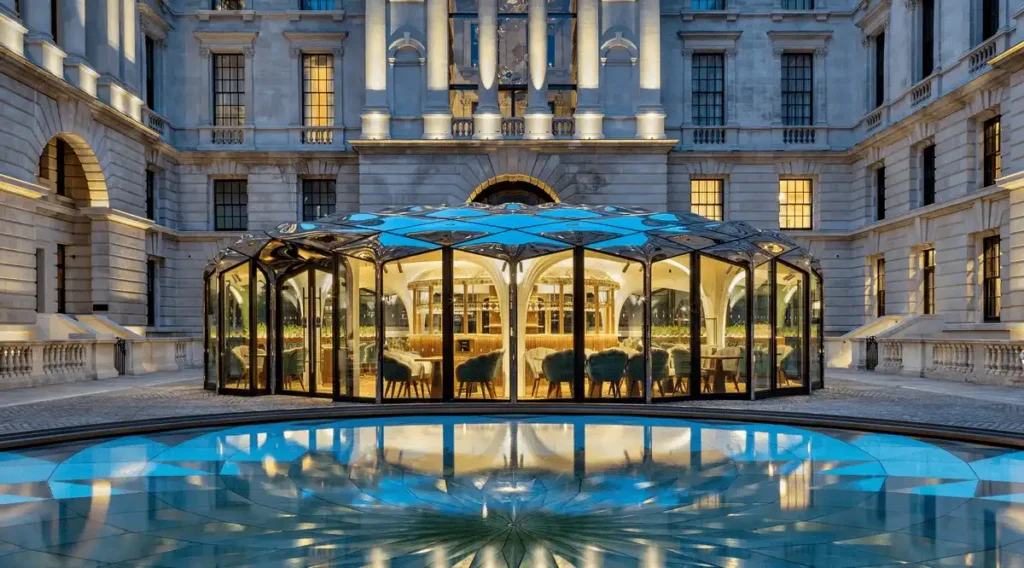
The sleek, modern glass and steel Courtyard Pavilion at Raffles London at The OWO, illuminated at night and reflected in a geometric water feature, set against the historic Portland stone facade of the former Old War Office.

Raffles London at The OWO: Where Churchill Commanded and Fleming Created 007

Raffles London at The OWO occupies the 1906 Old War Office—the administrative seat of the British Empire’s military dominance through two World Wars. Churchill directed global strategy from these corridors. Fleming conceived the 007 mythology within these walls. The building’s transformation from the nerve center of British intelligence into London’s most historically weighted residence delivers

Raffles London at The OWO: Where Churchill Commanded and Fleming Created 007 Read More »

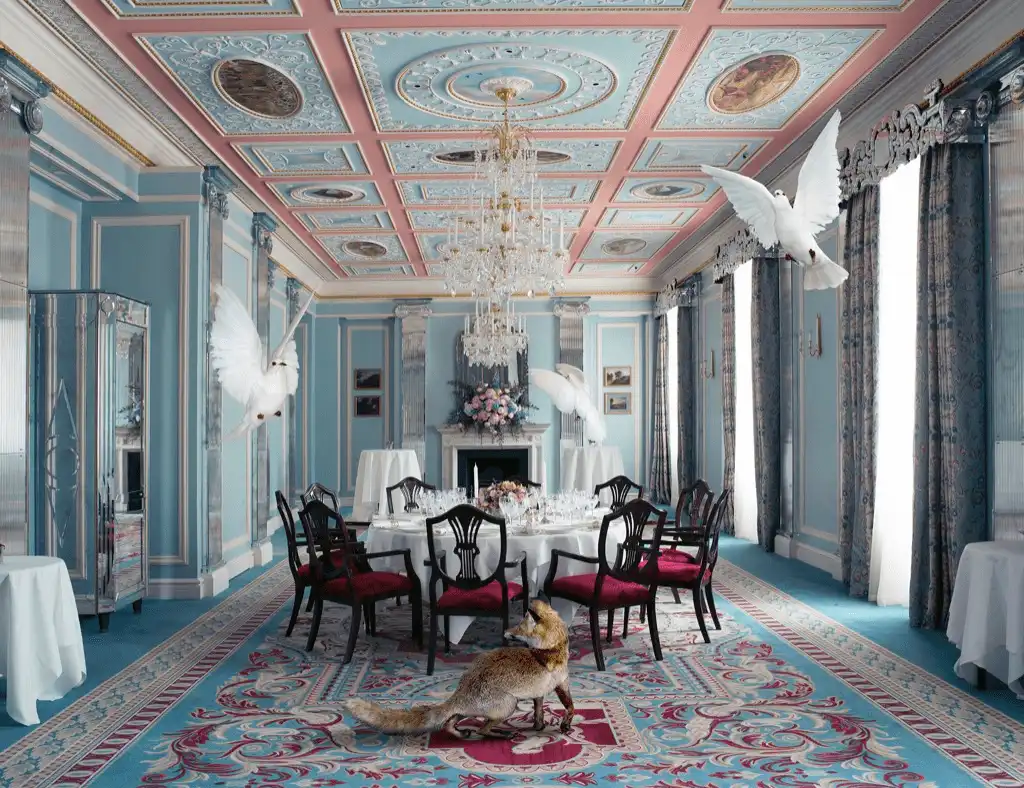
An opulent Regency-style dining room at The Lanesborough London featuring a pastel blue and pink coffered ceiling with gold-leaf detailing, a grand crystal chandelier, and walls adorned with 18th-century artwork.

The Lanesborough London: Where Regency Command Architecture Meets 250 Years of Medical Dominance

The Lanesborough London occupies the 1829 Greek Revival structure designed by William Wilkins—architect of the National Gallery—on the site of Viscount Lanesborough’s 1719 country estate. For 247 years, this building served as St George’s Hospital, one of London’s most vital medical institutions, where Florence Nightingale served as the first female governor and dictated the structural

The Lanesborough London: Where Regency Command Architecture Meets 250 Years of Medical Dominance Read More »

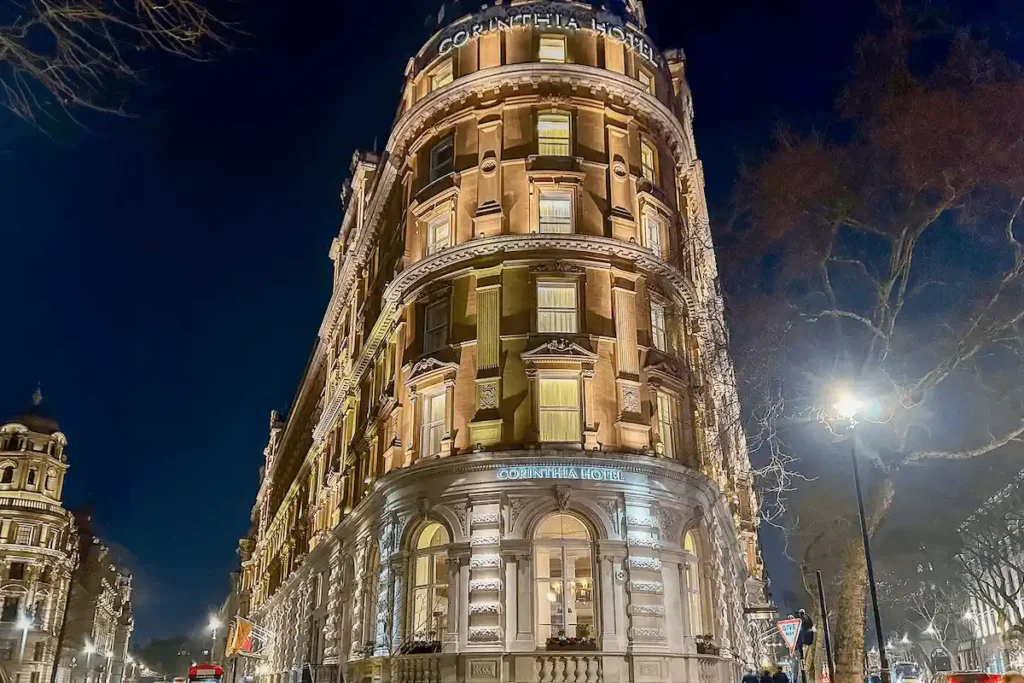
The illuminated Victorian facade of Corinthia London, a landmark 1885 building on Whitehall Place that formerly served as the Ministry of Defence, featuring an ornate curved corner, sand-colored stonework, and grand arched windows beneath a twilight sky.

Corinthia London: Where Victorian Empire Meets Ministry Command

The Corinthia London occupies the 1885 Hôtel Métropole footprint—the Victorian era’s largest grand hotel—requisitioned in 1936 to serve as Ministry of Defence headquarters through the Falklands conflict. Following £300 million reconstruction, the French Renaissance façade now frames 294 suites where government intelligence officers once planned Operation Overlord. The building’s Tudor wine cellar, moved 43 feet

Corinthia London: Where Victorian Empire Meets Ministry Command Read More »

The historic white Portland stone facade of Hotel Café Royal London on Regent Street, a Grade II listed landmark featuring iconic arched entryways and the building's distinctive copper-domed roof against a twilight sky.

Hotel Cafe Royal London: Where Crown Estate Architecture Meets Victorian Power

The Hotel Cafe Royal London occupies the triangular command point of Regent Street, a site hand-drawn by John Nash in 1811 to anchor the Crown Estate’s western corridor. This is not decorative heritage. This is verified territorial dominance: the building sits at the convergence of Piccadilly Circus and Air Street, controlling sightlines across one of

Hotel Cafe Royal London: Where Crown Estate Architecture Meets Victorian Power Read More »

The award-winning Scarfes Bar at Rosewood London, a sophisticated club-style library bar featuring mahogany shelving, a roaring fireplace, and original satirical illustrations by legendary British artist Gerald Scarfe.

Rosewood London: Edwardian Command in Holborn’s Heart

Rosewood London is not a hotel conversion—it is the physical seat of early 20th-century British financial dominance. Built in 1914 as the Pearl Assurance Company headquarters, this Grade II-listed Edwardian fortress in Holborn commands a private cobblestone courtyard and houses a legally protected seven-story marble vault that once secured the assets of an empire. The

Rosewood London: Edwardian Command in Holborn’s Heart Read More »

The iconic The Ned London bank vault entrance, featuring a massive 25-tonne circular stainless steel door from the building's 1920s history as the Midland Bank headquarters, set against a checkerboard floor.

The Ned London: Sir Edwin Lutyens’ 1924 Bank Headquarters

The Ned London commands the City’s financial district from Sir Edwin Lutyens’ 1924 Midland Bank headquarters—once the world’s most powerful bank. You’re staying inside a Grade I listed monument where 92 African verdite columns and a 25-tonne vault door document an era when global commerce answered to British authority. The £200 million restoration preserved walnut-paneled

The Ned London: Sir Edwin Lutyens’ 1924 Bank Headquarters Read More »

The illuminated 19th-century neoclassical facade of Sofitel Munich Bayerpost, formerly the Royal Bavarian Post Office, featuring grand arched windows and a modern fountain at the entrance.

Sofitel Munich Bayerpost: Where Bavarian Postal Sovereignty Became Five-Star Command

Sofitel Munich Bayerpost occupies the former Royal Bavarian Main Post Office, constructed between 1896 and 1900 as the Kingdom of Bavaria’s most critical communications hub. Unlike any other German region, Bavaria operated an independent postal system until 1920, and this Neoclassical sandstone fortress served as its nerve center. Today, a 27-meter-high atrium pierces through the

Sofitel Munich Bayerpost: Where Bavarian Postal Sovereignty Became Five-Star Command Read More »

The magnificent 19th-century stained-glass dome in the lobby of Hotel Vier Jahreszeiten Kempinski Munich, featuring intricate designs of the four seasons and bathing "Munich's most beautiful living room" in warm, golden light.

Vier Jahreszeiten Kempinski Munich: The Royal Commission That Defined Maximilianstrasse

The Vier Jahreszeiten Kempinski Munich stands as King Maximilian II’s 1858 decree made stone—the sovereign blueprint for Bavaria’s most commanding boulevard. This wasn’t hospitality by market demand; this was architecture as royal policy, commissioned to establish the aristocratic standard on Maximilianstrasse when the street itself was being carved through Munich as a demonstration of state

Vier Jahreszeiten Kempinski Munich: The Royal Commission That Defined Maximilianstrasse Read More »

The 7th-floor Mandarin Oriental Munich rooftop terrace featuring a sun-drenched lounge and swimming pool with panoramic views of Munich’s historic red-tiled roofs and the landmark towers of the Frauenkirche.

Mandarin Oriental Munich: The Royal Bavarian Command Center Where Medieval Foundations Meet Neo-Renaissance Dominance

Mandarin Oriental Munich commands the 1875 Neo-Renaissance “Centralsäle”—the theatrical social stage architect Johann Kilian Stützel built for King Ludwig II’s debutante elite. Beneath suites engineered with Japanese precision rest 56 meters of Munich’s 13th-century medieval city wall, preserved in the cellars where bankers once stored gold and generals planned campaigns. The convex facade that once

Mandarin Oriental Munich: The Royal Bavarian Command Center Where Medieval Foundations Meet Neo-Renaissance Dominance Read More »