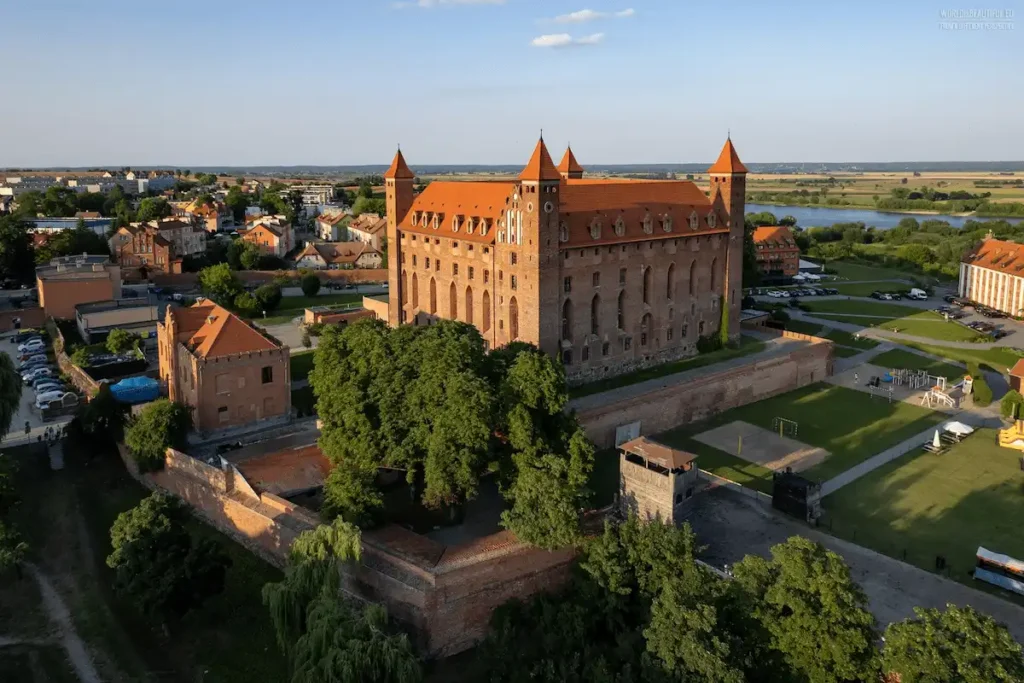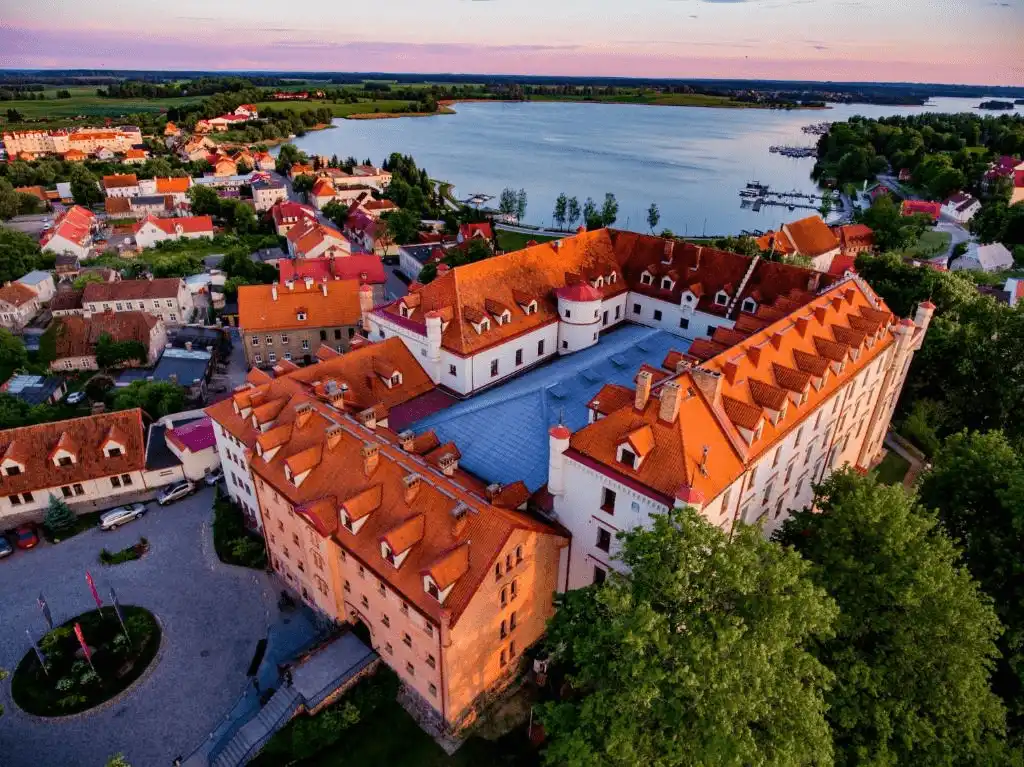
An aerial sunset view of Hotel Zamek Ryn, a massive 14th-century Teutonic Knights' castle in Poland featuring four wings, a large inner courtyard, and orange-tiled roofs, situated between Lake Ołów and Lake Ryńskie in the Masurian Lake District.

Hotel Zamek Ryn: Teutonic Command Post Above Masuria’s Waters

Hotel Zamek Ryn stands on the strategic high ground where the Teutonic Order built their 14th-century fortress to control the Masurian lake route between Königsberg and their southern territories. The castle’s defensive position commanded water traffic, trade routes, and territorial authority across the Great Masurian Lakes. The fortress walls, Gothic brick masonry, and corner bastions […]

Hotel Zamek Ryn: Teutonic Command Post Above Masuria’s Waters Read More »

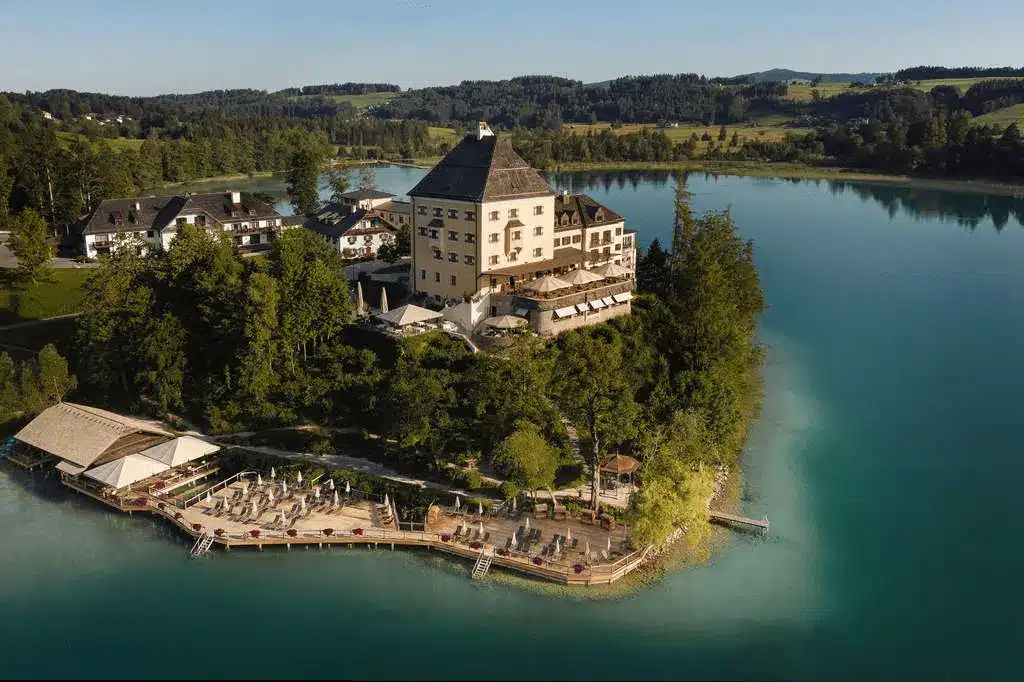
An elevated view of the historic Rosewood Schloss Fuschl, a 15th-century hunting lodge originally built for the Prince-Archbishops of Salzburg, featuring its iconic eggshell-yellow tower and red-roofed wings on a private peninsula overlooking the turquoise waters of Lake Fuschl.

Rosewood Schloss Fuschl: The Archbishop’s Lakeside Stronghold

Rosewood Schloss Fuschl commands the eastern shore of Fuschlsee from foundations laid in 1461 as the private hunting estate of Salzburg’s Prince-Archbishops. The castle’s strategic positioning—elevated above the lake with direct territorial sight lines—enforced ecclesiastical authority across the Salzkammergut region for four centuries. Today’s 67 suites occupy the original residential quarters where archbishops governed temporal

Rosewood Schloss Fuschl: The Archbishop’s Lakeside Stronghold Read More »

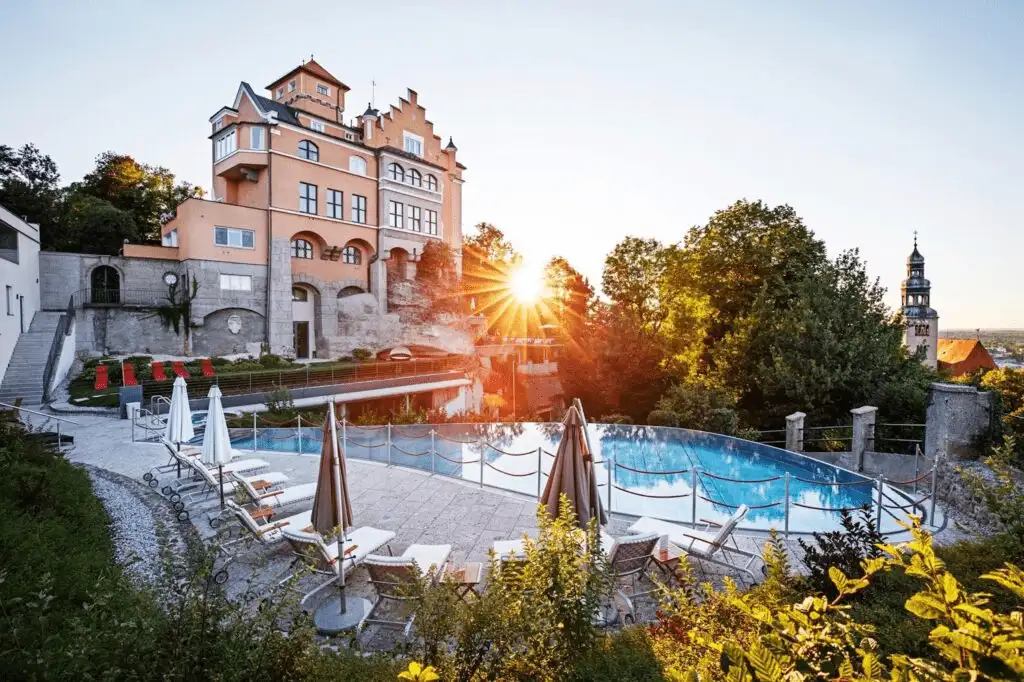
A sunset view of Hotel Schloss Mönchstein, a 14th-century fairy-tale castle in Salzburg, featuring its iconic stepped gables and peach-colored facade rising above a modern glass-edged infinity pool with panoramic views over the city.

Schloss Mönchstein: Austria’s Clifftop Command Post Above Salzburg

Hotel Schloss Mönchstein occupies the summit of Mönchsberg, a 14th-century fortified estate where Salzburg’s prince-archbishops established territorial oversight. The castle’s clifftop position 60 meters above the city enforced physical separation from the urban realm below—a defensive architecture that now delivers absolute privacy. The 24-room property retains the original stonework and defensive sightlines that defined Habsburg-era

Schloss Mönchstein: Austria’s Clifftop Command Post Above Salzburg Read More »

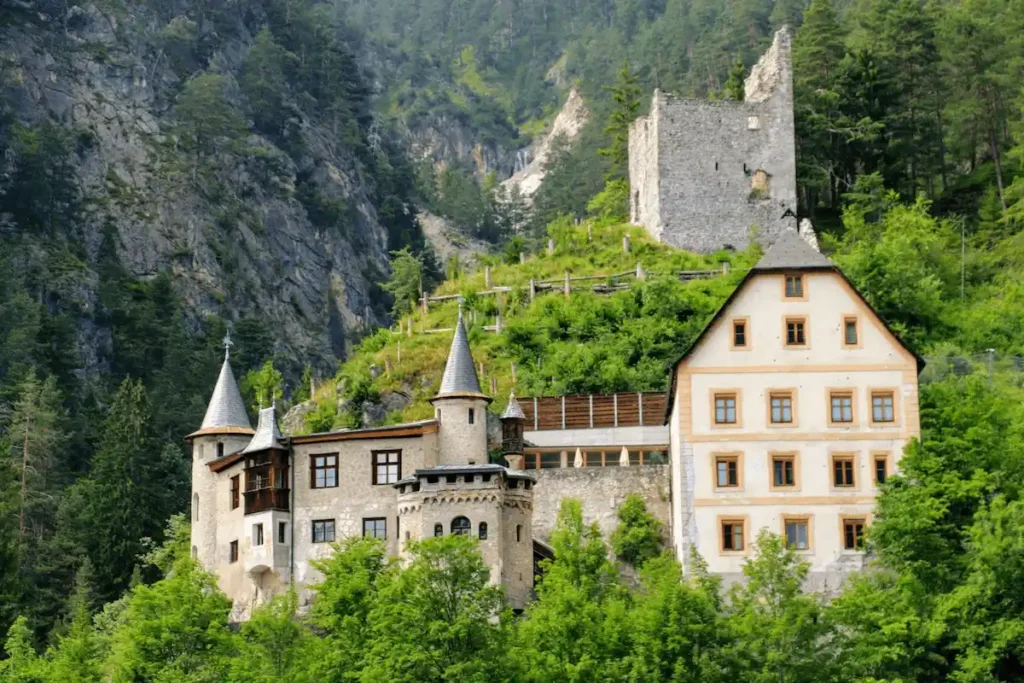
A view of the historic Schloss Hotel Fernsteinsee in the Austrian Alps, featuring its fairy-tale turrets and a yellow-walled manor house set against a sheer mountain cliff, with the stone ruins of the 13th-century Sigmundsburg Castle visible on the forested hilltop above.

Schloss Hotel Fernsteinsee: Habsburg Summit Command in the Tyrolean Alps

Schloss Hotel Fernsteinsee occupies the Fernpass, the strategic Alpine crossing that has governed movement between northern and southern Europe for centuries. This four-star castle hotel, operational since 1856, was purpose-built as a private retreat during the final years of Habsburg imperial authority. Positioned at 1,300 meters, the fortress overlooks Fernsteinsee Lake and the ancient trade

Schloss Hotel Fernsteinsee: Habsburg Summit Command in the Tyrolean Alps Read More »

An elevated view of the Pousada Castelo de Palmela, showing the 15th-century Monastery of the Order of Santiago integrated into the medieval hilltop fortress, overlooking the rolling Arrábida hills and the Atlantic coastline.

Pousada Castelo de Palmela: 12th-Century Fortress Command Above the Setúbal Peninsula

Pousada Castelo de Palmela occupies a 12th-century fortress that dominated the strategic high ground above the Setúbal Peninsula for over eight centuries. Built by the Knights of the Order of Santiago, this military stronghold commanded territorial control over the Atlantic trade routes and the surrounding agricultural valleys. The castle’s elevation and defensive masonry—battlements, watchtowers, and

Pousada Castelo de Palmela: 12th-Century Fortress Command Above the Setúbal Peninsula Read More »

A view of the Pousada Castelo de Estremoz (also known as the Palace of Rainha Santa Isabel) situated atop a hill in the Alentejo region, featuring the 13th-century marble "Tower of Three Crowns" and fortified walls rising above a cluster of traditional white-washed houses.

Pousada Castelo de Estremoz: Command the Royal Fortress of the Alentejo Plains

Pousada Castelo de Estremoz occupies the 13th-century royal castle where King Dinis reinforced Portuguese sovereignty over the strategic Alentejo frontier. The original fortifications—battlements, the three-story Torre das Três Coroas, and the Chapel of Queen Saint Isabel—establish this pousada as a seat of documented monarchical authority. The 33 suites inhabit the castle’s defensive masonry, where guests

Pousada Castelo de Estremoz: Command the Royal Fortress of the Alentejo Plains Read More »

A view of the Pousada Castelo de Óbidos, a premier example of Manueline architecture integrated into a medieval limestone fortress, featuring its massive crenellated keep and defensive curtain walls rising above the traditional white-washed houses of the historic walled village.

Pousada Castelo de Óbidos: Portugal’s Royal Fortress Above the Atlantic

Pousada Castelo de Óbidos is a 12th-century military stronghold built to guard Portugal’s western frontier, elevated on a limestone ridge where Moorish defenses were replaced by royal command. The castle’s battlements, reinforced by Dom Dinis and presented as a wedding gift to Queen Isabel, enforced territorial sovereignty across the Oeste region for eight centuries. Today,

Pousada Castelo de Óbidos: Portugal’s Royal Fortress Above the Atlantic Read More »

A wide landscape view of the Parador de Alarcón, an 8th-century medieval fortress with a massive square stone keep, situated on a craggy hilltop surrounded by defensive walls and the deep blue waters of the Júcar River.

Parador de Alarcón: Medieval Fortress Commanding Spain’s Strategic Heartland

Parador de Alarcón rises from a limestone promontory encircled by the Júcar River—a defensive stronghold engineered by Arab rulers in the 8th century and seized during the Reconquista by Castilian forces in 1184. The fortress controlled the vital Castile-Aragón corridor, and its strategic dominance made occupation synonymous with territorial sovereignty. Today, this 4-star parador translates

Parador de Alarcón: Medieval Fortress Commanding Spain’s Strategic Heartland Read More »

An aerial panorama of the Parador de Jaén, a monumental hotel integrated into the 13th-century Santa Catalina Castle; the image showcases the massive stone defensive walls, a prominent square keep, and several smaller watchtowers perched atop the rugged crest of Santa Catalina Hill.

Parador de Jaén: Command the Andalusian Highlands from a Medieval Fortress

The Parador de Jaén is not a repurposed castle—it is an active continuation of a 13th-century military stronghold that has commanded the approach to Andalusia’s eastern frontier for eight centuries. Built as a forward observation post during the Reconquista, this fortress was engineered for territorial dominance: its clifftop position overlooks 60 kilometers of olive groves

Parador de Jaén: Command the Andalusian Highlands from a Medieval Fortress Read More »

An aerial view of the Parador de Cuenca, a 16th-century former Convent of San Pablo, showcasing its prominent stone church and monastery buildings perched precariously on the edge of a sheer limestone cliff overlooking the Huécar Gorge.

Parador de Cuenca: Cliffside Dominican Command Above Castilla’s River Canyons

Parador de Cuenca converts the San Pablo Convent—a Dominican monastery founded in 1523—into a territorial command post suspended 100 meters above the Huécar Gorge. This isn’t adaptive reuse; it’s the continuation of a site selected for visual dominance over Cuenca’s canyon network and the fortified medieval city across the gorge. The original cloisters, vaulted refectory,

Parador de Cuenca: Cliffside Dominican Command Above Castilla’s River Canyons Read More »