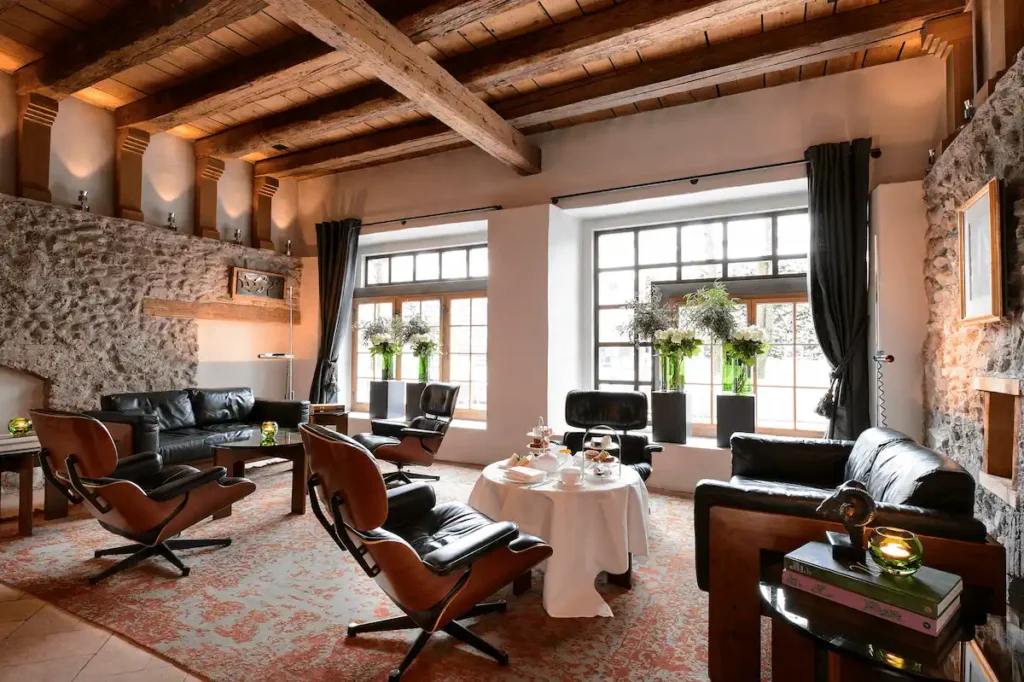
Widder Hotel Zurich is not a hotel—it is an architectural empire. Nine medieval townhouses, their stone foundations laid in the 14th century above 2,000-year-old Roman and Celtic ruins, were fused into a single structure through a decade-long restoration by architect Tilla Theus. Completed in 1995, this transformation required over 1,000 specialists to preserve 15th-century frescoes and Grisaille paintings while introducing chrome, steel, and a signature glass elevator that pierces through six centuries of stratified history.
The 49 rooms and suites are not replicated—each floor plan is singular, each suite a gallery housing original works by Warhol, Giacometti, and Rauschenberg. This is where Zurich’s medieval merchant authority meets the precision of 20th-century design mastery.
Widder Hotel Zurich ★★★★★
The Widder does not occupy Zurich’s Augustiner quarter—it is the quarter’s architectural spine. Nine separate medieval townhouses, their oldest timber frames carbon-dated to the 1300s, were not demolished but surgically connected through a restoration that spanned 1985 to 1995 under Tilla Theus. The architect did not erase the medieval—she elevated it. Original stone walls, exposed timber beams from Reformation-era construction, and intact 15th-century frescoes were kept as structural anchors. Then Theus introduced the modern vertebrae: a central glass-and-steel elevator shaft and staircase system that now serves as the vertical axis linking all nine historic properties.
Widder Hotel Zurich is a 700-year-old architectural marvel of nine medieval townhouses, famously home to high-tech adjustable beds and a world-class jazz bar with 650 whiskies.
The archaeological significance is undeniable. During excavation, a Roman well—intact and operational for two millennia—was discovered beneath the foundation. It remains visible within the hotel’s lower structure, a physical reminder that this site has commanded authority since Celtic and Roman occupation. The frescoes uncovered during renovation were not reproductions; they are original 15th-century religious and allegorical paintings, now permanently integrated into guest room walls and ceilings. These are not decorative touches—they are documented heritage assets that survived the Swiss Reformation’s iconoclastic purges.
The 49 guest rooms and four luxury apartments do not follow a template. Each space was individually designed, with no two floor plans identical. The beds are Turesta systems—Swiss-engineered platforms where mattress firmness adjusts electronically via remote, calibrated to the guest’s sleep preference in real time. But the rooms function as more than sleeping quarters. They are galleries. Original furniture by Charles and Ray Eames, Le Corbusier, and Mies van der Rohe anchors each suite—not replicas, but authenticated 20th-century pieces sourced directly from estate sales and auctions. The walls display original Warhol prints from the “Ram” series, Rauschenberg collages, and Giacometti sketches. You do not visit a museum—you inhabit one.
The Widder Bar is not a cocktail lounge—it is a spirit archive. Over 650 whiskies and 1,200 bottles from every major distilling tradition line shelves behind a lapis lazuli accent wall. The bar was designed as a library, not a nightclub, where the bartender functions as curator.
Upstairs, Boucherie AuGust replicates the interior of a traditional Swiss butcher shop, serving aged regional meats, house-made sausages, and charcuterie sourced from The Living Circle—the hotel group’s two private Swiss estate farms. This is not farm-to-table marketing—it is vertically integrated agricultural authority.
The Penthouse Suite commands the rooftop. Its 80-square-meter private terrace offers unobstructed 360-degree views across Lake Zurich and the Swiss Alps. The suite’s bathroom integrates high-definition television screens directly into mirror glass, while motion-sensitive night-lights activate along hallways as the guest moves through the space. These are not luxuries—they are baseline expectations in a property where medieval stone and smart technology coexist without contradiction.
The Widder does not present history as nostalgia. It presents history as infrastructure—structural proof that this site has been a seat of merchant and civic authority for 700 years. You are not staying in a hotel. You are occupying the architectural culmination of nine separate lineages, each with its own foundation, its own frescoes, its own claim to the quarter’s medieval dominance. The glass elevator that now connects them is not a disruption—it is the modern continuation of that authority.
Check Availability & Rates →Nine medieval houses, their frescoes untouched since the Reformation, now unified under glass and steel—this is not preservation, it is architectural dominance spanning seven centuries of Zurich’s merchant elite.
FAQ: Widder Hotel Zurich
What makes Widder Hotel Zurich architecturally significant?
Widder Hotel Zurich is the only property in Switzerland that architecturally unifies nine separate 14th-century medieval townhouses into a single functional hotel. Architect Tilla Theus led a decade-long restoration (1985–1995) that preserved original 15th-century frescoes, exposed timber beams, and a 2,000-year-old Roman well while introducing a modern glass-and-steel elevator shaft as the vertical connector. Over 1,000 specialists, including historians and conservationists, ensured the medieval structural integrity remained intact.
Does Widder Hotel display original artwork?
Yes. Each of the 49 guest rooms and suites functions as a private gallery featuring authenticated 20th-century design furniture by Charles and Ray Eames, Le Corbusier, and Mies van der Rohe. The walls display original works by Andy Warhol (specifically prints from the “Ram” series), Robert Rauschenberg, and Alberto Giacometti. These are not reproductions—they are verifiable pieces sourced from estate auctions and private collections.
What is unique about the Widder Bar?
The Widder Bar houses over 650 whiskies and 1,200 spirits, making it one of the most comprehensive spirit collections in Europe. The bar is designed as a library rather than a lounge, featuring a signature lapis lazuli accent wall. The bartenders function as curators, with expertise in rare single malts, vintage cognacs, and limited-edition distillations from closed distilleries.
Are the Roman ruins accessible to guests?
Yes. During the hotel’s construction, a 2,000-year-old Roman well was discovered beneath the foundation and preserved in situ. It remains visible within the hotel’s lower-level architecture as a permanent archaeological feature. The site also revealed Celtic artifacts, confirming continuous occupation of this location for over two millennia.
The Living Authority of Nine Houses
Widder Hotel Zurich does not replicate medieval grandeur—it inhabits it. From the Celtic foundations to the Reformation-era frescoes, from the glass elevator shaft to the Warhol prints, every structural layer of this property is a documented claim to architectural and civic authority. You are not booking a room—you are occupying a lineage.
For those seeking another seat of Zurich’s historic power, explore Baur au Lac, where lakeside elegance has commanded the city’s social elite since 1844.
For more curated itineraries and luxury-focused travel insights, visit Your Luxury Guide. For official travel information and destination updates, visit Switzerland tourism-info.
Your Luxury Guide — Where Exceptional Travel Begins.