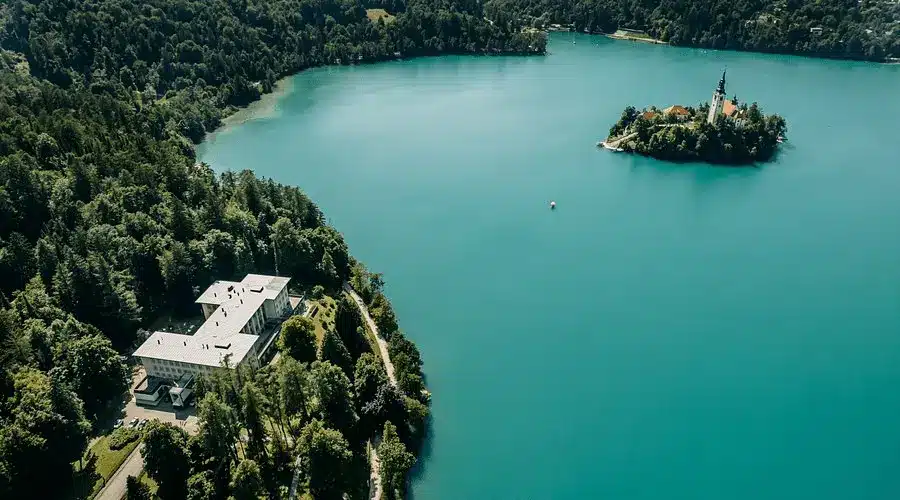
Vila Bled functioned as Yugoslavia’s most exclusive presidential residence from 1947 to 1980, where Marshal Josip Broz Tito entertained global leaders including Indira Gandhi, Muammar Gaddafi, and Haile Selassie. Originally commissioned in 1947 as the summer seat of Yugoslav state authority, this lakeside command post transformed diplomatic history through three decades of Cold War summit meetings.
Today’s guests occupy the same suites where world powers negotiated across ideological divides, with direct lake access and protected forest grounds that once required presidential clearance. Discover best historic hotels in Slovenia where heritage defines modern luxury.
Vila Bled ★★★★
Vila Bled’s construction began in 1947 under direct orders from Marshal Tito, who selected this elevated northern shore position for its strategic surveillance of Lake Bled and the Julian Alps corridor. The estate’s 13,000-square-meter grounds were designed as a self-contained diplomatic fortress, featuring underground passage networks to the private boat dock and observation terraces that commanded unobstructed views across the glacial lake to Bled Island’s 17th-century church.
Vila Bled is the definitive 1950s presidential retreat, where high-protocol modernist architecture meets the iconic Belvedere Pavilion and the most exclusive private rowing deck on Lake Bled.
Between 1953 and 1979, Vila Bled hosted 96 documented state visits, establishing Yugoslavia’s Non-Aligned Movement headquarters where Tito brokered neutrality agreements between Eastern and Western blocs. The Grand Salon—where guests now take breakfast—served as the negotiation chamber for the 1961 Belgrade Conference preparatory meetings, attended by Nehru, Nasser, and Sukarno.
The Presidential Suite occupies Tito’s personal quarters, preserving the original 1947 walnut paneling and the private terrace where the Marshal conducted morning briefings overlooking the Karawanks mountain range. The suite’s 65-square-meter footprint includes the study where Tito drafted the 1955 Brioni Declaration with Nehru and Nasser, establishing the foundation of Third World diplomatic independence.
Standard Superior Rooms maintain the estate’s original spatial hierarchy, with 32-square-meter layouts featuring lake-facing balconies, parquet flooring sourced from Slovenian oak forests, and en-suite marble bathrooms upgraded in 2018 while preserving the 1947 fixture placements. Each room retains period-specific brass hardware and door mechanisms installed during the estate’s initial construction phase.
The Grand Salon functions as both historical monument and contemporary dining venue, its 180-square-meter space anchored by the original 1947 Murano glass chandelier commissioned specifically for state dinners. Floor-to-ceiling windows frame Lake Bled through the same perspectives that hosted Khrushchev’s 1956 visit and Gaddafi’s 1974 state reception.
Vila Bled’s private boat dock provides direct rowing access to Bled Island, replicating the exclusive water route Tito used for diplomatic arrivals designed to display Yugoslav command of the alpine landscape. The 100-meter wooden pier, reconstructed in 2015 following original 1947 blueprints, extends into Lake Bled’s deepest northern basin.
The estate’s 2.5-hectare forest grounds preserve the original security perimeter that enclosed presidential movements, now offering guests the same wooded trails where Tito walked with Haile Selassie in 1970 and Indira Gandhi in 1968. The garden pavilion serves as an outdoor bar during summer months, occupying the former guardhouse that monitored all estate access points.
Dining at Vila Bled follows protocols established during state visit preparations, when Yugoslav culinary teams prepared menus that balanced socialist ideology with international diplomatic expectations. Today’s restaurant occupies the original state dining room, serving Slovenian lake trout and Karst prosciutto within the same 140-square-meter space that hosted 43 documented state banquets between 1955 and 1979.
The wine cellar maintains temperature-controlled storage in the underground chambers originally designed for presidential security operations, now housing selections from Slovenia’s Vipava Valley and Goriška Brda regions that continue the estate’s tradition of showcasing Yugoslav—now Slovenian—agricultural authority.
Check Availability & Rates →To occupy Vila Bled is to inhabit the exact coordinates where global power balanced on a glacial lake’s edge. These are not commemorative spaces—they are the preserved instruments of diplomatic command, where the Non-Aligned Movement rewrote Cold War assumptions from a forested promontory above ancient waters.
FAQ: Vila Bled
Did Marshal Tito actually live at Vila Bled?
Yes, Vila Bled served as Marshal Tito’s official summer residence and primary diplomatic venue from 1947 until his death in 1980. Historical records document 96 state visits to the estate, where Tito personally hosted world leaders including Indira Gandhi (1968), Haile Selassie (1970), and Muammar Gaddafi (1974). The estate functioned as Yugoslavia’s de facto summer capital, where Non-Aligned Movement strategy was developed during extended presidential residencies between May and September annually.
Can guests stay in Tito’s original presidential rooms?
The Presidential Suite at Vila Bled occupies Marshal Tito’s personal quarters, maintaining the original 1947 spatial layout, walnut wall paneling, and private terrace used for morning briefings. While modern amenities have been discreetly integrated, the suite preserves the 65-square-meter footprint where Tito drafted diplomatic correspondence and the study where he prepared for state negotiations. Standard rooms occupy former guest quarters used by visiting diplomats and security personnel.
What makes Vila Bled historically significant beyond its Tito connection?
Vila Bled functioned as the operational headquarters for Yugoslavia’s Non-Aligned Movement between 1955 and 1980, hosting preparatory meetings for the 1961 Belgrade Conference that established Third World diplomatic independence during the Cold War. The estate’s 96 documented state visits represent one of Europe’s highest concentrations of 20th-century diplomatic activity at a single private residence, making it a preserved monument to Yugoslavia’s unique position as a neutral power broker between NATO and Warsaw Pact blocs.
Does Vila Bled offer direct access to Lake Bled and the island?
Vila Bled maintains the original 1947 private boat dock with direct rowing access to Bled Island, preserving the exclusive water route Marshal Tito used for diplomatic arrivals. The 100-meter wooden pier extends into Lake Bled’s northern basin, offering guests the same lakefront command that defined the estate’s presidential authority. Traditional pletna boats can be arranged for island visits, replicating the ceremonial water approach used during state visits.
Vila Bled: Where Yugoslav Authority Became Slovenian Heritage
Vila Bled translates 33 years of presidential command into contemporary lakeside residence, where each suite and salon retains the spatial authority that hosted Cold War’s most significant neutral-ground negotiations. The estate’s preservation demonstrates how diplomatic infrastructure becomes luxury inheritance—these terraces and docks weren’t designed for tourism but for projecting state power across alpine waters.
For travelers seeking estates where 20th-century authority remains architecturally intact, continue to Grand Hotel Toplice, Lake Bled’s 1854 thermal command post, or Kendov Dvorec, a 14th-century manor where feudal hierarchy shaped Slovenian agricultural dominance.
For more curated itineraries and luxury-focused travel insights, visit Your Luxury Guide. For official travel information and destination updates, visit Slovenia tourism-info.
Your Luxury Guide — Where Exceptional Travel Begins.