The Vier Jahreszeiten Kempinski Munich stands as King Maximilian II’s 1858 decree made stone—the sovereign blueprint for Bavaria’s most commanding boulevard. This wasn’t hospitality by market demand; this was architecture as royal policy, commissioned to establish the aristocratic standard on Maximilianstrasse when the street itself was being carved through Munich as a demonstration of state power.
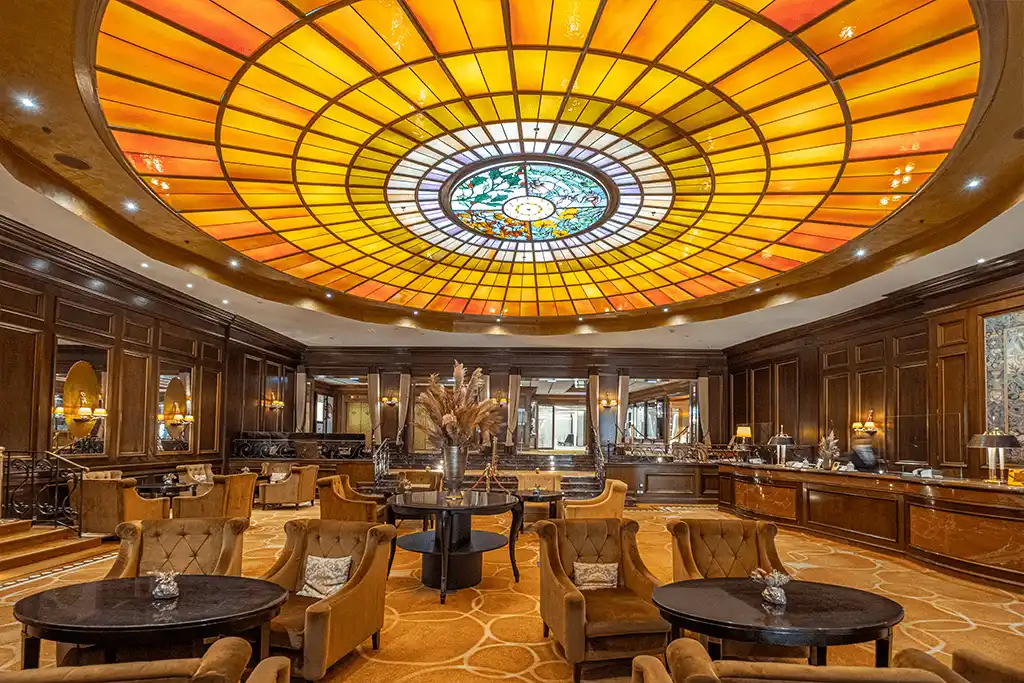
Rudolf Gottgetreu’s design merged Gothic authority with Neoclassical precision, creating the “Maximilianstil” vocabulary that still defines the city’s governmental quarter. The stained-glass dome—depicting the four seasons in 19th-century mastery—transforms the lobby into what Munich society has called “the city’s most beautiful living room“ for 165 years.
This is the address where royal households maintained their Munich presence, where 125 documented members of European nobility have resided, where the Thule Society convened in secret between 1919-1924, and where Empress Sisi once flooded her suite after succumbing to the novelty of modern marble bathtubs.
Vier Jahreszeiten Kempinski Munich ★★★★★
King Maximilian II didn’t request a hotel in 1858—he commanded an institution. The Vier Jahreszeiten Kempinski Munich was royal policy executed in stone and stained glass, the architectural anchor for Bavaria’s new seat of state power. While Maximilianstrasse was being engineered as Munich’s governmental artery, Gottgetreu‘s design established the visual authority that surrounding ministries and state buildings would echo for the next century. This was the “Maximilianstil”—Munich’s unique fusion of Gothic weight and Neoclassical precision—created specifically to signal that this boulevard represented a different level of Bavarian authority.
Hotel Vier Jahreszeiten Kempinski Munich is the grandest landmark on the Maximilianstrasse, a royal commission where guests can dine at the Michelin-starred Schwarzreiter and stay in the opulent Ludwig Suite.
The stained-glass dome remains the physical proof of that 1858 commission. Four seasons rendered in industrial-age craftsmanship, suspended above a lobby that European nobility has used as their Munich drawing room since gas lighting was considered revolutionary technology.
When the hotel opened, it featured a private telegraph office and steam-powered laundry—infrastructure that positioned it as the most technologically advanced building in the city. The structural DNA from that original opening survives because the Vier Jahreszeiten accomplished what most of Munich could not: it survived WWII air raids with its 1858 integrity intact.
Between 1919 and 1924, the hotel served as the undisclosed headquarters for the Thule Society—one of the most consequential (and controversial) political organizations in early 20th-century German history. These weren’t casual gatherings; these were the formative meetings that shaped Munich’s role in the Weimar period. The hotel’s archives document this without embellishment—these walls witnessed the conversations that altered the city’s trajectory.
The Royal Wing operates as a closeable, high-security district within the hotel—a concept that only makes sense when your guest registry includes over 125 documented members of royal and princely households. The Maximilian Suite anchors this wing with a terrace overlooking seven of Munich’s landmark structures, a spatial command that mirrors the original 1858 intention: this hotel was built to observe and define the city’s power center.
The Ludwig Suite spans 2,000 square feet of gold leaf ceilings and design motifs inspired by Ludwig II’s “Swan King” obsession. The original 1858 writing desk—verified in hotel archives as used by Empress Sisi—remains in situ. Sisi’s documented flooding of her suite (she fell asleep in one of the hotel’s then-novel marble bathtubs) is preserved in Kempinski records, a reminder that even Habsburg empresses were susceptible to the novelty of industrial-age luxury.
Guest rooms feature floor-to-ceiling reproductions of Old Masters from the Alte Pinakothek, transforming private quarters into extensions of Munich’s state art collection. This isn’t decoration—it’s spatial policy, the same principle that governed the 1858 commission: surround guests with evidence of Bavaria’s cultural authority.
The Walterspiel brothers (Alfred and Otto) transformed the hotel between 1926 and WWII into Europe’s premier culinary destination. Alfred Walterspiel is credited—by culinary historians, not marketing copy—with inventing “Young Bavarian Cuisine,” a movement that repositioned regional cooking as haute gastronomy. Schwarzreiter Restaurant continues this lineage under Michelin recognition, named after King Ludwig II’s preferred deep-sea char.
The 1972 Olympic overhaul cemented the hotel’s role as Munich’s primary host for heads of state, a designation that required structural upgrades to accommodate security protocols still in use today. Kempinski The Spa occupies the 6th-floor rooftop with a panoramic indoor pool and solar balcony—modern wellness infrastructure mapped onto the historic footprint where Albert Einstein, Alfred Hitchcock, The Rolling Stones, Andy Warhol, and Leonard Bernstein all maintained documented residence.
The “Lady in Red” ambassadors—Kempinski’s signature lobby presence—operate as living continuations of the 1858 service model: bespoke, anticipatory, designed for guests who expect the hotel to function as an extension of their own authority. Pâtisserie Ian Baker‘s Afternoon Tea (led by an award-winning British pastry chef) has been designated “the best in Germany” by culinary authorities who don’t traffic in hyperbole.
This is the address King Maximilian II built to define Munich’s aristocratic standard. The stained glass, the royal archives, the Thule Society legacy, the Empress Sisi anecdotes—these aren’t amenities. They’re the documented proof that this hotel was state policy, and that policy remains operational.
Check Availability & Rates →Where Maximilian II’s 1858 decree still governs the standard—stained glass overhead, royal archives underfoot, and seven Munich landmarks visible from suites designed when sovereignty meant commanding the skyline, not just occupying it.
FAQ: Vier Jahreszeiten Kempinski Munich
What makes Vier Jahreszeiten Kempinski Munich historically significant?
King Maximilian II personally commissioned the hotel in 1858 to establish the aristocratic standard for Maximilianstrasse, Munich’s new governmental boulevard. Rudolf Gottgetreu designed it in “Maximilianstil”—a unique Gothic-Neoclassical fusion created specifically for state buildings. The hotel served as the secret headquarters for the Thule Society (1919-1924) and survived WWII with its original 1858 structure intact, making it one of Munich’s few surviving mid-19th-century royal commissions.
Which famous figures have stayed at Vier Jahreszeiten Kempinski Munich?
Hotel archives document over 125 members of royal and princely households, including Empress Sisi (who famously flooded her suite). Notable guests include Albert Einstein, Alfred Hitchcock, The Rolling Stones, Andy Warhol, and Leonard Bernstein. The Royal Wing’s security infrastructure was designed specifically to accommodate heads of state during the 1972 Munich Olympics.
What is the stained-glass dome at Vier Jahreszeiten Kempinski Munich?
The lobby features a 19th-century stained-glass dome depicting the four seasons, commissioned as part of the original 1858 construction. It’s considered one of Munich’s finest examples of industrial-age craftsmanship and has earned the lobby the designation “Munich’s most beautiful living room” since the hotel’s opening. The dome represents the same artisan-level detail that Maximilian II required for all state buildings on the boulevard.
What is unique about the Royal Wing at Vier Jahreszeiten Kempinski Munich?
The Royal Wing functions as a closeable, high-security district within the hotel, designed to accommodate royal households and heads of state. The Maximilian Suite includes a private terrace with views over seven Munich landmarks—the same commanding spatial perspective that governed the 1858 commission. This infrastructure was significantly upgraded during the 1972 Olympics and remains operational for contemporary state visits.
Where Munich’s Royal Authority Resides
The Vier Jahreszeiten Kempinski Munich operates as King Maximilian II intended in 1858—the physical standard by which Munich’s aristocratic presence is measured. The stained-glass dome, the Royal Wing security protocols, the Thule Society archives, and the 125 documented royal residents aren’t historical footnotes. They’re the operational proof that this address still functions as Bavaria’s seat of hospitality authority.
For alternative royal commissions in Munich’s historic center, explore Hotel Bayerischer Hof and Sofitel Munich Bayerpost.
More curated itineraries and luxury-focused travel insights at Your Luxury Guide. For official travel information and destination updates, visit Germany tourism-info.
Your Luxury Guide — Where Exceptional Travel Begins.