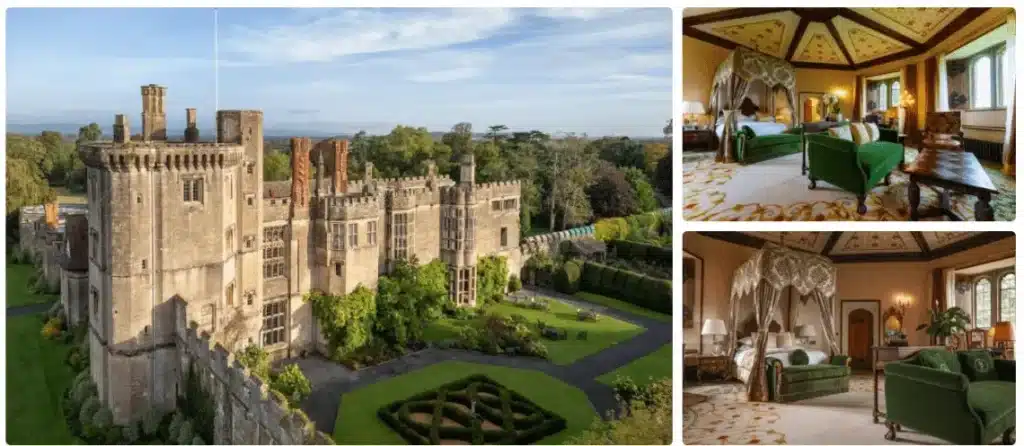
Thornbury Castle stands as England’s only castle hotel where Henry VIII actually resided—a documented 1535 royal visit that transformed this fortress into the ultimate seat of Tudor authority. Built in 1511 by Edward Stafford, 3rd Duke of Buckingham, this is not a country house reimagined as luxury; this is a fortified Tudor palace where Renaissance power politics played out in stone. The chimneys alone—each one a carved statement of ducal dominance—remain architectural proof of wealth so ostentatious it triggered royal jealousy and the Duke’s execution for treason.
Thornbury Castle ★★★★★
Thornbury Castle is the only hotel in England where guests occupy rooms once inhabited by Henry VIII and Anne Boleyn—a historical fact that elevates this property beyond boutique luxury into sovereign territory. Built between 1511-1521 by Edward Stafford, 3rd Duke of Buckingham.
The castle was designed as a direct challenge to royal authority: its scale, its defensive battlements (technically illegal without royal permission), and its 72 ornamental chimneys were calculated statements of power that ultimately cost the Duke his head.
At Thornbury Castle, you are reserving one of 27 suites within a structure where Tudor England’s most dangerous power struggle unfolded.
The Tudor Tower Suite occupies the exact chambers where Henry VIII stayed during his 10-day 1535 visit—the King’s attempt to assert dominance over a property that rivaled his own palaces. The four-poster bed, the stone-mullioned windows overlooking 15 acres of restored Tudor gardens, and the oriel window (a architectural feature reserved for the elite) place you within the physical architecture of Renaissance authority. The Duke’s Bedchamber, with its original 1511 wall paneling and garderobe (medieval toilet chamber), offers the visceral reality of living as a territorial lord.
The castle’s defensive architecture is not ceremonial. The 3-meter-thick walls, the arrow-slit windows in the gatehouse, and the murder holes above the entrance were constructed to repel armed attack—absolute physical barriers that now guarantee total privacy from the modern world. The original portcullis mechanism remains visible; the moat (now a dry earthwork) still encircles the north wing. This is functional military architecture that placed the Duke above common assault, and now places you above common hospitality.
The Baron’s Dining Hall operates within the Great Hall where the Duke entertained. The hammer-beam roof (a structural marvel requiring no central supports) and the minstrel’s gallery reflect the scale of Tudor entertaining—meals were political theater, and the architecture was designed to dwarf rivals. But the real luxury is the spatial dominance: you dine where England’s most powerful nobles once competed for royal favor.
Check Availability & Rates →You are sleeping in the only Tudor castle in England currently operating as a hotel, where the 16th-century bedchambers still bear the royal mark of Henry VIII and Anne Boleyn. The five-foot-thick walls and fortified towers aren’t decorative; they are the physical remains of the Duke of Buckingham’s final defiance against the Crown.
FAQ: Thornbury Castle
Did Henry VIII really stay at Thornbury Castle?
Yes. Henry VIII stayed at Thornbury Castle for 10 days in August 1535 with Anne Boleyn, following his seizure of the property after the Duke of Buckingham’s execution. Historical records confirm the King occupied the Tower Suite, now available for guest bookings, making Thornbury the only UK hotel where visitors sleep in verified royal chambers.
Why was the Duke of Buckingham executed?
Edward Stafford, 3rd Duke of Buckingham, was executed for treason in 1521 after building Thornbury Castle with unauthorized battlements and chimneys that rivaled royal palaces. His wealth and royal lineage (descended from Edward III) threatened Henry VIII’s authority. The castle’s construction was used as evidence of his ambition to usurp the throne.
What makes Thornbury Castle architecturally significant?
Thornbury Castle represents the last fortified castle built in England before the Tudor era shifted to undefended manor houses. Its 72 ornamental chimneys (the most of any Tudor building), illegal battlements, and military-grade 3-meter walls combine defensive medieval architecture with Renaissance luxury—a hybrid design reflecting the era’s political instability.
Can you tour the Tudor gardens at Thornbury Castle?
Yes. The 15 acres of gardens at Thornbury Castle include reconstructed Tudor knot gardens, an orchard, and a functioning vineyard planted on the Duke’s original 1511 layout. Guests have exclusive access to these historic grounds, which supply herbs and produce for the castle’s two-AA-Rosette restaurant.
The Sovereign Standard of Castle Hospitality
Thornbury Castle operates beyond standard luxury because its architecture enforces absolute territorial authority—the same thick masonry, the same defensive moats, the same spatial dominance that separated Renaissance lords from the common realm. You are not visiting history; you are occupying the seat of power where England’s Tudor elite lived, conspired, and fell.
For travelers seeking properties where provenance equals prestige, explore Cliveden House and Bovey Castle—estates where Britain’s ruling class continues to command the landscape.
For more curated itineraries and luxury-focused travel insights, visit Your Luxury Guide. For official travel information and destination updates, visit Britain tourism-info.
Your Luxury Guide — Where Exceptional Travel Begins.