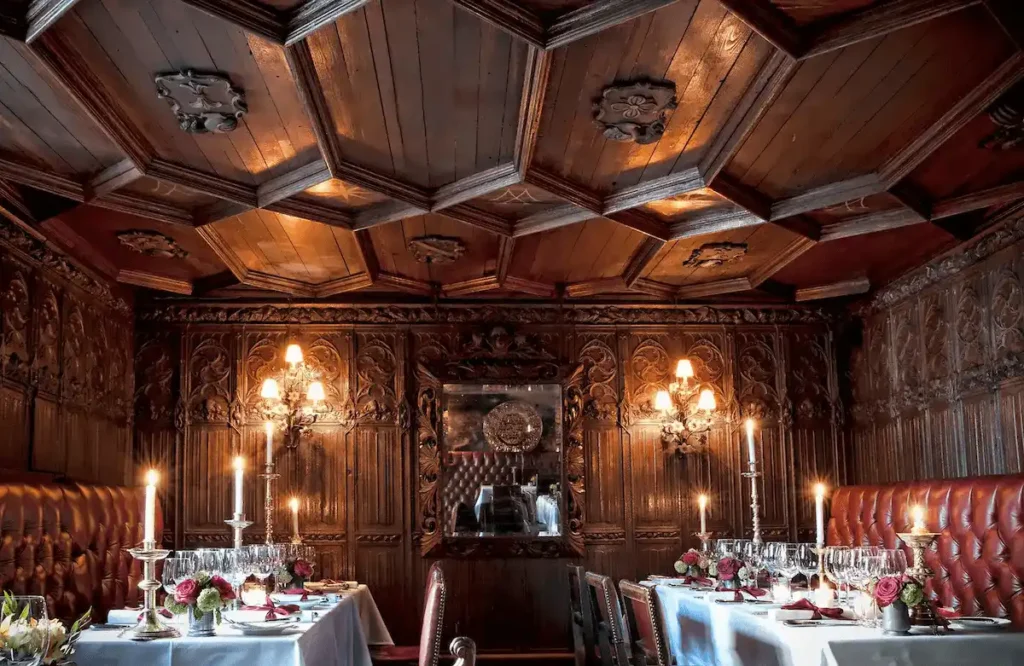
At the gates of Edinburgh Castle, The Witchery by the Castle occupies Boswell’s Court—a Category A listed merchant’s house from 1595 where Thomas Lowthian carved his authority into stone. This is not a hotel that imitates history; it is history. Nine theatrical suites preserve the Gothic maximalism of Scotland’s aristocratic past, where 17th-century oak paneling salvaged from St Giles Cathedral and heraldic ceilings inspired by the Palace of Holyroodhouse create an environment of unapologetic power.
The building’s 428-year lineage as merchant fortress, ecclesiastical chamber, and aristocratic townhouse establishes this as Edinburgh’s most commanding address. For travelers seeking accommodations that reflect true architectural dominance, explore our curated selection of the best historic hotels in Edinburgh.
The Witchery by the Castle ★★★★★
In 1595, merchant Thomas Lowthian erected Boswell’s Court as a fortified stone residence at 352 Castlehill—the exact point where Edinburgh’s Royal Mile ascends to the castle gates. His motto, “O Lord in thee is all my traist,” remains carved into the entrance lintel, a permanent declaration of faith and authority.
The building served successive power structures: a merchant’s command center, the Sempill family’s aristocratic townhouse, a Church of Scotland committee chamber, and finally a clerical rectory. By the 1970s, the structure had deteriorated into abandonment.
The Witchery by the Castle is a gothic masterpiece located at the gates of Edinburgh Castle, housed within a 16th-century merchant’s house that offers a theatrical and opulent escape into Scotland’s historic past.
In 1979, James Thomson—at 20 years old, Scotland’s youngest licensee—executed a rescue that would become legendary. He transformed the run-down tenement into a Gothic landmark by salvaging history others had discarded: 17th-century oak paneling rescued from a fire at St Giles Cathedral, additional wood paneling sourced from a Burgundian Chateau, and gilded leather screens that once graced aristocratic halls.
In 1990, Thomson commissioned The Secret Garden dining room on an abandoned schoolyard, featuring a hand-painted ceiling based on the Rossend Castle design now preserved in the National Museum of Scotland.
The nine suites are architectural declarations. The Library Suite conceals a hidden door within a functional bookcase—a passage to an opulent bathroom that maintains the theatrical secrecy of aristocratic estates. The Old Rectory Pulpit features a bed fashioned from antique church pulpits, a direct translation of the building’s ecclesiastical chapter. The Guardroom Suite occupies the former Sempill family townhouse, where original winding turret staircases and heraldic ceilings mirror the Palace of Holyroodhouse. Each suite features four-poster beds, velvet-lined walls, and free-standing silver or roll-top baths positioned as centerpieces rather than utilities.
The hotel’s name commemorates the hundreds executed as witches on Castlehill during the 16th and 17th centuries—a deliberate choice that anchors the property in Edinburgh’s darkest power struggles. Boswell’s Court itself is named for John Boswell, an eccentric 18th-century physician whose nephew, biographer James Boswell, dined here with Dr. Samuel Johnson in the late 1700s. The building has always been a seat of influence.
Thomson commissioned the Witchery Tartan and Tweed containing exactly 352 threads in the sett—a numeric mirror of the hotel’s Castlehill address. The wine cellar holds over 600 bottles, consistently earning the Wine Spectator Best Award of Excellence.
Both dining rooms—the original Witchery and the Secret Garden—operate exclusively by candlelight, a refusal to modernize the atmospheric power that has attracted A-list Edinburgh Festival guests including Andrew Lloyd Webber, Catherine Zeta-Jones, Jack Nicholson, and Ewan McGregor.
The hotel enforces an adults-only policy to preserve its intimate intensity. No extra beds exist. No children dilute the Gothic maximalism. Guests receive cooked breakfast or indulgent hampers in bed, featuring Scottish produce and champagne—service calibrated to the suites’ theatrical scale. This is accommodation as aristocratic immersion, where 428 years of documented authority create an environment that money alone cannot replicate.
Check Availability & Rates →The Witchery’s Gothic chambers are not merely decorated; they are architecturally inevitable—salvaged ecclesiastical oak, aristocratic heraldry, and merchant fortifications synthesized into Scotland’s most commanding overnight address at Edinburgh’s literal seat of power.
FAQ: The Witchery by the Castle
What makes The Witchery by the Castle historically significant?
The Witchery occupies Boswell’s Court, a Category A listed merchant’s house built in 1595 by Thomas Lowthian. The building served as an aristocratic townhouse for the Sempill family, a Church of Scotland committee chamber, and a clerical rectory before its 1979 transformation. It features salvaged 17th-century oak paneling from St Giles Cathedral and a Secret Garden dining room with a hand-painted ceiling based on a design now in the National Museum of Scotland.
Why is it called The Witchery by the Castle?
The name commemorates the hundreds of men and women burned at the stake as witches on Castlehill during the 16th and 17th centuries. The hotel sits at the exact location where Edinburgh’s darkest power struggles unfolded, deliberately anchoring the property in the city’s most dramatic historical chapter.
What are the accommodations like at The Witchery?
The hotel offers nine theatrical suites, each uniquely designed with Gothic maximalism: four-poster beds, velvet-lined walls, gilded leather screens, and free-standing silver or roll-top baths. The Library Suite features a hidden door concealed within a bookcase, while the Old Rectory Pulpit contains a bed fashioned from antique church pulpits. Original winding turret staircases and heraldic ceilings inspired by the Palace of Holyroodhouse complete the aristocratic immersion.
Is The Witchery suitable for families with children?
No. The hotel enforces a strict adults-only policy to maintain its intimate and romantic atmosphere. Extra beds are not available, and the theatrical Gothic interiors are calibrated exclusively for adults seeking an immersive historical experience without distraction.
Edinburgh’s Gothic Authority Secured
The Witchery by the Castle proves that architectural dominance cannot be manufactured—only inherited and meticulously preserved. From Thomas Lowthian’s 1595 stone fortress to James Thomson’s salvaged ecclesiastical oak, this is Edinburgh’s most commanding overnight address.
Travelers seeking comparable aristocratic estates, consider Prestonfield House or The Scotsman Hotel.
For more curated itineraries and luxury-focused travel insights, visit Your Luxury Guide. For official travel information and destination updates, visit Britain tourism-info.
Your Luxury Guide — Where Exceptional Travel Begins.