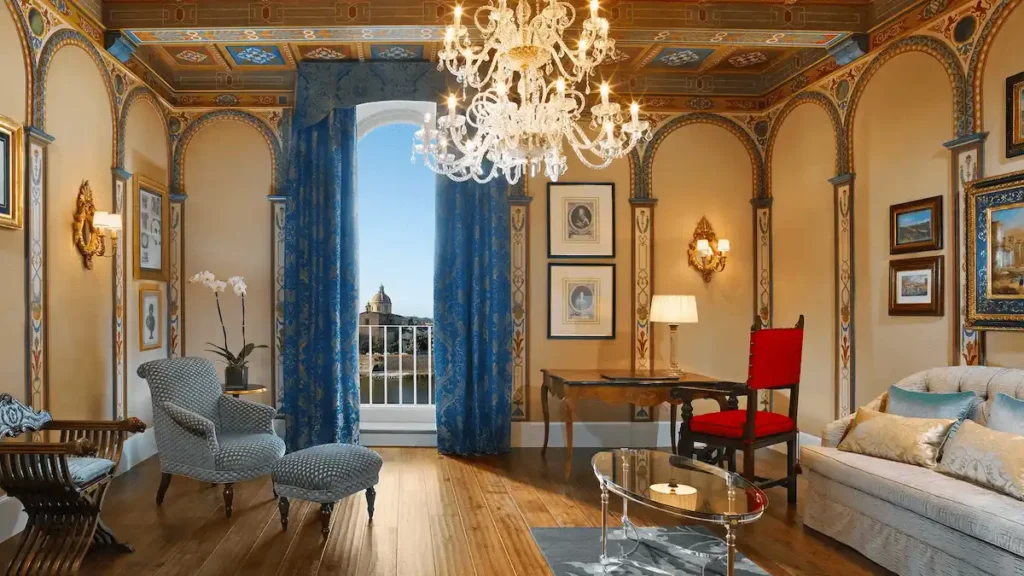
The St. Regis Florence is a 15th-century Brunelleschi palace on the Lungarno Vespucci, originally commissioned by the Giuntini noble family as a riverside seat of Florentine authority. This is a verified Renaissance structure that housed European royalty during the Grand Tour era, later operating as the Grand Hotel from the late 1800s through the 20th century.
The building retains its monumental scale: 80 guestrooms and 19 suites beneath original high-volume ceilings, antique furnishings authenticated to the Medici, Florentine Renaissance, and a 19th-century stained-glass vault in the Winter Garden that functions as the hotel’s central social anchor. The property delivers 24-hour St. Regis Butler Service—a protocol originating from the brand’s 1904 New York founding—alongside direct architectural dialogue with the Arno River and the historic Oltrarno district.
The St. Regis Florence ★★★★★
The authority of The St. Regis Florence derives from its provenance as a Filippo Brunelleschi commission—the architect who engineered the dome of Florence’s Duomo. The palace was constructed in the 1400s for the Giuntini family, a Florentine noble lineage that required a riverside fortress capable of projecting both mercantile and political dominance.
The building’s facade articulates classic Brunelleschi geometry: symmetrical rusticated stone, proportional fenestration, and a cornice that establishes visual sovereignty over the Lungarno Vespucci.
The St. Regis Florence is a peerless architectural landmark that offers guests the privilege of residing in a Brunelleschi-designed palace, combining the historic grandeur of the Renaissance with the personalized 24-hour service of the signature St. Regis Butler.
By the late 19th century, the structure was repurposed as the Grand Hotel, the definitive Florence stop on the European Grand Tour circuit. This was not aspirational tourism—it was the institutional migration route of Europe’s ruling class. The guest ledgers document arrivals from the Romanov dynasty, European royalty across multiple thrones, and cultural architects like Maria Callas and Richard Wagner, both of whom used the hotel as a creative retreat and social headquarters. The Grand Hotel era established the building’s modern identity: a palace where power, culture, and aristocratic leisure converged under one Renaissance roof.
The contemporary iteration, reborn as The St. Regis Florence following multi-million-dollar restoration, preserves the original 1400s structural bones while integrating the operational standards of ultra-luxury hospitality. The 80 guestrooms and 19 suites are categorized into three historically accurate design eras—Medici, Florentine Renaissance, and Serego Alighieri—each utilizing period-specific color palettes, silk wall coverings, and antique furnishings verified by provenance research.
This is spatial authenticity: you sleep in a room where the textile patterns, ceiling heights, and furniture proportions mirror the environments once inhabited by Florentine nobility.
The Winter Garden serves as the hotel’s social epicenter, crowned by a 19th-century stained-glass vault that rivals the structural ambition of Brunelleschi’s own ecclesiastical works. This space functions as both a Michelin-recognized restaurant and a ceremonial stage for the nightly champagne sabrage ritual—a St. Regis protocol that signals the transition from day to evening. Sabering a champagne bottle in a room where aristocrats once negotiated alliances.
The St. Regis Butler Service operates 24 hours, offering garment pressing, unpacking/packing assistance, and beverage service according to protocols established at the brand’s 1904 New York flagship. This is not concierge service—it is the operationalization of aristocratic household management, adapted for modern individuals who require seamless logistical execution without visible effort.
The Bottega Veneta Suite, designed by Tomas Maier, represents a unique convergence of Renaissance architecture and contemporary Italian luxury. The suite features custom furniture and a “stealth luxury” aesthetic that respects the building’s 15th-century proportions while delivering modern utility. This is a spatial dialogue between two eras of Florentine craftsmanship.
The Iridium Suites Spa utilizes My Blend by Clarins for customized facial and body treatments, delivered in a private high-design environment. The spa’s integration into the palace’s lower floors demonstrates how Renaissance vaulted architecture can accommodate modern wellness protocols without structural compromise.
The St. Regis Bar serves the “Brunello Bloody Mary,” a Florentine adaptation of the brand’s signature cocktail using local ingredients—a gesture that anchors global hospitality standards in regional provenance.
The hotel’s position on the Lungarno Vespucci provides direct visual access to the Arno River and the Oltrarno district, Florence’s historic artisan quarter. This is not scenic amenity—it is strategic location. The building’s riverside placement allowed the Giuntini family to monitor both commercial traffic and political movements, a spatial advantage now inherited by guests who can observe the city’s ceremonial and social rhythms from Renaissance-era windows.
The dedicated concierge team holds Clefs d’Or status, ensuring access to Florence’s most restricted historic sites, private collections, and invitation-only cultural events. This is logistical sovereignty: the ability to navigate a city whose most significant assets remain gatekept by institutional and aristocratic networks.
Check Availability & Rates →The St. Regis Florence is not a hotel that references history—it is a Brunelleschi palace where the Romanovs, Callas, and Wagner once exercised social authority. The stained-glass vault, the butler protocols, and the Arno-facing suites deliver the same spatial command that defined Florentine nobility for five centuries.
FAQ: The St. Regis Florence
Is The St. Regis Florence a historically protected building?
Yes. The St. Regis Florence occupies a 15th-century palace attributed to Filippo Brunelleschi, originally commissioned by the Giuntini noble family. The structure is a verified Renaissance landmark, later operating as the Grand Hotel during the European Grand Tour era. The building’s architectural integrity is preserved under Italian heritage regulations, with all modern integrations executed to respect the original 1400s proportions and materials.
What is St. Regis Butler Service, and how does it function at The St. Regis Florence?
St. Regis Butler Service is a 24-hour personalized protocol originating from the brand’s 1904 New York flagship. At The St. Regis Florence, butlers provide garment pressing, unpacking/packing assistance, beverage service, and logistical coordination—replicating the household management systems once employed by European aristocracy. This is not concierge service; it is the operationalization of private domestic authority adapted for contemporary ultra-luxury hospitality.
Who historically stayed at The St. Regis Florence when it operated as the Grand Hotel?
The Grand Hotel hosted members of the Romanov dynasty, European royalty across multiple thrones, and cultural figures including Maria Callas and Richard Wagner. The property served as a central node on the European Grand Tour circuit, where aristocrats and intellectuals conducted social, political, and creative exchanges. The guest ledgers document centuries of elite European migration through Florence, establishing the building’s identity as a seat of cultural and political authority.
What makes the Winter Garden architecturally significant?
The Winter Garden features a 19th-century stained-glass vault that rivals Brunelleschi’s own ecclesiastical engineering. This structural masterpiece functions as both a Michelin-recognized dining venue and a ceremonial stage for the nightly champagne sabrage ritual. The vault’s scale and craftsmanship demonstrate how grand hotel architecture adapted Renaissance techniques for modern social hospitality, creating a space where aristocratic ritual and contemporary luxury service converge.
Brunelleschi’s Riverside Palace: Where Florentine Nobility Still Commands
The St. Regis Florence is not a hotel borrowing historical aesthetics—it is a Brunelleschi palace where the Giuntini family once governed Florentine commerce and where the Romanovs, Callas, and Wagner later exercised social and cultural authority. The stained-glass vault, the butler protocols, and the Arno-facing suites deliver spatial command that has defined Florentine power for five centuries.
For further exploration of Florence’s most prestigious heritage properties, consider the Four Seasons Hotel Firenze, a Medici villa with botanical gardens, or the The Excelsior Hotel Florence, a Belle Époque riverside landmark.
For more curated itineraries and luxury-focused travel insights, visit Your Luxury Guide. For official travel information and destination updates, visit Italy tourism.
Your Luxury Guide — Where Exceptional Travel Begins.