The Shelbourne Dublin has occupied the commanding northern edge of St. Stephen’s Green since 1824, when three Georgian townhouses were unified under Martin Burke’s vision. This is not a hotel that borrowed prestige—it is the prestige. The 1867 Victorian expansion by architect John McCurdy introduced the red-brick and terracotta facade now flanked by four bronze torchères cast at France’s Val d’Osne foundry: two Egyptian, two Nubian, standing watch since the century’s turn.
In 1922, Room 112—now preserved as the Constitution Room—hosted Michael Collins and the committee that drafted the founding document of the Irish Free State. The original table and chairs remain. This is constitutional authority made architectural.
For Dublin’s full heritage portfolio, explore the best historic hotels in Dublin.
The Shelbourne Dublin ★★★★★
The Shelbourne Dublin does not whisper its dominance—it declares it through structural permanence and documented constitutional weight. When Martin Burke acquired three adjoining Georgian townhouses in 1824, he established Dublin’s first gaslit hotel, a year ahead of the city’s public adoption of the technology. John McCurdy‘s 1867 redesign cemented the hotel’s physical authority: red-brick Victorian grandeur crowned by terracotta detailing, the entrance guarded by four bronze caryatid figures—Egyptian and Nubian—cast in the Val d’Osne foundry and shipped from France. These torchères are not decorative gestures. They are signatures of imperial-era craftsmanship, permanent sentinels marking the threshold between public Dublin and private command.
The Shelbourne Dublin is the “Grand Dame” of St. Stephen’s Green, an 1824 landmark where Michael Collins chaired the drafting of the Irish Constitution and where the Genealogy Butler helps international guests reconnect with their ancestral heritage.
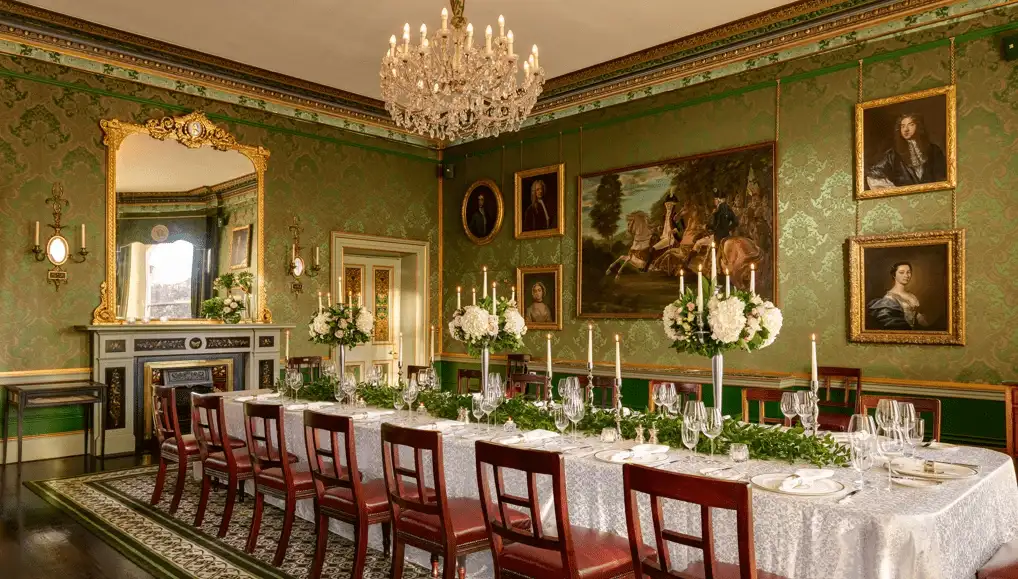
The Constitution Room—preserved exactly as it was in 1922—is the building’s ultimate historical asset. Here, Michael Collins chaired the committee that drafted the Constitution of the Irish Free State. The original mahogany table, the leather-backed chairs, the ink-stained workspace where Ireland’s legal sovereignty was authored: still intact, still functional. This is not a recreation. It is the actual room where constitutional authority was forged. Post-revolutionary leader W.T. Cosgrave held his first stabilization cabinet meetings here in 1923. The Shelbourne was the seat of power.
The grand internal staircase is heraldic cartography: stained-glass panels depicting the seals of every Irish county and province, a symbolic map of national unity designed into the building’s circulatory system. Guests ascend through illuminated geography.
The 1824 Bar, wood-paneled and resident-intimate, displays a Paul Slater mural of Constance Markievicz, the revolutionary aristocrat who commanded Irish Citizen Army forces in St. Stephen’s Green during the 1916 Easter Rising—when British troops occupied The Shelbourne to fire upon her position. Bullet scars remained visible in the facade for decades. This is spatial memory: the building absorbed conflict and survived.
The Horseshoe Bar, opened in 1957, became Dublin’s neutral diplomatic ground—its curved counter designed for visibility and informal negotiation. Rival politicians met here, separated by whiskey rather than barricades. Hollywood followed: Charlie Chaplin, Greta Garbo, Elizabeth Taylor, James Cagney.
The Princess Grace Suite memorializes Grace Kelly’s frequent stays with curated artifacts from her career and Monaco reign. George Moore set scenes from A Drama in Muslin (1886) in these halls. Thackeray, Seamus Heaney, and the founding session of The Chieftains—Ireland’s most successful folk export—all claimed The Shelbourne as their operational base.
The Lord Mayor’s Lounge, with gold-leaf ceilings and unobstructed views of St. Stephen’s Green (Europe’s largest garden square), anchors the hotel’s afternoon tea ritual—a spatial tradition where social hierarchy is performed through ritual and architecture.
The Genealogy Butler service is not novelty hospitality—it is institutional research infrastructure, connecting guests to Ireland’s documented lineage through archival tracing. Even Alois Hitler Jr., half-brother of Adolf Hitler, worked in the kitchens in the early 1900s after eloping to Dublin—a footnote of historical incongruity that underscores the building’s attraction to figures across every ideological and social spectrum.
The rooms occupy spaces where constitutional drafts were debated, where revolutionary commanders strategized, where cinematic royalty slept. The bronze torchères have outlasted empires. The Constitution Room table has survived civil war. This is not a hotel that references power. It is a hotel where power was written into law.
Check Availability & Rates →To stay at The Shelbourne is to inhabit Ireland’s documented transition from colonial subjugation to sovereign statehood—where bronze sentries still guard the threshold, where constitutional ink still marks the wood, where every staircase ascends through heraldic glass mapping a nation’s claim to permanence.
FAQ: The Shelbourne Dublin
What historical significance does The Shelbourne Dublin hold?
The Shelbourne served as the meeting site where Michael Collins and his committee drafted the Constitution of the Irish Free State in 1922 in Room 112, now preserved as the Constitution Room. The hotel also hosted W.T. Cosgrave’s first cabinet meetings in 1923 and was occupied by British forces during the 1916 Easter Rising to fire upon Irish revolutionaries in St. Stephen’s Green.
What are the four bronze statues at The Shelbourne’s entrance?
The entrance is flanked by four bronze caryatid-style torchères—two depicting Egyptian figures and two Nubian figures—cast at the Val d’Osne foundry in France and installed in 1867 during architect John McCurdy’s Victorian redesign. They have remained permanent guardians of the hotel’s threshold for over 150 years.
Can guests visit the Constitution Room at The Shelbourne?
Yes. The Constitution Room (originally Room 112) is preserved with the original 1922 table and chairs where Ireland’s Constitution was drafted. It remains a functional space within the hotel and can be visited or reserved for private meetings, maintaining its historical authenticity and constitutional gravitas.
What is the Genealogy Butler service at The Shelbourne?
The Shelbourne offers a dedicated Genealogy Butler who assists guests in tracing their Irish ancestry through archival research and family lineage documentation. This service connects guests to Ireland’s recorded history through professional genealogical investigation, a unique institutional offering rooted in the hotel’s historical research capacity.
The Authority of Documented Permanence
The Shelbourne does not market heritage—it is heritage, authenticated by constitutional drafts, bronze permanence, and stained-glass cartography. The torchères have outlasted empires. The Constitution Room table survived civil war. To stay here is to occupy the infrastructure of sovereignty itself.
For equal institutional gravitas in Dublin’s heritage architecture, continue to The Merrion Hotel.
More curated itineraries and luxury-focused travel insights at Your Luxury Guide. For official travel information and destination updates, visit Ireland tourism-info.
Your Luxury Guide — Where Exceptional Travel Begins.