The Scotsman Hotel occupies a monumental landmark commissioned in 1905 by The Scotsman newspaper, when architects James Miller and John Begg were tasked with constructing a media empire headquarters that served as a powerhouse of journalism until 2001. The resulting Edwardian Baroque fortress on North Bridge became Scotland’s most influential address for nearly a century, where editorial decisions shaped national discourse and massive subterranean printing presses thundered beneath marble floors.
Today, guests inhabit the same rooms where editors once wielded authority over Scotland’s narrative, sleeping in suites fitted with the original mahogany paneling and marble fireplaces that witnessed a hundred years of power. This is luxury anchored by institutional dominance—a stay within the physical infrastructure that controlled Scotland’s media for generations.
The Scotsman Hotel ★★★★
The building’s exterior announces its purpose immediately: distinctive pinkish-beige sandstone, dramatic baronial turrets, and ornate gables designed to command Edinburgh’s skyline from its strategic North Bridge position, connecting Old and New Towns. This Category A listed landmark doesn’t blend—it dominates. Step inside, and the ceremonial staircase of Carrara marble winds through the building’s core, the same path taken by journalists rushing copy to press for nearly a century.
The Scotsman Hotel occupies a monumental Edwardian Baroque landmark that served as the high-tech headquarters for Scotland’s national newspaper from 1905 to 2001, before its multi-million pound restoration transformed the printing house into a luxury retreat.
The 2001 conversion transformed industrial printing floors into 69 luxury guest rooms, but the architects preserved the building’s institutional DNA. Many suites occupy former editorial offices, retaining floor-to-ceiling windows that once illuminated deadline-driven work, the original 1905 woodwork where reporters hung their coats, and the same marble fireplaces that warmed Scotland’s media elite.
The Director’s Suite—located in the former boardroom—features a private balcony and massive original fireplace where board decisions were made. These are the actual power spaces, repurposed for modern comfort but unchanged in their authority.
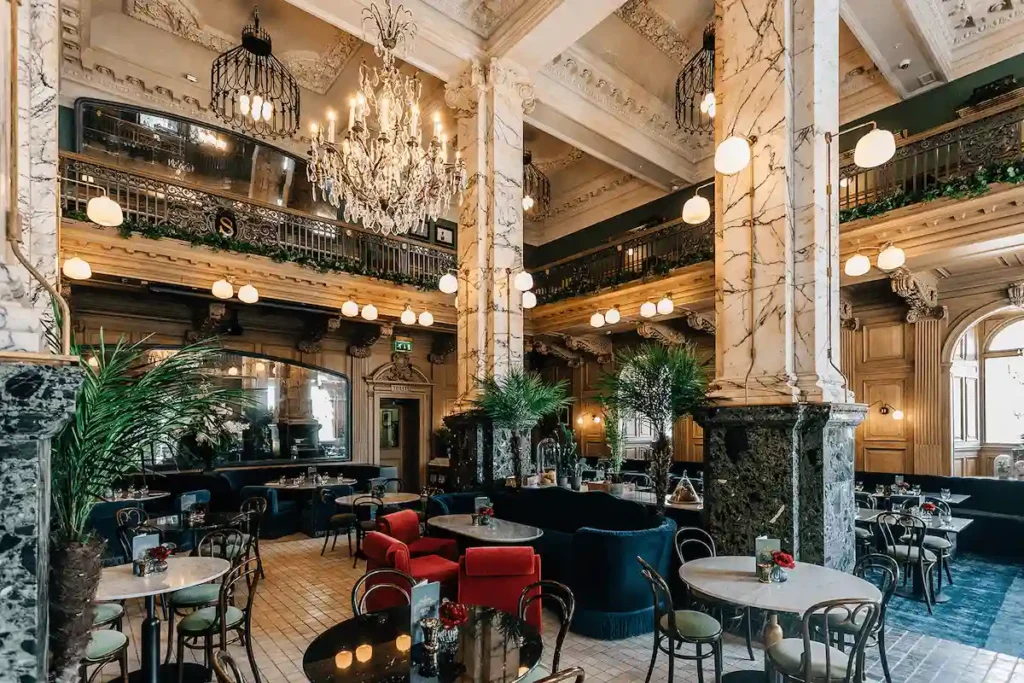
The Grand Café operates within the former double-height advertising hall, where the public once queued to place classified ads. Original marble pillars support the mezzanine gallery, and Parisian brasserie-inspired design acknowledges the building’s commercial legacy. Below, the Scotsman Health Club occupies subterranean levels once dominated by printing presses—a 16-meter stainless steel pool now fills the space where industrial machinery once shook the foundations.
The private 48-seat Scotsman Cinema preserves the building’s media heritage, featuring plush red velvet seating and wood-paneled walls in a space originally used for press screenings. Every morning, guests receive a complimentary copy of The Scotsman in a bespoke wooden holder—a tactile reminder that this building’s purpose was information distribution, and that legacy continues in refined form.
The building’s North Bridge position delivers 360-degree views: Edinburgh Castle to the west, the Firth of Forth north, Arthur’s Seat east. These weren’t aesthetic considerations—they were strategic. The location facilitated the subterranean tunnel network leading directly to Waverley Station, enabling rapid newspaper distribution across Scotland. Today, those tunnels remain beneath your feet, inaccessible but present—the literal infrastructure of media dominance preserved in stone and steel.
The Hide Bar occupies a discreet corner, focusing on local Scottish spirits in an environment that favors discretion over spectacle. This was a building designed for serious work, and that ethos persists: understated luxury, functional elegance, spaces designed for authority rather than display.
Check Availability & Rates →The Scotsman Hotel preserves the institutional weight of Edinburgh’s media command center—a century of editorial authority converted into 69 suites where guests inhabit the same marble-floored corridors and mahogany-paneled offices that once controlled Scotland’s narrative, anchored by Carrara staircases and subterranean infrastructure.
FAQ: The Scotsman Hotel
What is the historical significance of The Scotsman Hotel building?
Built in 1905 as the purpose-designed headquarters for The Scotsman newspaper, the Edwardian Baroque structure served as Scotland’s media nerve center for 96 years until 2001. The building housed editorial offices, advertising halls, and massive subterranean printing presses connected by private tunnels to Waverley Station for rapid distribution. Its Carrara marble staircase and Category A listed status reflect its role as an institutional monument rather than mere office space.
What original features from the newspaper era are preserved?
Many guest rooms retain original 1905 mahogany paneling, marble fireplaces, and floor-to-ceiling windows from the editorial offices. The Grand Café operates in the former double-height advertising hall with original marble pillars. The central Carrara marble staircase remains intact, and the private 48-seat cinema preserves wood paneling from press screening areas. The subterranean levels where printing presses operated now house the health club.
Does the hotel maintain any connection to its newspaper heritage?
Every guest receives a complimentary copy of The Scotsman delivered in a bespoke wooden holder each morning, continuing the building’s century-long tradition of information distribution. The private cinema shows films in the same space used for press screenings, and suite names often reference the building’s editorial past. The architectural preservation ensures guests inhabit authentic working environments where Scotland’s media elite once operated.
What makes the building’s location strategically significant?
The North Bridge position connects Edinburgh’s Old and New Towns, offering commanding 360-degree views of Edinburgh Castle, the Firth of Forth, and Arthur’s Seat. This wasn’t aesthetic—the location enabled construction of subterranean tunnels directly to Waverley Station for rapid newspaper distribution across Scotland. The building’s prominence on the bridge ensured visibility and accessibility, critical for a media headquarters controlling national discourse.
Where Editorial Authority Meets Modern Prestige
The Scotsman Hotel doesn’t replicate historic luxury—it preserves the actual infrastructure of institutional power. You’re inhabiting the Category A listed building where Scotland’s narrative was controlled for nearly a century, sleeping in editors’ offices, walking marble staircases funded by media profits, and swimming in pools carved from printing press foundations.
Explore The Balmoral Hotel or The Witchery by the Castle for more Edinburgh legacy properties.
For more curated itineraries and luxury-focused travel insights, visit Your Luxury Guide. For official travel information and destination updates, visit Britain tourism-info.
Your Luxury Guide — Where Exceptional Travel Begins.