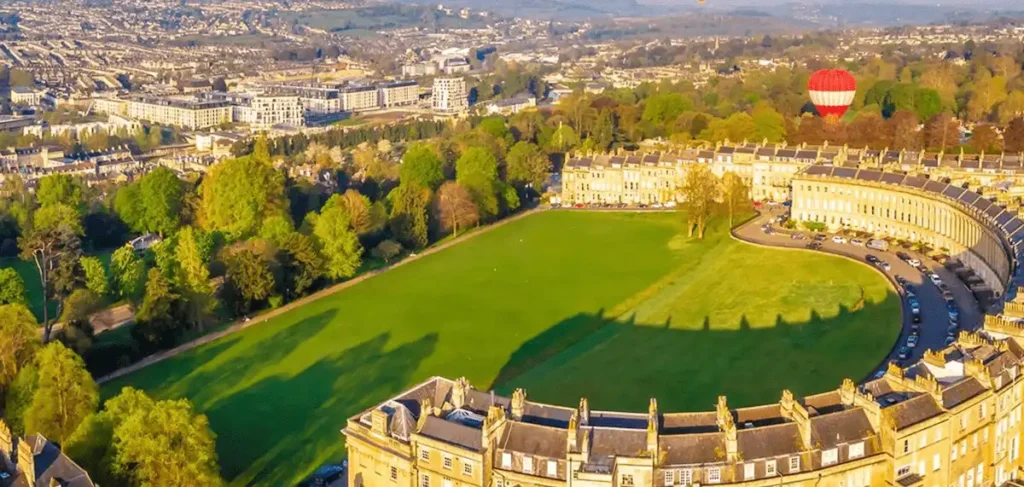
The Royal Crescent Hotel & Spa commands the centerpiece of John Wood the Younger’s 1775 Palladian achievement—No. 15 and No. 16, directly where Prince Frederick, Duke of York established royal residence. This is not merely accommodation within a historic building; this is inhabiting the literal seat of Georgian command, where 114 Ionic columns frame 47 feet of vertical Bath stone authority.
The architectural symbolism represents lunar dominance, complementing the nearby Circus’s solar power—a deliberate cosmic hierarchy mapped onto the landscape. Guests occupy the same thresholds where 18th-century aristocracy exercised social control, now translated into modern luxury infrastructure while preserving every element of architectural supremacy.
For the definitive collection of heritage power properties, explore the best historic hotels in Bath.
The Royal Crescent Hotel & Spa ★★★★★
John Wood the Younger completed the Royal Crescent in 1775 as Georgian Bath’s ultimate statement of architectural dominance—30 residences forming a 500-foot Palladian sweep overlooking Royal Victoria Park. The Royal Crescent Hotel & Spa occupies No. 15 and No. 16, the precise mathematical center of this monumental colonnade, where 114 Ionic columns stand 47 feet high, each carved from honey-colored Bath stone quarried from local oolitic limestone deposits. This is the building’s first layer of authority: physical scale translated into social hierarchy.
The Royal Crescent Hotel & Spa occupies the prestigious center of a 1775 Palladian masterpiece, a historic Grade I listed landmark
Prince Frederick, Duke of York granted the structure its “Royal” designation when he claimed No. 16 as his residence in the late 18th century. The architectural footprint reflects Georgian society’s obsession with visible uniformity and concealed individualism—what contemporaries called “Queen Anne Front, Sally Anne Behind.” The street-facing facade maintains strict Palladian discipline while the rear elevations reveal the chaotic, personalized construction styles of original developers. Guests inhabit this contradiction: public grandeur masking private autonomy.
The hotel’s one-acre walled Taittinger Spa Garden operates as a “rus in urbe”—countryside transplanted into urban command. This is the original 18th-century ha-ha trench system, a recessed landscape barrier designed to exclude livestock without interrupting sightlines. During World War II, the front lawn was converted to a victory garden growing cabbages for local distribution, demonstrating how elite spaces adapt to maintain relevance during national crisis.
The Bath House Spa now occupies the original coach house and stables, preserving 12-meter stone-vaulted ceilings and ecclesiastical windows while housing a relaxation pool. The Sir Percy Blakeney Suite—named after The Scarlet Pimpernel’s protagonist—is the only accommodation offering simultaneous views of the front parkland and rear gardens, a spatial privilege reflecting the suite’s position within the building’s geometric center. This is architectural authority translated into guest experience: occupying the same thresholds where Georgian aristocracy surveyed their dominion.
Montagu’s Mews restaurant operates from the 1769 extension John Wood the Younger designed as his private development office—the “Gentleman’s Retreat” where construction decisions were negotiated over Somerset-sourced ingredients. The Twilight Spa Experience packages sunset pool access with Himalayan salt therapy, modernizing the Georgian ritual of conspicuous leisure.
Netflix’s Bridgerton uses the Royal Crescent‘s exterior as the Featherington family residence, confirming the building’s continued function as shorthand for inherited social power. Alfie, the hotel’s resident cat and self-appointed Director of Guest Relations, maintains the property’s tradition of hosting figures who understand their position within hierarchical systems.
Check Availability & Rates →The Royal Crescent Hotel & Spa translates Georgian Bath’s social architecture into modern command—114 Ionic columns framing the same lunar-solar axis where Prince Frederick established aristocratic residence. You’re not visiting history; you’re inhabiting the geometric center of 18th-century power.
FAQ: The Royal Crescent Hotel & Spa
What makes The Royal Crescent Hotel & Spa architecturally significant?
The hotel occupies No. 15 and No. 16—the precise center of John Wood the Younger’s 1775 Palladian masterpiece featuring 114 Ionic columns, each 30 inches in diameter and 47 feet high. The building represents lunar symbolism complementing the nearby Circus’s solar design, creating a deliberate cosmic hierarchy mapped onto Bath’s Georgian landscape.
Why is it called “Royal” Crescent?
Prince Frederick, Duke of York established residence at No. 16 in the late 18th century, granting the building its royal designation. This transformed the Crescent from elite private housing into a recognized seat of aristocratic authority.
What is the ha-ha trench at the Royal Crescent?
The original 18th-century ha-ha is a recessed landscape barrier designed to exclude livestock from the front lawn without obstructing views of Royal Victoria Park. It demonstrates Georgian landscape engineering that maintained visual dominance while enforcing spatial exclusivity.
Where was Bridgerton filmed at the Royal Crescent?
The exterior serves as the Featherington family home in Netflix’s Bridgerton, confirming the building’s continued cultural function as visual shorthand for inherited Georgian social power and aristocratic residency.
Georgian Authority Meets Modern Command
The Royal Crescent Hotel & Spa operates as living proof that architectural dominance transcends historical periods. Guests inhabit the same geometric center where Prince Frederick exercised royal authority, now supported by 21st-century spa infrastructure and farm-to-fork dining protocols.
For another interpretation of heritage power translated into contemporary luxury, discover The Gainsborough Bath Spa.
More curated itineraries and luxury-focused travel insights at Your Luxury Guide. For official travel information and destination updates, visit Britain tourism-info.
Your Luxury Guide — Where Exceptional Travel Begins.