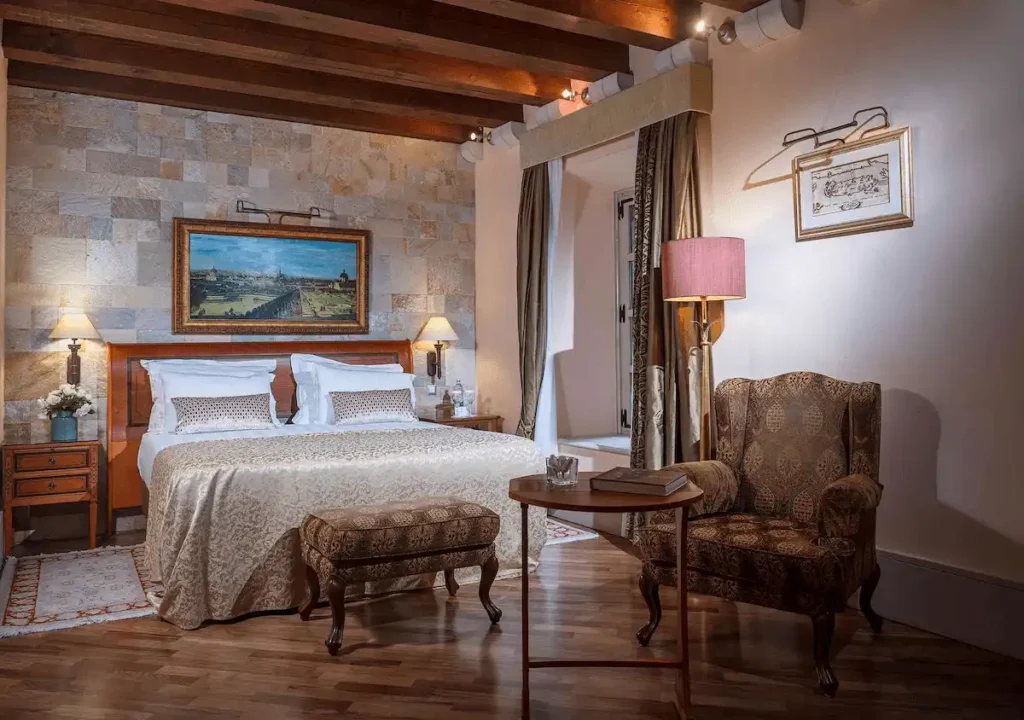
The Pucic Palace operates from the 1700-built urban residence of the Pucić family, one of the Republic of Ragusa’s most commanding noble lineages. As Dubrovnik’s first hotel established within the fortified city walls in 1895, this protected cultural landmark positions guests in a 19-suite Baroque palace where senators once governed maritime trade routes.
Original stone masonry from 1813 frames rooms displaying 18th-century antiques and artworks, while structural soundproofing allows modern privacy within walls where aristocratic authority was once absolute. Discover more elite accommodations in our guide to the best historic hotels in Dubrovnik.
The Pucic Palace ★★★★★
The physical command of The Pucic Palace begins with its 1700 construction date—a period when Dubrovnik’s noble families consolidated power through architectural statements within the fortified Old Town. Built as the private urban residence for the Pucić family, this Baroque palace functioned as the administrative seat for one of Ragusa’s most influential senatorial dynasties.
The property’s transformation into Dubrovnik’s first hotel within the city walls in 1895 established a precedent: historic authority converted into exclusive hospitality infrastructure.
The Pucic Palace is a refined Baroque manor located directly on Gundulić Square, offering an intimate 19-room sanctuary that blends aristocratic history with immediate access to the city’s historic market and cathedral.
The building’s protected status as a cultural landmark reflects its architectural integrity. High-volume ceilings characteristic of 18th-century Dalmatian nobility rise above dark oak floors preserved through the 2012 renovation that integrated fiber-optic technology and modern soundproofing into stone walls dating to 1813.
The central stone staircase—a monumental feature typical of high-status merchant palaces—connects 19 individualized rooms where guests inhabit spaces displaying period antiques and original artworks rather than reproductions. The specialized two-level Deluxe Suite features a hydro-massage bathtub positioned within the same structural footprint where the Pucić family once entertained diplomatic visitors.
Location precision matters in a UNESCO pedestrian zone. The palace occupies Gundulić Square in the absolute heart of the Old Town, positioned within 100 meters of the Rector’s Palace and the Cathedral. Guests overlook the traditional fruit and vegetable market from original Baroque stone windows—a viewpoint that captures daily civic life unchanged since the 18th century. The market-view rooms provide direct visual access to the square where Senator Nikola Lucijan Pucić’s family exercised administrative authority, named for their hereditary seat.
The property’s connection to Countess Elena Pucić—an 18th-century composer whose legacy is woven into the hotel’s classical themes—demonstrates how cultural capital translated into social dominance. Her position as a pioneering female composer in the Republic of Ragusa mirrors the hotel’s role as the city’s pioneering luxury accommodation within defensive walls designed to protect merchant wealth. Guests sleep in Tempur-Pedic beds positioned in rooms where musical salons once displayed the family’s refined cultural influence.
The hotel’s amenity infrastructure reflects strategic adaptations of historic space. The Café Royal operates within ground-floor chambers that once functioned as the palace’s formal reception areas, while the Wine Bar Razonoda—specializing in rare Croatian vintages—occupies vaulted stone cellars originally designed for merchant storage.
The private section of Banje Beach accessible through medieval Ploče Gate extends the property’s territorial reach beyond the palace walls, providing guests with an exclusive coastal access point that replicates the historic privilege of waterfront control.
Operational details demonstrate how historic architecture demands specialized logistics. Airport transfer services navigate the car-free UNESCO zone’s vehicular restrictions, while 24-hour porter services manage luggage movement through narrow streets designed for 16th-century foot traffic. Rooms equipped with individually controlled climate systems, heated towel rails, and blackout curtains maintain modern comfort within thick stone walls built for defensive security rather than thermal efficiency. High-definition satellite TV and fiber-optic WiFi function within structural elements constructed three centuries before electrical infrastructure existed.
The authentic wooden beams and Italian bathroom mosaics represent preservation choices that maintain historical accuracy while delivering contemporary utility. These are not decorative approximations but verified architectural elements from a building that served as both residential fortress and social headquarters for one of Ragusa’s governing families.
Guests occupy the same spatial hierarchy that defined aristocratic power: high ceilings signaling status, stone windows framing territorial views, and antique furnishings marking inherited wealth rather than purchased decoration.
Check Availability & Rates →The palace operates as a monument to senatorial authority converted into hospitality infrastructure—19 suites where Baroque architectural precision meets the documented legacy of Ragusa’s merchant-noble governance, preserved within walls that established Dubrovnik’s first luxury lodging inside the UNESCO fortifications.
FAQ: The Pucic Palace
What makes The Pucic Palace historically significant in Dubrovnik?
The Pucic Palace was built in 1700 as the urban residence for the noble Pucić family and became Dubrovnik’s first hotel within the fortified city walls when it opened in 1895. The building holds protected cultural landmark status and features original 1813 stone masonry, representing the architectural authority of one of the Republic of Ragusa’s most influential senatorial dynasties.
What type of rooms does The Pucic Palace offer?
The property features 19 individualized rooms and suites with 18th-century antiques, original artworks, dark oak floors, and Italian mosaic bathrooms. The specialized two-level Deluxe Suite includes a hydro-massage bathtub. All accommodations include Tempur-Pedic beds, modern soundproofing, blackout curtains, heated towel rails, and climate control within the historic Baroque structure.
Where is The Pucic Palace located in Dubrovnik’s Old Town?
The palace sits on Gundulić Square in the absolute center of the UNESCO-protected Old Town, within 100 meters of the Rector’s Palace, the Cathedral, and the Stradun. Market-view rooms overlook the traditional daily fruit and vegetable market from original Baroque stone windows. The property also provides exclusive access to a private section of Banje Beach through the medieval Ploče Gate.
What dining and amenity options are available at The Pucic Palace?
The hotel houses the Café Royal and Wine Bar Razonoda, which specializes in rare Croatian vintages and traditional Mediterranean cuisine. Amenities include 24-hour reception, luggage porter services, airport transfers navigating the car-free zone, fiber-optic WiFi throughout the stone structure, and high-definition satellite TV in all rooms.
The Legacy of Ragusa’s Senatorial Architecture
The Pucic Palace stands as verification that historic command translates into modern exclusivity when preservation maintains architectural integrity rather than aesthetic approximation. Guests inhabit 1700-built chambers where the spatial hierarchy of Baroque nobility—high ceilings, stone staircases, antique furnishings—frames contemporary stays within Dubrovnik’s first luxury hotel inside defensive walls.
For additional historic properties where architectural authority defines the guest experience, explore the imperial restoration of Hilton Imperial Dubrovnik and the 1913-built coastal dominance of Hotel Excelsior Dubrovnik.
More curated itineraries and luxury-focused travel insights at Your Luxury Guide. For official travel information and destination updates, visit Croatia tourism-info.
Your Luxury Guide — Where Exceptional Travel Begins.