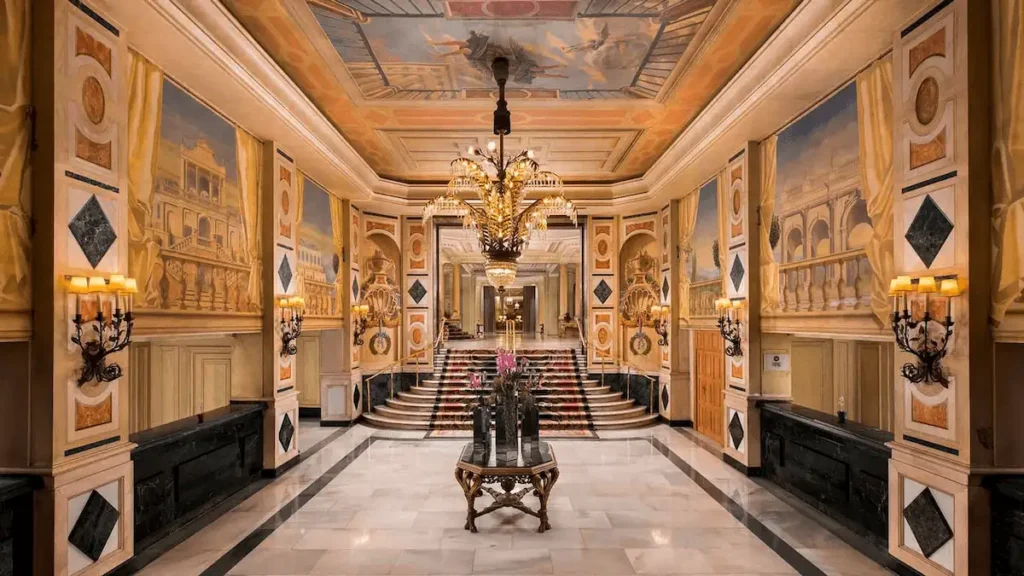
The Palace Madrid was commissioned by King Alfonso XIII in 1912 to establish Spain’s position among Europe’s capitals of luxury. Built on the grounds of the former Palace of the Dukes of Medinaceli, it introduced the nation’s first hotel rooms with private baths and telephones—a declaration of modernity that would host generations of monarchs, spies, and literary giants.
Following a meticulous €90 million restoration completed in 2025, the property has reclaimed its original 1912 facade pigment and fully restored its Art Nouveau stained-glass dome, pane by pane. This is not adaptive reuse; this is the preservation of Spain’s entry into the modern luxury era.
Discover more properties of this caliber in our guide to the best historic hotels in Madrid.
The Palace, a Luxury Collection Hotel, Madrid ★★★★★
King Alfonso XIII did not commission The Palace Madrid to compete with Europe’s grand hotels—he commissioned it to surpass them. Opened in 1912 on the site of the former Palace of the Dukes of Medinaceli, the hotel was built as a strategic instrument of national prestige, designed to position Madrid alongside Paris and London as a destination for global power.
The Palace Madrid is a legendary Belle Époque landmark, reclaiming its 1912 splendor within the UNESCO-designated “Landscape of Light” district.
Every room was outfitted with a private bath and telephone, unprecedented luxuries in Spanish hospitality. The King’s ambition was realized: The Palace became the official residence of visiting heads of state and the operational headquarters of Spain’s cultural elite.
The property’s architectural authority derives from its Art Nouveau stained-glass dome, designed by Eduard Ferrés i Puig. Spanning the hotel’s central lounge, the dome comprises 1,875 individual glass panes—each removed, cataloged, and restored during the 2025 renovation.
The Palace’s social history is a catalog of 20th-century power. During World War I, the hotel operated as neutral ground for European intelligence networks. Mata Hari resided here under an alias; her presence is documented in guest registries, and her legend persists among staff who claim certain corridors retain her influence. During the Spanish Civil War, the hotel was requisitioned as a military hospital. The glass-domed lounge, celebrated for its natural light, was converted into an operating theater—a transformation from symbol of luxury to instrument of survival.
The hotel’s literary legacy is equally documented. Salvador Dalí and Federico García Lorca were permanent fixtures at the bar, part of Spain’s Generation of ’27 who used the property as an informal headquarters. Dalí once painted directly onto the walls of his suite—an impromptu mural that was scrubbed away by housekeeping before its significance was understood. Ernest Hemingway immortalized the hotel’s bar in The Sun Also Rises, declaring it the finest location in Madrid for a dry martini, a detail that established the property in the literary geography of modernist Europe.
The 2025 restoration has reimagined the guest experience while maintaining the property’s historical authority. La Cúpula, the hotel’s signature restaurant, now operates directly beneath the restored dome, serving “New Castilian” cuisine. The 27 Club, a cocktail bar designed as a living museum, honors the writers and artists of the 1920s with over 70 custom illustrations and original guest books displayed under glass.
The 470 redesigned rooms feature hand-painted wallpapers inspired by the Royal Botanical Garden, with bathroom mosaics that reproduce an aerial view of the park—spatial design that integrates Madrid’s historical landscape into the private suite.
The Royal Suite spans 1,700 square feet and includes a private library, a chef’s kitchen, and floor-to-ceiling windows overlooking the Neptune Fountain. This is not a room; this is a residence of state, designed for guests who require the infrastructure of command within a setting of historical legitimacy.
Check Availability & Rates →The Palace Madrid does not present itself as a museum of Spanish royalty—it presents itself as the operational headquarters where that royalty exercised authority. You are not observing history; you are inhabiting the room where it was negotiated.
FAQ: The Palace Madrid
What makes The Palace Madrid historically significant?
The Palace Madrid was commissioned by King Alfonso XIII in 1912 as Spain’s first hotel to offer private baths and telephones in every room. Built on the site of the Palace of the Dukes of Medinaceli, it was designed to establish Madrid as a European capital of luxury. The property served as a military hospital during the Spanish Civil War and hosted figures including Mata Hari, Salvador Dalí, and Ernest Hemingway.
What was restored during the 2025 renovation?
The €90 million restoration included the complete disassembly and cleaning of the Art Nouveau stained-glass dome’s 1,875 individual panes. The original 1912 facade pigment—a warm beige with terracotta accents—was rediscovered beneath decades of repainting. All 470 rooms were redesigned with hand-painted botanical wallpapers and mosaic bathrooms inspired by Madrid’s Royal Botanical Garden.
What is the significance of the stained-glass dome?
Designed by Eduard Ferrés i Puig, the dome was installed in 1912 and spans the hotel’s central lounge. During World War I and the Spanish Civil War, the dome’s natural light made the space suitable for intelligence meetings and wartime surgery. The 2025 restoration returned each pane to its original clarity, restoring the dome to its function as both architectural symbol and practical light source.
What is the Royal Suite at The Palace Madrid?
The Royal Suite is a 1,700-square-foot residence featuring a private library, chef’s kitchen, and views of the Neptune Fountain. It was designed for visiting heads of state and dignitaries who required both ceremonial grandeur and operational privacy. The suite maintains the spatial hierarchy established in 1912, when the hotel functioned as an extension of royal protocol.
Historic Authority Secured
The Palace Madrid was not built to accommodate travelers—it was built to accommodate the exercise of power. From Mata Hari’s wartime intelligence operations to Dalí’s impromptu murals, the property has functioned as both witness and participant in Spain’s transformation across the 20th century.
The 2025 restoration has preserved this authority while modernizing the infrastructure of luxury, ensuring the building remains a functioning seat of prestige.
Travelers seeking properties where history is not decoration but operational legacy, explore the Mandarin Oriental Ritz Madrid and Santo Mauro Madrid.
For more curated itineraries and luxury-focused travel insights, visit Your Luxury Guide. For official travel information and destination updates, visit Spain tourism-info.
Your Luxury Guide — Where Exceptional Travel Begins.