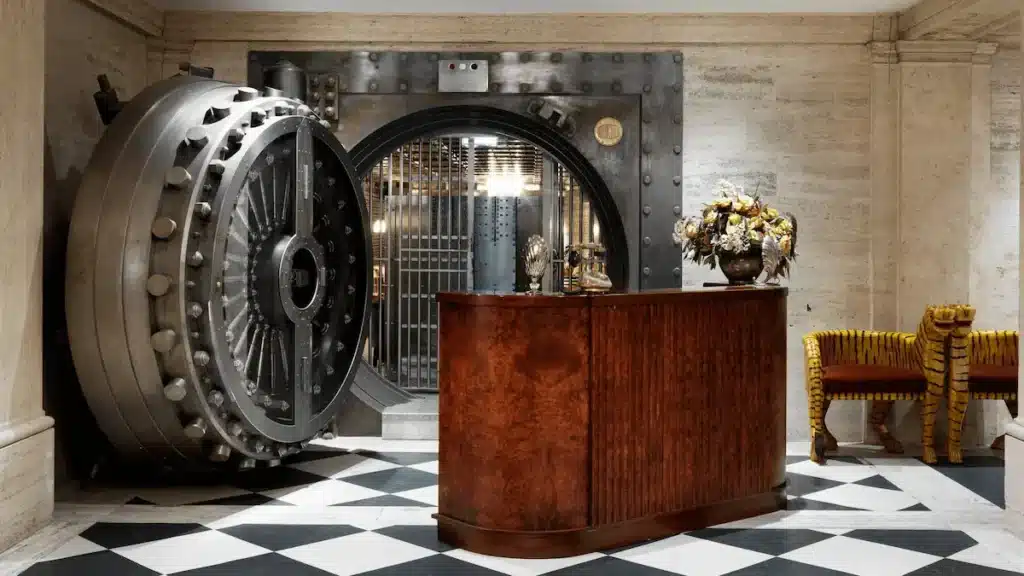
The Ned London commands the City’s financial district from Sir Edwin Lutyens’ 1924 Midland Bank headquarters—once the world’s most powerful bank. You’re staying inside a Grade I listed monument where 92 African verdite columns and a 25-tonne vault door document an era when global commerce answered to British authority.
The £200 million restoration preserved walnut-paneled boardrooms, secret chairman lifts, and the 3,000 m² banking hall that inspired Fort Knox in Goldfinger. This is verified institutional power converted to private use—discover more at best historic hotels in London.
The Ned London ★★★★★
The former Midland Bank headquarters stands as the City’s most significant early 20th-century monument to financial empire. When Sir Edwin “Ned” Lutyens designed this building in 1924, he created the physical seat of the world’s most dominant banking institution—a structure so imposing that its reinforced vault and intimidating scale later became Ian Fleming‘s direct reference for Fort Knox in the 1964 Bond film Goldfinger.
The building’s Grade I listing confirms its status as one of fewer than three dozen 20th-century structures in Britain deemed worthy of the nation’s highest heritage protection.
The Ned London is a monumental landmark in the City, where guests can dine among 92 verdite columns or sip cocktails inside a high-security bank vault.
Your suite occupies space where Midland Bank directors once controlled international capital flows. The 5th-floor Heritage Suites retain original 1920s walnut paneling and marble fireplaces from executive offices—rooms where currency policy was decided, not debated.
The 6th-floor Directors’ Floor preserves Lutyens’ original boardrooms, including the Tapestry Room, which houses a 1932 pastoral tapestry that was among England’s largest commissioned works of its era. Custom walnut cupboards, designed specifically for directors to store top hats and canes during meetings, remain in their original positions.
The building’s 92 African verdite columns define the restored 3,000 m² banking hall. This rare dark green rock was so scarce that each pillar required assembly like a jigsaw puzzle from fragments sourced across southern Africa—a material choice that demonstrated Midland’s reach into colonial resource networks. The concave Portland stone facade features the peculiar “Boy with a Goose” statue, nodding to the building’s address on Poultry street while maintaining the neoclassical authority Lutyens perfected at the Cenotaph and across New Delhi’s imperial core.
The Vault Bar operates behind a 25-tonne stainless steel door manufactured by the Chatwood Safe Company. Three thousand original safety deposit boxes line the walls—the same compartments where London’s elite secured assets during the interwar period.
Above, the Ned’s Club rooftop converts two Baroque-style domes into private terraces with heated pool and direct sightlines to St. Paul’s Cathedral. The subterranean spa descends into reinforced bullion vaults, where a 20-meter pool and Moroccan hammam now occupy chambers built to withstand siege-level assault.
Nine restaurants operate under the banking hall’s soaring ceiling, with the Nickel Bar positioned precisely where teller counters once processed the City’s daily capital movements. Live music stages nightly at the exact point where currency changed hands between empire and enterprise.
The hidden “Chairman’s Lift“—designed to transport the bank’s head from vestibule to private office without mingling with general staff—still functions, bypassing public floors entirely.
Nick Jones discovered the building in 2012 after eight years of vacancy. His partnership with American billionaire Ron Burkle funded the £200 million restoration that maintained Lutyens’ spatial hierarchy while converting institutional command centers into guest accommodations.
You’re not renting a room near financial history—you’re inhabiting the authenticated boardrooms where that history was authored.
Check Availability & Rates →The Ned London translates Sir Edwin Lutyens’ neoclassical precision into occupied authority—92 verdite columns and Fort Knox-grade security converted from banking dominance to guest sovereignty. You sleep inside verified Grade I institutional power.
FAQ: The Ned London
Why is The Ned London historically significant?
The Ned occupies Sir Edwin Lutyens’ 1924 Midland Bank headquarters—the world’s most powerful bank at the time. Its Grade I listing, 92 African verdite columns, and reinforced vault that inspired Fort Knox in Goldfinger document an era when British financial institutions controlled global commerce from the City of London.
What original architectural features remain at The Ned?
The hotel preserves Lutyens’ 1920s walnut-paneled boardrooms, marble fireplaces, custom top-hat cupboards, the hidden Chairman’s Lift, 3,000 stainless steel safety deposit boxes in the vault, and the complete 3,000 m² banking hall with 92 assembled verdite columns—all protected under Grade I heritage status.
Who was Sir Edwin “Ned” Lutyens?
Sir Edwin Lutyens was Britain’s most influential neoclassical architect, designer of the Cenotaph war memorial and master planner of New Delhi’s imperial core. The hotel’s name directly honors his nickname among peers. His 1924 Midland Bank headquarters remains one of fewer than 40 twentieth-century buildings awarded Grade I listing in the United Kingdom.
What makes The Ned’s vault unique?
The Vault Bar operates behind a 25-tonne Chatwood Safe Company stainless steel door—the same security infrastructure that inspired Ian Fleming’s description of Fort Knox in the 1964 James Bond film Goldfinger. The walls retain 3,000 original safety deposit boxes from the bank’s operational period, preserving the spatial arrangement where London’s elite secured wealth during the interwar years.
Beyond Lutyens’ Banking Monument
The Ned London proves that institutional power, when documented through Grade I architectural preservation, creates guest experiences no contemporary construction can replicate. From Midland Bank’s verdite-columned dominance to private rooftop domes overlooking St. Paul’s, you’re inhabiting verified financial empire—not a themed approximation.
Continue with Hotel Cafe Royal London and Rosewood London to map the City’s authenticated heritage properties.
For more curated itineraries and luxury-focused travel insights, visit Your Luxury Guide. For official travel information and destination updates, visit Britain tourism-info.
Your Luxury Guide — Where Exceptional Travel Begins.