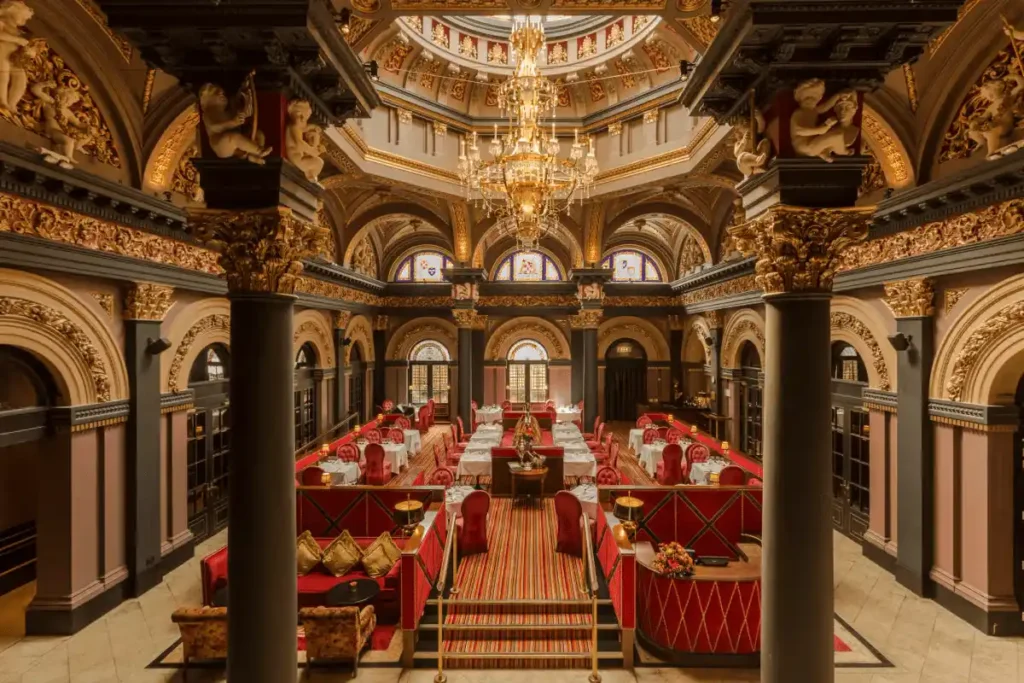
The Merrion Hotel commands four Grade I listed Georgian townhouses (Nos. 21–24 Upper Merrion Street) built in the 1760s by Lord Charles Stanley Monck. These structures served as the address of Ireland’s parliamentary elite before the Act of Union—nearly every resident until 1800 held a seat in the Irish Parliament.
No. 24, formerly Mornington House, is the birthplace of Arthur Wellesley, 1st Duke of Wellington, born here in 1769. After two centuries as state offices, including tenure as the Irish Land Commission headquarters, the quartet reopened in 1997 as a hotel following restoration that hand-recast missing Rococo plasterwork in Wellington’s birth residence and preserved original timber sash windows, Portland stone, and peacock’s-tail fanlights.
For travelers seeking accommodation rooted in documented power rather than decorator theatrics, explore best historic hotels in Dublin.
The Merrion Hotel ★★★★★
The 1760s townhouses that comprise The Merrion were not built for merchants or tradesmen—they were commissioned by Lord Charles Stanley Monck as residences for Ireland’s ruling class. Upper Merrion Street functioned as a political nerve center: parliamentary members convened here before walking to the nearby Irish Houses of Parliament. The street’s nickname, “the Nobs,” reflected its concentration of titled occupants.
No. 24 holds the distinction of being the Duke of Wellington’s birthplace, the general who defeated Napoleon at Waterloo in 1815. When Ireland’s government restructured in the 20th century, these houses transitioned to administrative use—the Irish Land Commission occupied them for decades, turning drawing rooms into filing archives and private chambers into bureaucratic offices.
The Merrion Hotel is a 5-star Georgian masterpiece comprised of four 1760s townhouses, a historic landmark that served as the birthplace of the Duke of Wellington and now houses Ireland’s largest private art collection.
The 1997 restoration reversed that conversion. Craftsmen removed mid-century partitions to expose original spatial volumes. In Wellington’s birth residence, missing plasterwork sections were hand-recast from surviving fragments, matching the delicate Rococo motifs that adorned elite Georgian interiors. The hotel retained the traditional “Irish Georgian” interior palette—walls painted in restful tones like shellcove soft green rather than papered—to better display Ireland’s largest private art collection. Masterworks by Jack B. Yeats, Paul Henry, and William Leech hang in public corridors and guest suites, creating a living gallery where 19th and 20th-century Irish visual power is on constant display.
The contemporary Garden Wing connects the four original houses around two 18th-century-style landscaped gardens. These private grounds feature a full-sized bronze statue of James Joyce, text from Ulysses woven around its base—a physical anchoring of Ireland’s literary authority within a seat of political and military legacy. The gardens are visible through floor-to-ceiling glass from The Garden Room, where modern Irish cuisine is served against a backdrop of period landscaping that mirrors what parliamentary residents would have surveyed from these same townhouse windows 250 years prior.
Beneath the ground floor, the original 18th-century vaulted wine cellars now house The Cellar Bar. The authentic brick vaulting and alcove structure remain unchanged—these are the same storage chambers where Georgian-era wine stocks were kept.
Above, in the public Drawing Rooms, original Rococo plasterwork frames open turf fires, and guests take tea in spaces where MPs once debated policy before the 1800 Act of Union dissolved Ireland’s independent parliament. No. 23 Cocktail Bar occupies an intimate chamber designed to replicate an 18th-century private library, complete with rare whiskey reserves and creative cocktails served in surroundings that reinforce the townhouses’ club-like exclusivity.
The Tethra Spa—named after the Irish mythological “Land of the Young”—features an 18-meter infinity pool set in French limestone. A dramatic classical mural backs the pool, continuing the hotel’s architectural dialogue between Georgian restraint and symbolic grandeur. Guests swim where state clerks once filed paperwork, the spa’s contemporary amenities layered over foundations laid when Ireland’s elite exercised regional command from these exact addresses.
The Merrion’s Art Afternoon Tea translates its visual collection into edible form: pastries are hand-designed to resemble specific works from the hotel’s holdings, making the tea service both a culinary and curatorial experience. This is hospitality as institutional authority—each element, from hand-recast plaster to Joyce’s bronze presence in the garden, reinforces the guest’s occupation of a documented seat of Irish political, military, and artistic power.
Check Availability & Rates →To stay at The Merrion is to inhabit the preserved command architecture of Georgian Dublin—where Wellington drew his first breath, parliamentarians shaped policy, and Ireland’s visual masters now line the walls in perpetuity.
FAQ: The Merrion Hotel
What makes The Merrion Hotel historically significant?
The Merrion occupies four Grade I listed Georgian townhouses built in the 1760s on Upper Merrion Street, Dublin’s political epicenter before the 1800 Act of Union. No. 24 is the verified birthplace of Arthur Wellesley, 1st Duke of Wellington, born in 1769. Nearly every resident until 1800 was a Member of the Irish Parliament, making these structures a documented seat of governmental power.
How was the original Georgian architecture preserved?
The 1997 restoration retained original timber sash windows, Portland stone facades, and peacock’s-tail fanlights above the doors. In the Duke of Wellington’s birth residence, craftsmen hand-recast missing Rococo plasterwork from surviving fragments. Walls follow the traditional Irish Georgian palette—painted in restful tones rather than wallpapered—to showcase the hotel’s art collection without visual competition.
What is unique about The Merrion’s art collection?
The hotel houses Ireland’s largest private collection of 19th and 20th-century art, including masterpieces by Jack B. Yeats, Paul Henry, and William Leech. Works are displayed throughout public spaces and guest suites, turning the property into a living gallery. The Art Afternoon Tea features pastries designed to resemble specific pieces from the collection.
What original 18th-century features remain accessible to guests?
The Cellar Bar occupies the original vaulted wine cellars with authentic brick vaulting and alcove structure. The Drawing Rooms retain their Rococo plasterwork and open turf fires. The two 18th-century-style gardens, featuring a full-sized bronze of James Joyce, are framed by the original townhouse rear elevations and accessible through the contemporary Garden Wing.
Where Georgian Authority Meets Contemporary Command
The Merrion Hotel translates 260 years of documented Irish power—from parliamentary assembly to military legend to artistic mastery—into a modern five-star residence. Guests occupy the physical spaces where Wellington was born and MPs debated Ireland’s fate, with every restored detail reinforcing the property’s institutional prestige.
Those drawn to Ireland’s other heritage seats of authority, The Shelbourne Dublin offers a parallel command experience on St Stephen’s Green.
For more curated itineraries and luxury-focused travel insights, visit Your Luxury Guide. For official travel information and destination updates, visit Ireland tourism-info.
Your Luxury Guide — Where Exceptional Travel Begins.