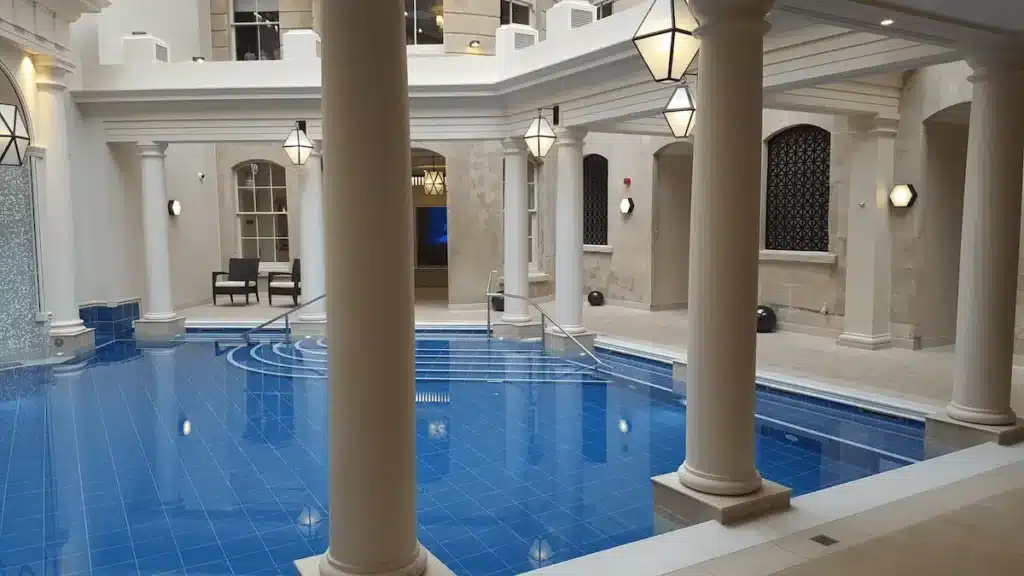
The Gainsborough Bath Spa occupies two Grade II listed Georgian buildings designed by John Pinch the elder in 1824, originally serving as the Royal United Hospital until 1932. This is the only hotel in the United Kingdom offering direct, private access to Bath’s natural thermal mineral waters—the same Roman springs that established the city as a seat of imperial bathing authority.
YTL Hotels’ 2015 restoration transformed Victorian hospital wards into high-ceilinged suites while unearthing the Beau Street Hoard, Britain’s largest cache of Roman silver coins.
The Gainsborough Bath Spa ★★★★★
The Gainsborough Bath Spa commands two Grade II listed structures designed by John Pinch the elder in 1824, their honey-colored Georgian facades anchoring Beau Street—the exact site where over 17,500 Roman silver coins, now known as the Beau Street Hoard, were excavated in 2007.
Originally constructed as the Royal United Hospital, these Neo-Classical wings served Bath’s medical elite for 108 years before transitioning to the Bath College of Art and Design. YTL Hotels acquired the abandoned property in 2013, launching a historically meticulous restoration that preserved original sandstone walls, vaulted ceilings, and the building’s chapel—spaces where art students had painted over Georgian stonework during seven decades of creative occupation.
The Gainsborough Bath Spa is a 5-star Georgian landmark and the only hotel in the UK to offer private access to Bath’s thermal waters
The 2015 reopening established something unprecedented in British hospitality: the nation’s first hotel with direct, engineered access to Bath’s Roman thermal springs. Specific “Spa Rooms” feature third taps in alcove roll-top bathtubs that channel 46°C mineral-rich thermal water directly into guest quarters—the same geological source that powered ancient Roman bathhouses. This is not thematic design; it is infrastructural dominance.
The hotel’s 14,000-square-foot Spa Village, designed by New York’s Champalimaud Design, replicates Roman social bathing architecture through a glass-domed four-story atrium housing three interconnected thermal pools. During construction, workers uncovered a 4th-century Roman mosaic beneath the foundation; while the original remains protected, a museum-quality replica anchors the spa’s entrance, establishing visual continuity with Bath’s imperial occupation.
Former hospital wards now function as high-ceilinged suites with restored Victorian moldings and contemporary interventions: freestanding thermal bathtubs, heated limestone floors, and bespoke apothecary bars where guests blend personalized aromatherapy oils—a nod to medieval British pharmaceutical tradition.
The Canvas Room, characterized by polished mirrors and gold-leaf detailing, serves traditional afternoon tea beneath the original chapel’s vaulted ceiling. The marble-clad lobby displays a genuine 18th-century sedan chair, the conveyance method by which Georgian society arrived at Bath’s bathhouses. Guests at Spa Village engage in the “wax tablet ritual,” inscribing thoughts onto replica Roman wax tablets before submerging them in thermal water—an experiential echo of ancient “curse tablet” practices documented in archaeological records.
The property honors Sir Thomas Gainsborough, the portrait artist who resided in Bath from 1759 to 1774, establishing the city as Britain’s artistic capital. The Gainsborough Brasserie, formerly awarded 3 AA Rosettes, delivers contemporary British cuisine with Malaysian influences—a culinary bridge reflecting YTL Hotels’ Asia-Pacific heritage.
This is not a heritage hotel that references history; it is a Georgian medical landmark that grants exclusive thermal access to the geological force that built Roman Bath’s imperial authority.
Check Availability & Rates →The Gainsborough Bath Spa does not interpret Bath’s Roman heritage—it grants physical access to the thermal springs that established the city as an imperial bathing seat, channeling 46°C mineral water directly into Georgian hospital wards reborn as Britain’s most architecturally significant thermal suites.
FAQ: The Gainsborough Bath Spa
What makes The Gainsborough Bath Spa historically unique?
The Gainsborough Bath Spa is the only hotel in the United Kingdom with direct, private access to Bath’s natural Roman thermal springs. Built in 1824 as the Royal United Hospital by architect John Pinch the elder, the property occupies two Grade II listed Georgian buildings where the Beau Street Hoard—over 17,500 Roman silver coins—was discovered in 2007. Specific “Spa Rooms” feature third taps that channel 46°C thermal water directly into guest bathtubs.
What is the building’s original purpose and architectural significance?
Designed by John Pinch the elder in 1824, the property functioned as the Royal United Hospital until 1932, serving Bath’s medical establishment for 108 years. Following closure, it became the Bath College of Art and Design for seven decades. The Neo-Classical structure features honey-colored Georgian facades, Victorian wings, and a preserved chapel with vaulted ceilings—now restored to museum-grade standards by YTL Hotels in 2015.
What was discovered during the hotel’s restoration?
During YTL Hotels’ 2015 restoration, workers uncovered a 4th-century Roman mosaic beneath the foundation. While the original remains archaeologically protected, a museum-quality replica is displayed in Spa Village. The site also yielded the Beau Street Hoard in 2007—Britain’s largest cache of Roman silver coins, establishing the property’s location as a documented Roman settlement point.
How does the thermal spa experience connect to Roman history?
The Gainsborough Bath Spa’s 14,000-square-foot Spa Village replicates Roman social bathing architecture through a glass-domed four-story atrium housing three thermal pools fed by Bath’s natural springs. Guests participate in the “wax tablet ritual,” inscribing thoughts onto replica Roman wax tablets before submerging them in thermal water—mirroring ancient “curse tablet” practices documented in Bath’s archaeological record. This is the UK’s only hotel offering engineered thermal access to the same geological source used by Roman baths.
The Gainsborough Bath Spa: Where Georgian Medicine Meets Roman Thermal Authority
The Gainsborough Bath Spa translates 1824 Neo-Classical hospital architecture into Britain’s only thermal-access luxury property. This is not heritage theming—it is direct geological connection to the Roman springs that established Bath as an imperial bathing seat, channeled through John Pinch’s Grade II listed Georgian landmark.
For comparable historic authority, explore The Royal Crescent Hotel & Spa, another Georgian masterpiece commanding Bath’s architectural prestige.
More curated itineraries and luxury-focused travel insights at Your Luxury Guide. For official travel information and destination updates, visit Britain tourism-info.
Your Luxury Guide — Where Exceptional Travel Begins.