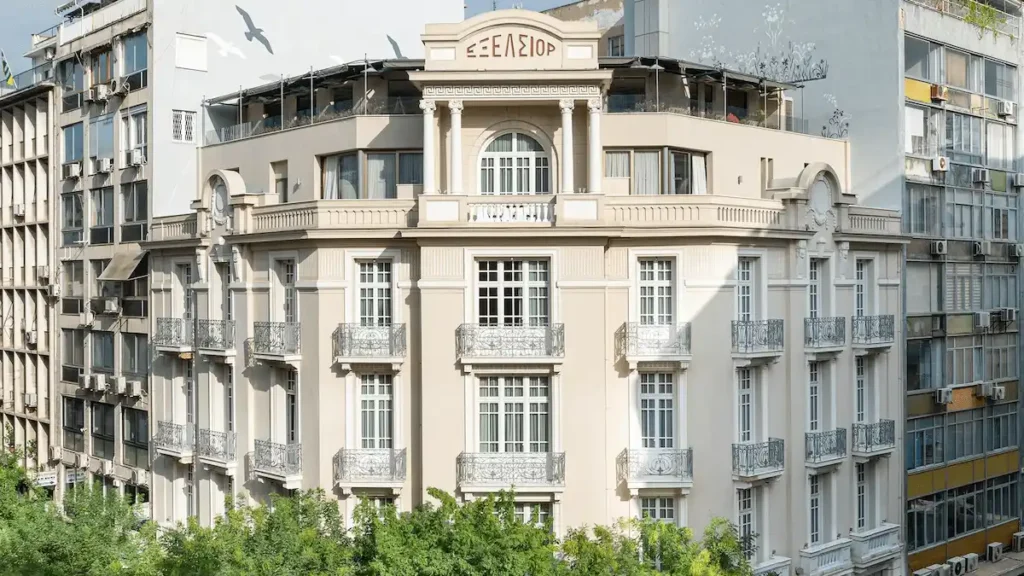
The Excelsior Thessaloniki has dominated Aristotelous Square since 1925, when architect Eli Modiano designed this Neoclassical anchor as the city’s ceremonial gateway to the Thermaic Gulf. The building’s symmetrical façade and monumental positioning established it as Thessaloniki’s architectural statement of post-Ottoman modernization.
Today, this Small Luxury Hotels of the World member translates that documented legacy into 32 suites where marble floors and seven-meter ceilings preserve the spatial authority of interwar Greek prosperity. This is verified historic command in Greece’s second city.
Discover the audit of best historic hotels in Thessaloniki.
The Excelsior – Small Luxury Hotels of the World ★★★★★
The Excelsior Thessaloniki occupies the most commanding position in Greece’s northern capital: the southeastern terminus of Aristotelous Square, where Ernest Hébrard’s 1918 master plan designated this site as the city’s architectural focal point. Eli Modiano’s 1925 design delivered a six-story Neoclassical statement that synchronized with Hébrard’s vision of monumental symmetry extending from the square to the sea.
The Excelsior stands as a masterpiece of neoclassical architecture, offering a refined boutique stay in a historic building that has remained a centerpiece of the city’s Thessaloniki center for over a century.
The building‘s limestone façade, ornamental balconies, and rhythmic fenestration established it as the visual anchor of Thessaloniki’s post-fire reconstruction—the physical embodiment of Greek urban renewal after the devastating 1917 blaze.
The property’s transformation into a Small Luxury Hotels of the World member preserves its spatial dominance while integrating contemporary utility.
The 32 suites occupy the original floor plan, where seven-meter ceiling heights and floor-to-ceiling windows maintain the building’s monumental scale. Carrara marble bathrooms and Coco-Mat mattresses function within rooms that preserve the structural proportions of 1925 bourgeois apartments.
The Terrace Suite commands dual views: Aristotelous Square to the north and the Thermaic Gulf to the south, replicating the visual axis Hébrard engineered to project Greek authority across the Aegean trade routes.
The Excelsior’s ground-floor spaces translate the building’s ceremonial function into modern social infrastructure. The lobby preserves original marble flooring and wrought-iron balustrades that once welcomed Thessaloniki’s commercial elite conducting maritime trade negotiations.
The rooftop terrace extends the building’s vertical dominance, offering 360-degree views across the archaeological layers of Byzantine walls, Ottoman mosques, and the White Tower that mark the city’s imperial transitions. The Ergon Agora restaurant operates within the ground floor, occupying the commercial arcade that historically connected Aristotelous Square’s financial institutions to the waterfront customs houses.
The hotel’s position delivers immediate access to Thessaloniki’s power centers. The Aristotelous Square entrance places guests 180 meters from the city’s original stock exchange building and 400 meters from the Makedonia Palace, where Winston Churchill negotiated Greek sovereignty during the 1944 Caserta Conference. The Roman Forum lies 300 meters northeast; the Arch of Galerius—built AD 298 to commemorate Roman victories over Persia—stands 600 meters east.
This is inhabiting the urban grid where Mediterranean commerce, imperial diplomacy, and Greek national identity converged for twenty-seven centuries.
The Excelsior Thessaloniki does not perform luxury; it occupies documented authority. The building’s 1925 construction coincided with Greece’s territorial expansion following the Treaty of Lausanne—the moment Thessaloniki transformed from Ottoman provincial capital to the nation’s primary Aegean port. Guests sleep in the architectural statement that announced that transition to the world.
Check Availability & Rates →To occupy The Excelsior is to inherit the only building on Aristotelous Square designed to visually dominate both the city’s ceremonial heart and its mercantile waterfront—the spatial authority Hébrard mapped for Greece’s Aegean resurgence.
FAQ: The Excelsior Thessaloniki
What makes The Excelsior Thessaloniki historically significant?
The Excelsior anchors Aristotelous Square in a 1925 Neoclassical building designed by Eli Modiano as the southeastern terminus of Ernest Hébrard’s post-1917 master plan. The property occupies the most strategic position in Thessaloniki’s urban reconstruction—the visual axis connecting the city’s ceremonial square to the Thermaic Gulf trade routes that defined Mediterranean commerce for millennia.
How does The Excelsior preserve its 1925 architecture?
The hotel maintains original seven-meter ceiling heights, marble flooring, and wrought-iron balustrades throughout its 32 suites. The building’s Neoclassical façade, symmetrical fenestration, and monumental proportions remain unaltered from Modiano’s 1925 design, ensuring guests inhabit the spatial authority that established the building as Thessaloniki’s architectural statement of Greek modernization.
What is The Excelsior’s connection to Aristotelous Square?
The property occupies the square’s southeastern corner—the position Ernest Hébrard designated as the city’s primary architectural focal point in his 1918 master plan. The building’s ground-floor arcade historically connected Thessaloniki’s financial institutions to waterfront customs houses, making The Excelsior the physical link between civic ceremony and maritime commerce.
Why is The Excelsior considered a Small Luxury Hotels of the World property?
The Excelsior’s membership reflects its documented 1925 heritage, architectural provenance as part of Hébrard’s UNESCO-recognized urban plan, and strategic position commanding Thessaloniki’s most significant public space. The property delivers verifiable historic authority rather than manufactured boutique aesthetics—occupying a building that defined the city’s transition from Ottoman province to Greek Aegean capital.
The Enduring Command of Neoclassical Thessaloniki
The Excelsior Thessaloniki does not simulate heritage—it occupies the building that visually codified Greece’s national resurgence. Every suite preserves the spatial proportions that announced Thessaloniki’s transformation from imperial periphery to Mediterranean power center.
Explore another documented landmark at Capsis Bristol Boutique Hotel.
For more curated itineraries and luxury-focused travel insights, visit Your Luxury Guide. For official travel information and destination updates, visit Greece tourism-info.
Your Luxury Guide — Where Exceptional Travel Begins.