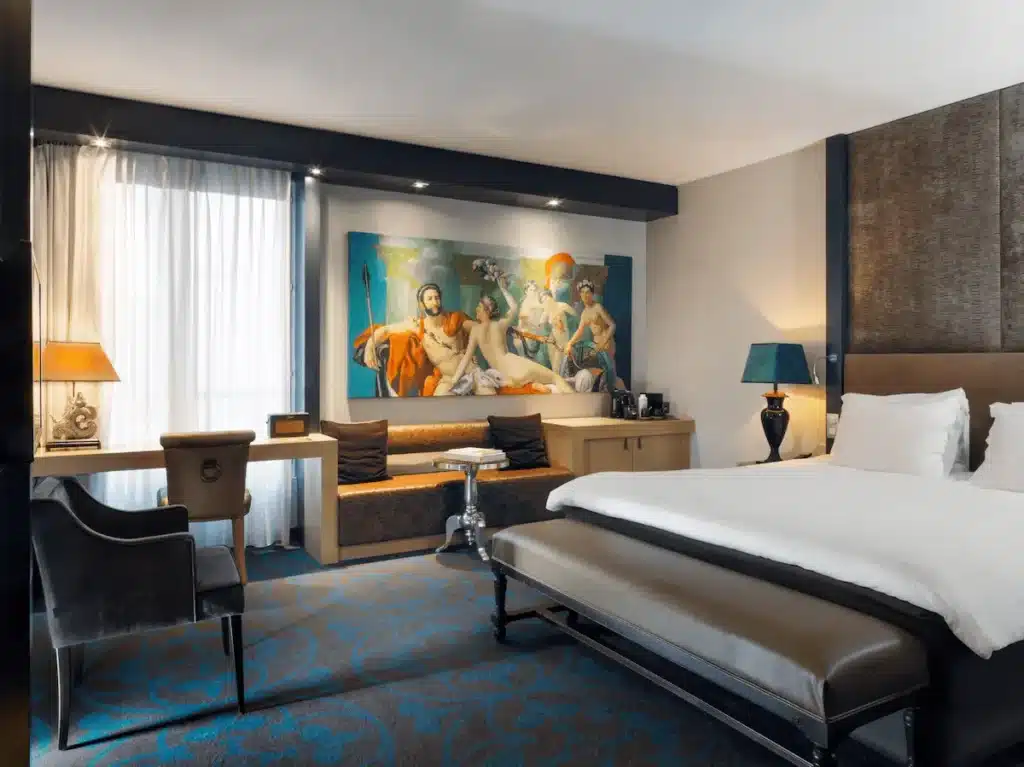
The Dominican Brussels stands on the foundations of a 15th-century Dominican abbey, where the exiled French painter Jacques-Louis David lived and died in 1825 after completing The Mars Disarmed by Venus in his final studio. The hotel preserves the original cloister layout, monastic archways, and the central courtyard where monks once walked in silent contemplation. Guests now inhabit the same stone corridors that sheltered religious scholars and a master painter who shaped European art history. For context on Brussels’ heritage properties, explore the city’s best historic hotels in Brussels.
The Dominican Brussels ★★★★
The site’s documented lineage begins in the 1400s as a fully functioning Dominican monastery, a religious center that operated continuously until the French Revolution dismantled much of the structure. The abbey’s original cloister plan survives intact: the hotel’s central courtyard follows the exact monastic footprint, enclosed by thick stone walls engineered to create acoustic isolation from the Brussels city center.
In 1816, Jacques-Louis David—Napoleon’s former court painter, exiled after the Empire’s collapse—moved into this former abbey complex. Here, in the building’s upper chambers, David established his final studio and painted The Mars Disarmed by Venus, his last major work before his death on the premises in 1825. A commemorative plaque at the entrance marks the exact location where he lived and died, anchoring the hotel to one of European art’s most significant figures.
The Dominican Brussels occupies the historic site of a 15th-century monastery and the final studio of painter Jacques-Louis David.
The 2002 renovation by FG Stijl deliberately intensified the monastic atmosphere. The design employs soaring ceilings, dark timber beams salvaged from the original structure, and iron-studded doors that replicate the weight and solemnity of abbey cells. The central courtyard functions as a private, heated inner sanctum—the same space where Dominican monks conducted their daily routines—now repurposed for al fresco dining beneath the original abbey-plan walls. The neoclassical facade added in the 19th century creates a deceptive exterior; inside, guests encounter a “cloister-style” environment where double-height spaces and sweeping monastic archways dominate the visual field.
The hotel’s 150 rooms include unique “Loft” accommodations featuring 4-meter-high ceilings and exposed timber beams from the 15th-century structure. Each room is fitted with bespoke heavy linen drapes and iron-studded doors designed to evoke a modern monastic cell. The corridors and elevators play subtle Gregorian chants—a direct sensory tribute to the Dominican monks who occupied this exact footprint for 400 years. This isn’t decorative ambiance; it’s a deliberate acoustic strategy to restore the building’s original religious atmosphere.
The Lounge Bar occupies a double-height space with velvet “confessional” seating booths and a floor-to-ceiling library stocked with art history volumes, many focused on David’s exile period. The bar’s signature cocktail menu is inspired by the botanical herbs once cultivated in the abbey’s private gardens.
The basement houses a dedicated wellness suite with a traditional Finnish sauna and hammam, carved into the building’s historic foundation.
The hotel is located directly behind the Théâtre Royal de la Monnaie, historically positioning it as a hub for performing artists and political exiles—a crossroad where religious contemplation met revolutionary culture.
Check Availability & Rates →The Dominican Brussels translates a 15th-century abbey’s silence and Jacques-Louis David’s final exile into a sanctuary where monastic discipline meets neoclassical authority, offering guests a residence defined by historical gravity and unshakeable architectural command.
FAQ: The Dominican Brussels
Did Jacques-Louis David actually live at The Dominican Brussels?
Yes. Jacques-Louis David moved into the former Dominican abbey complex in 1816 after being exiled from France following Napoleon’s fall. He established his final studio in the building’s upper chambers, where he completed The Mars Disarmed by Venus before his death on the premises in 1825. A commemorative plaque at the hotel’s entrance marks the exact location of his residence and death.
What remains of the original 15th-century Dominican abbey?
The hotel preserves the abbey’s original cloister layout, including the central courtyard footprint, sweeping monastic archways, and thick stone walls designed for acoustic isolation. The 2002 renovation incorporated salvaged timber beams from the 15th-century structure into the “Loft” rooms, and the building’s neoclassical 19th-century facade still conceals the monastic interior plan.
What makes the hotel’s design historically significant?
FG Stijl’s 2002 renovation deliberately intensified the monastic atmosphere by using soaring ceilings, dark wood, and iron-studded doors to replicate abbey cells. The central courtyard functions as it did for 400 years—a private, enclosed space where monks conducted daily routines—now repurposed for modern guests. The corridors play Gregorian chants, directly invoking the Dominican monks who occupied this exact site from the 1400s until the French Revolution.
How does the location connect to Brussels’ cultural history?
The hotel sits directly behind the Théâtre Royal de la Monnaie, historically positioning it as a meeting point for performing artists and political exiles. During David’s residence, the site served as both a refuge for a deposed court painter and a creative studio where neoclassical art was produced in the heart of Brussels’ post-revolutionary cultural scene.
Brussels’ Monastic Power Reimagined
The Dominican Brussels operates as a modern translation of a 15th-century religious institution where Jacques-Louis David painted his final masterwork in exile. The building’s preserved cloister layout, monastic archways, and commemorative plaque establish a lineage of authority that spans from Dominican monks to a revolutionary-era painter who shaped European art. Guests inhabit the same stone corridors and enclosed courtyard that defined this site’s 600-year legacy of contemplation and creative command.
For additional heritage properties where Brussels’ elite history remains physically intact, consider Hotel Amigo Brussels and Hotel Le Plaza Brussels.
For more curated itineraries and luxury-focused travel insights, visit Your Luxury Guide. For official travel information and destination updates, visit Belgium tourism-info.
Your Luxury Guide — Where Exceptional Travel Begins.