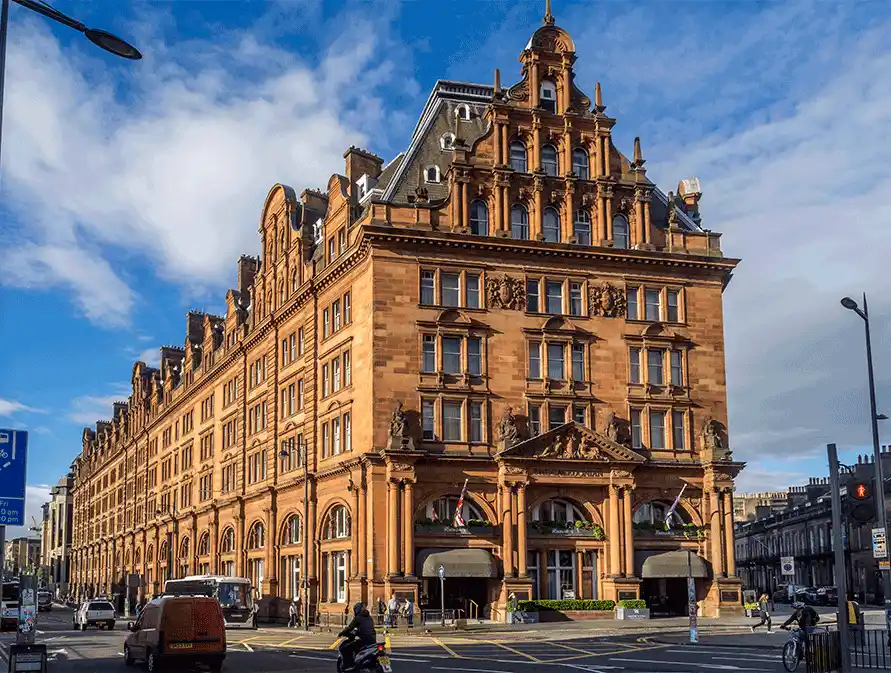
The Caledonian Edinburgh occupies Britain’s last surviving grand railway terminus hotel—a red sandstone fortress built in 1903 where station platforms once carried the Empire’s elite directly into Edinburgh’s social command structure. This is where the European Union’s founding agreement was drafted in 1992, where Hollywood royalty rode horses up marble staircases, and where today’s global travelers inhabit the exact concourse halls that once controlled Scotland’s transport power.
For those seeking Edinburgh’s deepest institutional legacy, explore our curated collection of best historic hotels in Edinburgh.
The Caledonian Edinburgh, Curio Collection by Hilton ★★★★★
The Caledonian Railway Company did not build a hotel in 1903—they constructed a vertical empire. Where Princes Street Station’s seven platforms delivered passengers beneath vaulted stone arches, the upper floors housed Scotland’s most powerful railway hotel, a structure designed by architects Peddie and Browne to project permanence through Dumfriesshire red sandstone.
This was not hospitality; this was infrastructure dressed as prestige. The building functioned as Edinburgh’s western transport gateway until 1965, when the last trains departed and the station concourse became Peacock Alley—the promenade where power still circulates today.
The Caledonian Edinburgh occupies the monumental red sandstone landmark that served as the grand 1903 terminus hotel for the Caledonian Railway, a historic social hub.
The architecture speaks in railway logistics. The grand marble staircase—famously ascended by Roy Rogers’ white horse Trigger in 1954—was engineered for crowd flow, not theatrical effect. The Hamilton & Inches station clock, salvaged from the 1890 fire that destroyed the original wooden terminus, still stands preserved, traditionally set five minutes fast to ensure no passenger missed their connection. These were operational advantages that now serve as spatial authority for guests inhabiting rooms named after Alexander Graham Bell, Arthur Conan Doyle, and Robert Louis Stevenson.
The European Union‘s legal foundation was drafted here. In 1992, the Edinburgh Agreement—the diplomatic document that formalized EU treaties—was negotiated within these walls during the European Council summit. This was the British government deploying Scotland’s most credible institutional space for continental diplomacy. The same concourse that once processed Empire passengers became the negotiating theater where modern European power structures were formalized.
Hollywood understood the building’s gravitational pull. Charlie Chaplin, Judy Garland, Marlene Dietrich, and Elizabeth Taylor all stayed at The Caledonian during its Golden Age as Britain’s premier Scottish gateway hotel. Gene Kelly performed an impromptu “Singin’ in the Rain” routine on the staircase in 1953—not as publicity stunt, but as instinctive response to the building’s theatrical scale. Roy Rogers’ 1954 horse ride up the stairs remains the property’s most audacious spatial claim: if the architecture could handle railway crowds, it could handle a Hollywood cowboy.
Today’s rooms occupy the exact footprint where Victorian railway power once operated. The Pompadour restaurant, opened in 1925 and named after Madame de Pompadour, maintains its original plasterwork and unobstructed Edinburgh Castle views—the same sight lines that made this location militarily and commercially dominant since 1903.
The Spa at The Caledonian, featuring Edinburgh’s only Guerlain-branded treatments and a 15-meter pool, is carved into the old station’s lower levels where luggage rooms and service tunnels once supported passenger flow. The Court, opened October 2024, functions as the modern iteration of Peacock Alley—live music, cocktail authority, and all-day dining within the original station concourse proportions.
Grazing by Mark Greenaway anchors the culinary program with Scotland’s terroir-driven precision. This is not farm-to-table theater; this is regional ingredient command deployed through Michelin-grade technique. The building’s red sandstone exterior remains a Category A listed landmark, its V-shaped station base still visible beneath the hotel superstructure—physical evidence that every guest room sits atop the infrastructure that once moved Scotland’s ruling class.
The Caledonian Edinburgh does not market nostalgia—it leases access to the exact location where Britain’s railway empire intersected with Edinburgh’s military geography, where European diplomacy rewrote continental law, and where Hollywood’s elite instinctively recognized spatial dominance worth inhabiting.
Check Availability & Rates →Where Britain’s railway command halls became Edinburgh’s diplomatic theater—1903 infrastructure still defining modern prestige through station clocks, castle views, and the marble stairs where Hollywood legends tested the building’s gravitational authority.
FAQ: The Caledonian Edinburgh
What makes The Caledonian Edinburgh historically significant?
The Caledonian Edinburgh was built in 1903 as Britain’s premier Scottish railway hotel, directly atop Princes Street Station’s seven platforms. It served as Edinburgh’s western transport gateway until 1965 and hosted the 1992 European Council summit where the Edinburgh Agreement—foundational to the European Union’s legal structure—was negotiated. The building’s red sandstone architecture, designed by Peddie and Browne, remains a Category A listed landmark with preserved station infrastructure including the original Hamilton & Inches clock.
Which famous figures have stayed at The Caledonian Edinburgh?
Hollywood’s Golden Age elite—Charlie Chaplin, Judy Garland, Marlene Dietrich, Elizabeth Taylor, and Gene Kelly—regularly stayed at The Caledonian during its peak as Scotland’s premier luxury hotel. Roy Rogers famously rode his horse Trigger up the marble staircase in 1954, while Gene Kelly performed an impromptu “Singin’ in the Rain” dance in 1953. The building’s institutional authority attracted both entertainment royalty and diplomatic power during the 20th century.
What are the signature dining venues at The Caledonian Edinburgh?
The Pompadour, opened in 1925 and named after Madame de Pompadour, offers fine dining with original plasterwork and unobstructed Edinburgh Castle views. Grazing by Mark Greenaway delivers Scotland’s regional ingredients through Michelin-level technique. The Court, opened October 2024 in the former station concourse, combines live music, craft cocktails, and all-day dining within the historic Peacock Alley’s soaring proportions—the original ticket hall that now serves as the hotel’s social command center.
Does The Caledonian Edinburgh still have original railway features?
Yes. The hotel preserves the Hamilton & Inches station clock that survived the 1890 fire and was traditionally set five minutes fast to prevent passengers from missing trains. Peacock Alley occupies the original station concourse with its vaulted ceilings intact. The building’s V-shaped base remains visible as the old station structure beneath the hotel superstructure. The Spa at The Caledonian is built into former luggage rooms and service tunnels where railway operations once supported passenger flow through the seven platforms below.
Edinburgh’s Railway Palace Legacy Endures
The Caledonian Edinburgh does not compete with modern luxury—it predates it through 1903 railway infrastructure that controlled Scotland’s transport power before air travel existed. This is where British institutional authority intersected with Edinburgh Castle’s military geography, where European diplomacy formalized continental law, and where Hollywood’s elite recognized spatial dominance worth inhabiting.
For travelers seeking Edinburgh’s deepest prestige rooted in verified operational history, The Balmoral Hotel and Prestonfield House offer parallel legacies where Scottish power structures remain tangible through preserved architecture and documented social command.
For more curated itineraries and luxury-focused travel insights, visit Your Luxury Guide. For official travel information and destination updates, visit Britain tourism-info.
Your Luxury Guide — Where Exceptional Travel Begins.