The Bank Hotel Istanbul doesn’t offer a themed “banking experience”—it occupies the actual 1867 headquarters of Crédit Général Ottoman, the institution where European capital first penetrated the Ottoman Empire’s financial architecture. Located on Bankalar Caddesi (Banks Street), this is the address where empires negotiated debt, where Deutsche Bank later established its eastern command, and where the Turkish Republic’s Sümerbank consolidated state banking power.
Today’s guest inhabits rooms where 19th-century financiers structured imperial loans worth millions in gold francs. Discover more properties commanding Beyoğlu’s historic district at Best Hotels in Beyoğlu Istanbul.
The Bank Hotel Istanbul ★★★★★
Antoine Tedeschi’s 1867 Neo-Renaissance masterpiece for Crédit Général Ottoman wasn’t designed to impress—it was engineered to project absolute financial authority across the Golden Horn. The building’s limestone facade, rising six stories above Bankalar Caddesi, announced European banking sophistication to an empire that had just begun borrowing on international markets.
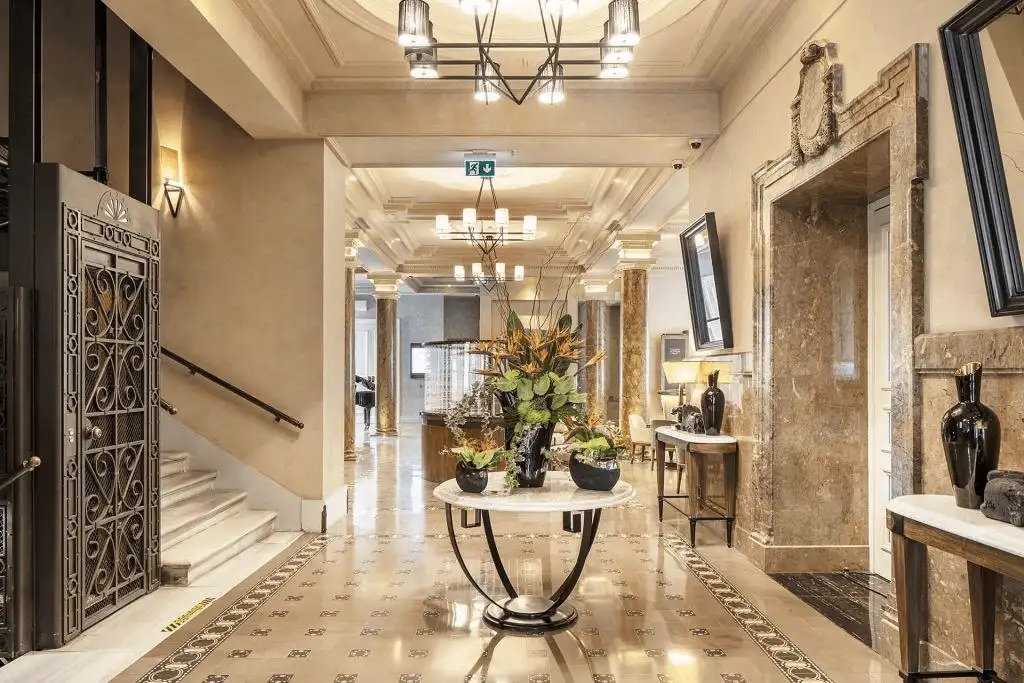
The Bank Hotel Istanbul occupies a meticulously restored 19th-century Neo-Renaissance landmark in Karaköy, where original features like antique marble and vintage banking elevators have been preserved to offer a luxury stay rooted in financial history.
When Deutsche Bank assumed control, they reinforced that authority with German-engineered steel vaults featuring two-foot-thick doors—security architecture designed for sovereign gold reserves, not hotel guests’ valuables.
Han Tümertekin’s 2014 restoration follows a singular mandate: preserve every mechanism that made this a center of Ottoman financial power. The two original vaults remain functional—one now serves as The Vault Bar, where cocktails are mixed behind the same steel door that once secured imperial bonds.
The underground wine cellar operates within the second vault, its original locking mechanism still operable. Twenty-foot ceilings and massive arched windows in the suites aren’t aesthetic flourishes—they’re the actual dimensions required for 19th-century executive banking floors where clerks processed transactions that moved millions across continents.
The lobby functions as an operational museum: restored 19th-century cash registers, mechanical calculators that computed compound interest before electricity, vintage house telephones connected to trading floors that no longer exist. Original cast-iron radiators snake along corridors of Marmara marble, the same heating system that warmed bankers during Ottoman winter negotiations.
Sinan Kafadar’s interior palette of deep banking greens and burnt currency oranges doesn’t reference wealth abstractly—these are the exact colors of Ottoman financial instruments and Deutsche Bank’s ledger systems.
The Bank Roof Bar delivers what fortress walls once prevented: 360-degree panoramic command over the Golden Horn, with sight lines extending from Hagia Sophia to Galata Tower. The rooftop wasn’t accessible to 19th-century banking staff—today’s guest enjoys visual authority the building’s original occupants never possessed.
Below, in foundations cut from Byzantine bedrock, a 24-hour gym and traditional Turkish Hammam occupy stone chambers where bank vaults once stored physical gold backing Ottoman currency.
The property’s dual heritage—Sümerbank headquarters fused with the Cemaathan Building (Neve Shalom congregation’s former community center)—creates architectural evidence of Istanbul’s multilayered financial district evolution. An in-house art curator rotates contemporary Turkish works against Tedeschi’s heavy Neo-Renaissance columns, creating deliberate friction between imperial banking solemnity and modern creative capital.
The 2014 transformation earned Design Hotels membership not through boutique styling, but by maintaining the building’s original function: projecting authority through architectural mass and preserved institutional memory.
Check Availability & Rates →You sleep in chambers where Ottoman ministers signed loans that financed railways from Vienna to Baghdad—the rooms still carry the weight of decisions that moved empires, not travelers.
FAQ: The Bank Hotel Istanbul
What makes The Bank Hotel Istanbul historically significant?
The Bank Hotel Istanbul occupies the 1867 Crédit Général Ottoman headquarters designed by Antoine Tedeschi—the first European banking institution to establish sovereign lending operations within the Ottoman Empire. The building later housed Deutsche Bank and Sümerbank, with original German-engineered steel vaults and 19th-century banking equipment preserved throughout the property.
What are the original features preserved at The Bank Hotel?
Two massive steel bank vaults with two-foot-thick doors remain operational—one functions as The Vault Bar, the other as an underground wine cellar. The property maintains original cast-iron radiators, 19th-century cash registers, mechanical calculators, vintage banking telephones, and Marmara marble corridors from its financial institution era.
What views does The Bank Roof Bar offer?
The Bank Roof Bar provides 360-degree panoramic views across the Golden Horn, with direct sight lines to both Hagia Sophia and Galata Tower—a visual command of Istanbul’s historic peninsula that the building’s original banking occupants never accessed from this fortified address.
Who designed The Bank Hotel’s restoration?
Architect Han Tümertekin led the 2014 restoration following a strict preservation principle: “Renew by keeping the original shape and protecting the artistic value.” Interior designer Sinan Kafadar created the color palette using banking greens and currency oranges that reference Ottoman financial instruments and Deutsche Bank’s ledger systems.
Where Ottoman Banking Authority Remains Operational
The Bank Hotel Istanbul proves that institutional architecture doesn’t dilute into boutique hospitality—it intensifies. When foundations were cut for 19th-century vault security and ceilings raised for executive banking operations, they created spaces that can’t be replicated through contemporary design.
Guests seeking similar preservation of financial district authority should examine Pera Palace Hotel and Soho House Istanbul, where historic architecture commands equivalent prestige across Beyoğlu’s layered urban fabric.
For more curated itineraries and luxury-focused travel insights, visit Your Luxury Guide. For official travel information and destination updates, visit Turkey tourism-info.
Your Luxury Guide — Where Exceptional Travel Begins.