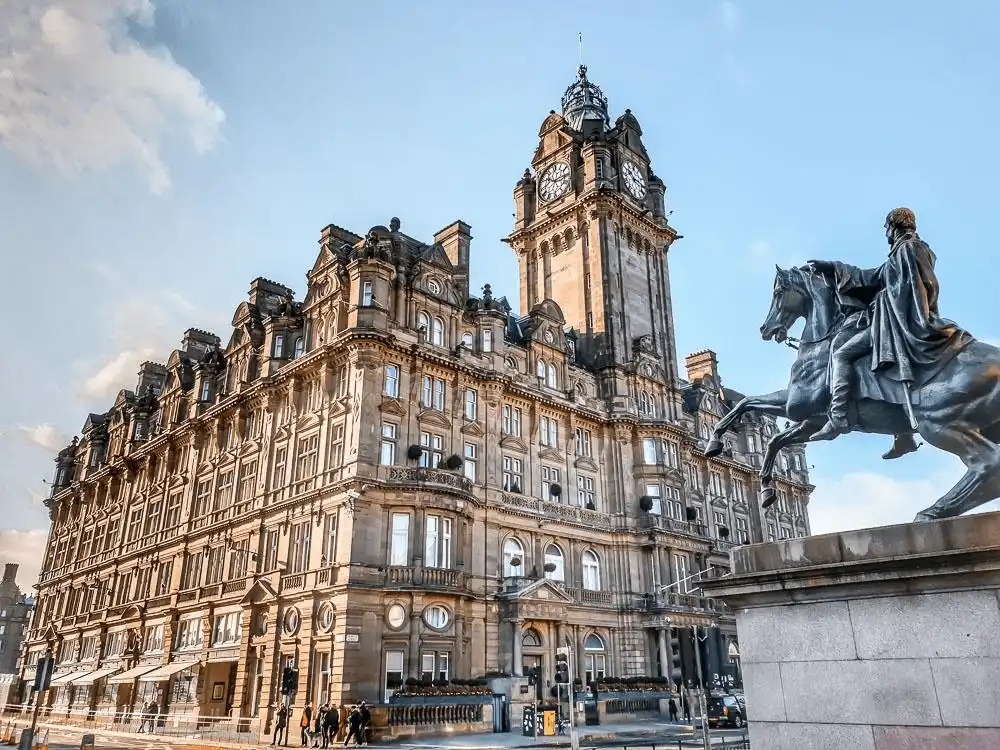
The Balmoral Hotel stands as Edinburgh’s commanding railway monument—a 190-foot clock tower that has governed the city’s timekeeping since 1902, when the North British Railway Company built this sandstone fortress to anchor their empire at Scotland’s most strategic transport junction. From Queen Elizabeth the Queen Mother’s reserved corner table to the suite where J.K. Rowling finished the world’s best-selling book series, this is not a hotel that accommodated history—this is where Scotland’s modern legends were written. Discover why discerning travelers choose best historic hotels in Edinburgh that command rather than decorate.
The Balmoral Hotel ★★★★★
William Hamilton Beattie’s 1902 masterpiece was never intended as mere accommodation—the North British Railway Company commissioned this Category B listed fortress to physically demonstrate their dominance over Scottish rail transport. Four clock faces, each 13 feet in diameter, project from the 190-foot tower that stands as one of four massive stone anchors structurally supporting North Bridge, the vital artery connecting Edinburgh’s Old and New Towns. This is architectural authority: a building designed to govern the rhythm of an entire city.
The Balmoral Hotel is a Victorian masterpiece anchoring the North Bridge, a legendary railway icon
The strategy was absolute. Red-jacketed porters once operated a dedicated lift connecting Waverley Station platforms directly to the hotel foyer—railway passengers transitioned from train carriage to suite without touching public streets. The North British Station Hotel functioned as a vertical extension of the railway empire itself, where corporate power translated into controlled luxury. Every sandstone turret, every Renaissance-inspired balcony, every element of the Scots Baronial design vocabulary reinforced a single message: this building represented command.
The 1991 transformation marked strategic rebranding, not retreat. A £23 million restoration repositioned the fortress as “The Balmoral”—Gaelic for “majestic dwelling”—with Edinburgh-born Sean Connery, who once delivered milk to this address as a young man, cutting the reopening ribbon.
The clock tower maintains its governing role: set three minutes fast year-round to prevent travelers from missing trains, corrected only once annually on Hogmanay when the entire city watches this tower to mark midnight. Edinburgh doesn’t check phones for the New Year countdown—they check The Balmoral.
Room 552 demonstrates how physical spaces absorb cultural authority. On January 11, 2007, J.K. Rowling completed Harry Potter and the Deathly Hallows in this suite, signing a marble bust of Hermes with her statement of completion—now preserved behind glass within the room. The Glamis Suite, named after Queen Elizabeth the Queen Mother’s childhood home, stocks a Shinola record player with vintage vinyl spanning jazz to rock, a deliberate acknowledgment of Her Majesty’s frequent visits to her favored corner table in the hotel restaurant.
SCOTCH Whisky Bar houses over 500 single malts representing every current and several closed distilleries across Scotland—a liquid archive of national production. Palm Court, beneath its glass dome and Venetian chandelier, operates as Edinburgh’s definitive Afternoon Tea venue with resident harpist, while Brasserie Prince translates the Auld Alliance between Scotland and France through Martin Brudnizki’s design vocabulary.
The 15-meter subterranean pool in The Balmoral Spa references the Forte family’s Mediterranean heritage, yet the Scone & Crombie Suite—the property’s largest signature accommodation—offers floor-to-ceiling command of the Old Town skyline reserved for heads of state.
The Scent Butler service reveals operational sophistication: guests select signature fragrances while learning Scotland’s olfactory history. Signature suite guests discover their initials embroidered onto pillows—permanent souvenirs of inhabiting authority. This sandstone fortress doesn’t offer historic atmosphere—it offers documented lineage where railway power, royal preference, and literary completion converged to establish Edinburgh’s most commanding address.
Check Availability & Rates →The Balmoral’s clock tower has governed Edinburgh’s rhythm for 122 years—three minutes fast to command the city’s schedule, corrected only once annually when Scotland watches this single building to mark the New Year. This is not heritage hospitality. This is architectural authority where guests inhabit the same stone corridors where railway empires were directed, where the Queen Mother reserved her table, where the world’s best-selling book series reached completion.
FAQ: The Balmoral Hotel
Why is The Balmoral Hotel’s clock tower set three minutes fast?
Since 1902, the 190-foot clock tower has been deliberately set three minutes ahead of GMT to prevent travelers from missing trains at adjacent Waverley Station. The only exception occurs on Hogmanay (New Year’s Eve) when the clock is corrected to actual time, serving as Edinburgh’s official countdown for citywide celebrations—the entire city watches this single building to mark midnight.
What is the significance of Room 552 at The Balmoral?
Room 552 is where J.K. Rowling completed Harry Potter and the Deathly Hallows on January 11, 2007. She signed a marble bust of Hermes with her statement of completion, which is now displayed behind glass within the suite. The room represents documented literary authority—the physical location where the world’s best-selling book series reached conclusion.
What was the original purpose of The Balmoral Hotel?
The North British Railway Company commissioned architect William Hamilton Beattie to design the North British Station Hotel in 1902 as a vertical extension of their railway empire. Red-jacketed porters operated a dedicated lift connecting Waverley Station platforms directly to the hotel foyer, allowing railway passengers to transition from train to suite without using public streets—this was corporate architecture designed to demonstrate transport dominance.
How many single malt whiskies are available at The Balmoral’s SCOTCH Bar?
SCOTCH Whisky Bar houses over 500 single malts representing every current Scottish distillery and several closed operations—a complete liquid archive of Scotland’s whisky production. The collection functions as both beverage service and documented national heritage, offering guests access to expressions no longer in commercial production.
Where Edinburgh’s Railway Empire Became Royal Legacy
The Balmoral’s 190-foot clock tower continues governing Edinburgh’s rhythm not through technological superiority but through 122 years of uninterrupted authority—the city’s only building trusted to mark the New Year. This sandstone fortress demonstrates how physical architecture translates corporate power into permanent cultural command.
Travelers seeking Scotland’s documented railway heritage, explore The Scotsman Hotel and The Caledonian Edinburgh.
For more curated itineraries and luxury-focused travel insights, visit Your Luxury Guide. For official travel information and destination updates, visit Britain tourism-info.
Your Luxury Guide — Where Exceptional Travel Begins.