The Telegraphenamt Berlin occupies Max Lehmann’s 1910–1916 Imperial Main Telegraph Office—Germany’s most expensive postal building and the nerve center of early 20th-century German communications. This Neo-Baroque fortress once commanded a 400km pneumatic tube network spanning Berlin, operated through two World Wars and the GDR era until 1977.
Today, seven maisonette suites with 5-meter ceilings and the subterranean Rohrpostbar preserve the architectural authority of a building designed to control information at the scale of empire. Guests inhabit the physical infrastructure where state communication power was engineered and executed.
Telegraphenamt Berlin ★★★★★
Max Lehmann’s 1916 completion established a Neo-Baroque monument to technological dominance. The Haupttelegraphenamt was not simply a post office—it was the central node for German radio and telegraph communications, a building whose pneumatic tube system represented one of Europe’s most sophisticated message-routing infrastructures.
The 400km Rohrpost network connected government ministries, military command posts, and commercial centers through pressurized cylinders moving at speeds that eliminated courier delays. This was communication architecture at imperial scale.
Telegraphenamt Berlin is a meticulously restored Neo-Baroque landmark that transforms Germany’s former central telegraph office into a cosmopolitan retreat featuring preserved pneumatic tube systems and soaring industrial-chic interiors.
The natural stone facade and sweeping arched windows announced institutional permanence. Inside, barrel-vaulted ceilings sheltered rows of telegraph operators managing transmissions that directed military movements, financial transactions, and diplomatic correspondence.
The building functioned through the chaos of both World Wars—its communication lines too vital to be permanently severed. When the GDR assumed control, the technical systems continued uninterrupted until 1977, making the Telegraphenamt one of the longest-operating heritage communication centers in European history.
Roland Mary’s 2022 conversion with Dreimeta preserved the structural evidence of this operational past. The seven maisonette suites maintain the original 5-meter ceiling heights, with floor-to-ceiling windows that capture the building’s institutional proportions. These are not rooms scaled to domestic comfort—they are spaces designed for command visibility, where every sightline reinforced the building’s function as an observation point over Berlin’s information flow.
The Rohrpostbar occupies the basement vault behind steel security doors, its original pneumatic dispatch tubes now integrated as historical artifacts within a working bar. Guests descend into the physical infrastructure that once routed state communications, where the exposed brickwork and preserved “shoots” (tube outlets) map the underground geography of imperial message transmission. These are the actual engineering spaces where communication speed determined political advantage.
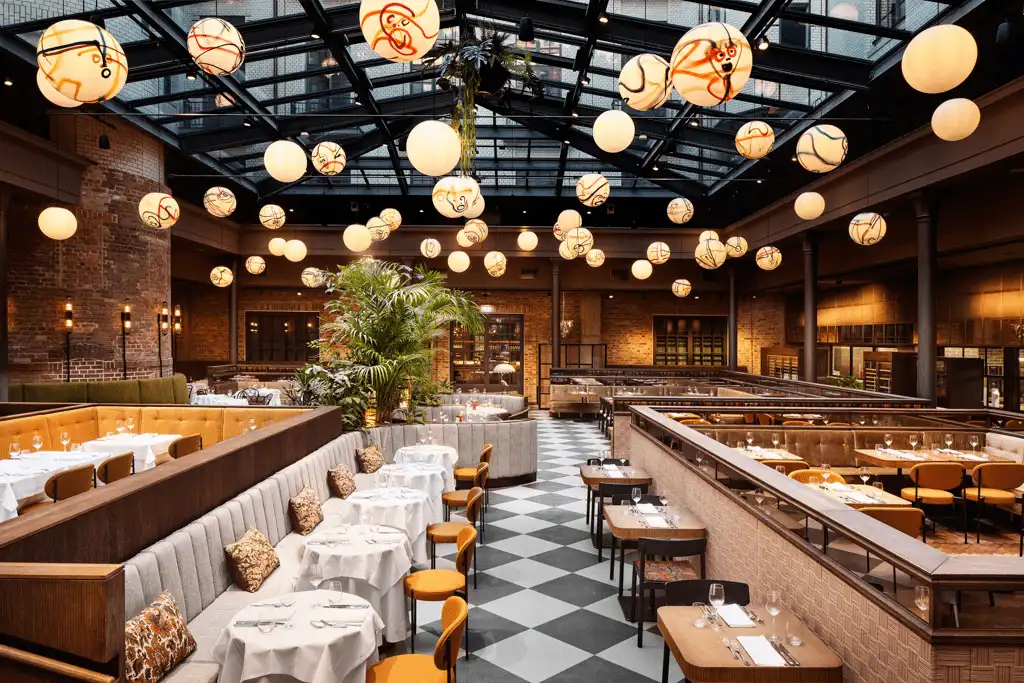
Root Restaurant sits beneath a glass orangery roof in the former interior courtyard, a light-filled space that once served as the building’s operational heart. The 1920s Berlin and the Arts and Crafts design language honors the interwar period when the Telegraphenamt transitioned from imperial to republican service, maintaining its technical authority through regime changes that destroyed lesser institutions.
The 1,200 m² wellness area with sauna and treatment rooms occupies spaces originally dedicated to technical maintenance—where engineers serviced the pneumatic compressors and relay systems that kept Berlin connected. Guests now access amenities within rooms that once hummed with machinery designed to compress, route, and deliver information faster than human messengers could traverse the city.
The Forum an der Museumsinsel positioning places guests within walking distance of Berlin’s concentrated museum quarter, but the Telegraphenamt’s significance extends beyond proximity. This building defined communication infrastructure before digital networks, when physical architecture and pneumatic engineering determined who controlled the flow of intelligence.
The restoration preserves not just aesthetic grandeur but operational evidence—the tube shoots, the vaulted dispatch rooms, the steel doors that secured state secrets.
Every suite, every preserved dispatch tube, every barrel vault ceiling documents the physical reality of communication power in an age when controlling message speed meant controlling political outcomes. The Telegraphenamt Berlin offers residence within the architectural proof that information dominance has always required fortified space, engineered systems, and institutional permanence that outlasts the governments it served.
Check Availability & Rates →To occupy the Telegraphenamt is to inhabit the literal infrastructure of state communication—where Neo-Baroque permanence and pneumatic precision engineered the velocity of power itself, preserved now as residence for those who understand that command always required fortress-scale architecture and uninterrupted operational discipline across empires, wars, and revolutions.
FAQ: Telegraphenamt Berlin
What was the original function of the Telegraphenamt Berlin?
The Telegraphenamt served as the Imperial Main Telegraph Office (Haupttelegraphenamt) from 1916, functioning as the central hub for German radio and telegraph communications. It housed one of Europe’s largest pneumatic tube networks, spanning 400km across Berlin, which enabled rapid message transmission between government, military, and commercial centers. The building remained operational through both World Wars and continued under GDR administration until 1977.
What architectural features define the Telegraphenamt Berlin hotel?
Max Lehmann’s 1910–1916 Neo-Baroque design features a natural stone facade, sweeping arched windows, and barrel-vaulted ceilings. The seven maisonette suites preserve original 5-meter ceiling heights with floor-to-ceiling windows. Exposed original brickwork and preserved pneumatic tube “shoots” throughout public spaces document the building’s communication infrastructure history.
What is the Rohrpostbar at Telegraphenamt Berlin?
The Rohrpostbar occupies the original basement vault behind heavy steel security doors, where the pneumatic tube system’s dispatch mechanisms were housed. Original telegraph tubes and engineering infrastructure remain integrated as working design elements, allowing guests to experience the physical spaces where Berlin’s 400km message network was routed and controlled from 1916 through 1977.
Who designed and restored the Telegraphenamt Berlin?
Government architect Max Lehmann designed the original 1910–1916 Neo-Baroque structure as Germany’s most expensive postal building. The 2022 hotel conversion was executed by Dreimeta interior design, drawing influence from 1920s Berlin aesthetics and the Arts and Crafts movement, while restaurateur Roland Mary (owner of Berlin’s Borchardt restaurant) conceptualized the heritage hotel transformation.
Where Imperial Infrastructure Becomes Residence
The Telegraphenamt Berlin preserves the architectural authority of state-scale communication command—where pneumatic precision and Neo-Baroque permanence engineered the flow of power across an empire. Guests inhabit the proven infrastructure of institutional dominance, within sight of Berlin’s museum quarter and within the physical proof that controlling information has always required fortress-grade architecture and engineering systems designed to outlast regimes.
Continue exploring Hotel de Rome Berlin and Das Stue Berlin.
For more curated itineraries and luxury-focused travel insights, visit Your Luxury Guide. For official travel information and destination updates, visit Germany tourism-info.
Your Luxury Guide — Where Exceptional Travel Begins.