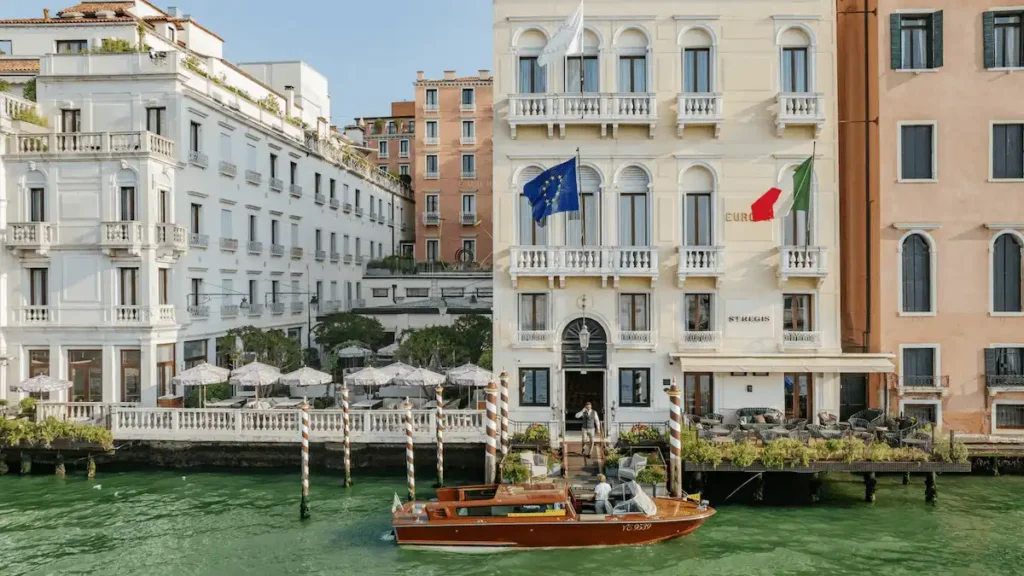
St. Regis Venice is the only hotel in the city built from the strategic merger of five separate 17th-century palaces, creating the largest privately controlled waterfront on the Grand Canal—a scale of dominance legally impossible to replicate today. Anchored by Palazzo Badoer Tiepolo, the ancestral seat of a founding Apostolic family that produced multiple Doges, this property occupies the physical ground where Vivaldi premiered operas at Teatro Sant’Angelo and where Monet spent ten weeks capturing his most famous Venetian light studies. You’re inhabiting the exact command center where Venice’s global trade empire was directed.
St. Regis Venice ★★★★★
This is not a curated collection of old buildings—this is the deliberate consolidation of five separate palaces (Badoer Tiepolo, Barozzi, Regina, Europa, and Ca’ Nova) into a single operational estate that controls the longest uninterrupted stretch of private Grand Canal waterfront in the San Marco district.
The core structure, Palazzo Badoer Tiepolo, was the residential seat of one of Venice’s twelve founding “Apostolic” families, a bloodline that held repeated executive power as Doges and financed the artists who defined the Venetian Renaissance. When you walk these hallways, you’re moving through the literal decision-making corridors where maritime trade routes were negotiated and diplomatic alliances sealed.
St. Regis Venice is a prestigious five-palazzo residence that offers the city’s largest private waterfrontage on the Grand Canal, providing a light-filled 17th-century interior built upon the 1676 foundations of the Teatro Sant’Angelo.
The property’s cultural authority is embedded in its physical footprint. Part of the hotel occupies the site of the 1676 Teatro Sant’Angelo, the specific venue where Antonio Vivaldi held the position of maestro di violino and premiered his operas to the Republic’s elite. In 1908, Claude Monet arrived and used the hotel’s Grand Canal terraces as his open-air studio for ten weeks, producing the light studies that became his most celebrated Venetian series—the exact vantage points he painted from are still accessible to guests today. This is the physical infrastructure where culture was created and controlled.
The modern intervention respects this legacy while eliminating the operational compromises of historic properties. During its comprehensive 2017–2019 conversion, the entire five-palazzo complex was structurally reinforced and fitted with a silent, multi-zone HVAC system and fiber-optic backbone, making it the only 17th-century Venetian structure operating with full climate and connectivity stability.
All 163 rooms were interior-designed using a chromatic palette technically modeled after the light frequencies Monet captured in his 1908 studies, ensuring the interior atmosphere reflects the natural shifts of Grand Canal light from dawn to dusk. The St. Regis Butler—a 24/7 professional service standard for all keys, not just suites—provides garment pressing, packing, and in-room delivery as baseline utility, the kind of operational precision the founding Apostolic families would have deployed in their own households.
The waterfront dining at Gio’s offers dual-aspect sightlines: direct views across to the Santa Maria della Salute Basilica and down the full length of the Grand Canal, a strategic visual command no other San Marco restaurant can provide. The Arts Bar functions as the city’s primary social hub during the Biennale, attracting the global art-collecting class who treat it as their unofficial headquarters.
The acoustic rose garden—a rare, high-walled Italianate space that predates the hotel’s 1895 founding as the Grand Hotel Britannia—provides total residential silence exactly four minutes’ walk from the Piazza San Marco crowds, a spatial luxury that reflects the original families’ understanding of urban power positioning.
The hotel installed Venice’s first high-speed electric boat charging pier, supporting zero-vibration private water limousine transfers—a silent, health-conscious alternative to diesel vaporetto transit. Every social interaction, from the garden Spritz Trolley to afternoon tea service, uses vessels from the Ginori 1735 partnership, Italy’s most prestigious porcelain house, maintaining the material standards the Badoer Tiepolo family would have expected in their own diplomatic receptions.
The daily Sabrage ceremony—Champagne sabering in the garden—functions as a high-value networking event where the hotel’s international guest base congregates, continuing the property’s 400-year role as a social command center for Venice’s global elite.
Check Availability & Rates →Five palaces merged into one command estate—this is the physical infrastructure where the Venetian Republic directed its maritime empire, where Vivaldi premiered operas, and where Monet captured light that still defines how the world sees Venice.
FAQ: St. Regis Venice
What makes St. Regis Venice historically significant?
St. Regis Venice is the only hotel created from the strategic merger of five separate 17th-century palaces, anchored by Palazzo Badoer Tiepolo, the ancestral seat of a founding Apostolic family that produced multiple Doges. Part of the property occupies the site of the 1676 Teatro Sant’Angelo, where Antonio Vivaldi premiered his operas, and the terraces were used by Claude Monet as his studio during his famous 1908 residency, making it a verified landmark in both musical and visual art history.
Does St. Regis Venice have modern infrastructure despite its historic age?
Yes. During its multi-million euro conversion, the entire five-palazzo complex was structurally reinforced and fitted with a silent, multi-zone HVAC system and fiber-optic backbone, making it the only 17th-century Venetian property operating with full climate control and connectivity stability. The hotel also installed Venice’s first electric boat charging pier for zero-vibration private water transfers.
What guest services are unique to St. Regis Venice?
Unlike competitors who reserve butler service for suites, St. Regis Venice provides 24/7 professional butler service as a standard utility for all 163 keys, including garment pressing, packing, and in-room delivery. The property also maintains a partnership with Ginori 1735, Italy’s most prestigious porcelain house, ensuring all social interactions—from the garden Spritz Trolley to afternoon tea—use high-jewelry standards of service vessels.
What is the cultural significance of the hotel’s location?
The hotel controls the largest private waterfront on the Grand Canal and occupies the site of Teatro Sant’Angelo, the specific venue where Vivaldi held his maestro position and premiered operas to the Venetian elite. The terraces provided the exact vantage points for Monet’s 1908 Venetian light studies, and the property served as the official residence for Queen Elena of Montenegro in the 1930s, cementing its role as the mandatory base for European heads of state and cultural influencers.
The Waterfront Estate Where Venice’s Executive Power Resided
St. Regis Venice is the consolidation of five palaces into a single operational estate that commanded the Republic’s most strategic waterfront position. You’re inhabiting the physical seat where maritime trade routes were negotiated, where Vivaldi premiered operas to the ruling class, and where Monet captured the light that still defines Venice in the global imagination. The Apostolic families understood that control of space equals control of influence, and this property remains the city’s most complete expression of that principle.
Explore parallel estates that defined Venice’s Golden Age, Gritti Palace Venice and Londra Palace Venice.
For more curated itineraries and luxury-focused travel insights, visit Your Luxury Guide. For official travel information and destination updates, visit Italy tourism.
Your Luxury Guide — Where Exceptional Travel Begins.