Spa Hotel Imperial stands as Karlovy Vary’s most commanding architectural statement—a 1912 neo-Renaissance palace engineered with the first poured concrete structure in Czech territory. Perched on Imperial Hill within a 50,000-square-meter private park, this fortress-scale estate was built to host the Rothschilds, Russian Grand Dukes, and international diplomatic summits requiring absolute security.
Today, its underground funicular delivers guests directly from the hilltop sanctuary to the spa colonnades below, bypassing the pedestrian crowds. The 205-room palace operates as a certified medical facility with on-site specialists, four professional tennis courts, and 1,600 square meters of balneological treatment spaces. This is a seat of authority where geopolitics and high society converged for over a century.
Spa Hotel Imperial ★★★★★
The scale announces dominance before you pass the gates. Spa Hotel Imperial was engineered in 1912 by French architect Ernest Hébrard not as accommodation, but as a diplomatic fortress—a Belle Époque stronghold where European power brokers could convene beyond public reach. Its hilltop position on Imperial Hill provided military-grade security, its 50,000-square-meter wooded estate ensured surveillance-proof privacy.
Revolutionary for its era, it was the first structure in Czech lands built entirely with poured concrete, allowing Hébrard to execute palace-scale proportions with structural integrity unmatched by brick or stone.
Spa Hotel Imperial is the definitive hilltop sanctuary for medical wellness, offering elite travelers a private funicular entrance, professional-grade tennis facilities, and a world-class thermal clinic focused on long-term health optimization.
The building’s purpose was explicit: host the families who controlled European finance and the statesmen who negotiated continental treaties.
The Rothschild dynasty occupied entire floors. Russian Grand Dukes held private consultations in the frescoed drawing rooms. Throughout the 20th century, the Imperial served as the primary venue for high-level international diplomatic summits, its location and infrastructure purpose-built for delegates requiring absolute operational security. The grand Neo-Renaissance halls were not designed for leisure—they were designed for power concentration.
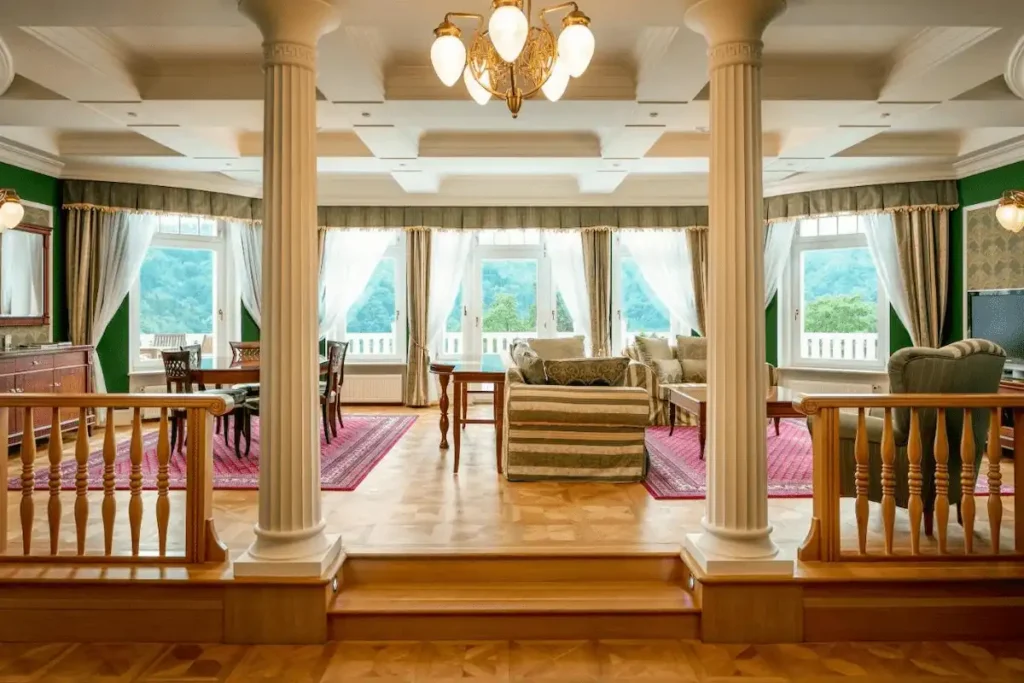
The Presidential Suite occupies the palace’s most strategic vantage: expansive windows command unobstructed views across the Teplá River valley and the lower spa town. High ceilings and original architectural details establish immediate spatial authority. Across 205 rooms and suites, the estate maintains the architectural language of command hierarchy—public halls scaled for state functions, private wings designed for confidential negotiations.
Modern utility is total. The private underground funicular is not a novelty; it is a tactical advantage. Guests bypass the congested pedestrian spa zone entirely, arriving directly at the historic colonnades via exclusive rail transport. The estate’s certified medical facility operates with a permanent team of on-site doctors specializing in digestive and metabolic disorders—access to high-level diagnostic care without leaving the property.
The 1,600-square-meter Imperial Spa Center delivers over 60 therapeutic balneological treatments, anchored by a large indoor pool and dedicated sauna complex.
The Sportcentrum Imperial reinforces the estate’s self-contained utility: four professional tennis courts, year-round indoor sports facilities, and a high-specification fitness center designed for guests maintaining performance-level conditioning. The social infrastructure mirrors the building’s original diplomatic function.
Café Vienna operates as the city’s central gathering point for local elite and international guests—live music, Viennese pastries, and the atmosphere of negotiation over coffee that defined Central European power culture. The grand halls host high-society galas and international summits with unchanged frequency.
Restaurant Prague delivers grand-scale gourmet dining in rooms built for state banquets. Restaurant Paris focuses on refined French à la carte service in more intimate chambers. The estate’s private forest paths provide immediate access to panoramic viewpoints over the entire Karlovy Vary valley—secured walking routes where privacy is absolute. Large-scale private parking and shuttle services eliminate the logistical friction of the lower town’s pedestrian restrictions.
This is not heritage repurposed for tourism. Spa Hotel Imperial remains what it was built to be: a seat of command where Europe’s most consequential figures have exercised authority. The guest does not visit history—they inhabit the spatial language of power that defined a century of continental diplomacy.
Check Availability & Rates →Imperial Hill was never about wellness tourism—it was engineered as the continent’s most secure gathering point for those who required total operational privacy. The funicular, the forest perimeter, the concrete fortress structure: this is architecture that understood power concentration. A guest here occupies the same strategic vantage the Rothschilds and Russian Grand Dukes considered essential.
FAQ: Spa Hotel Imperial
What makes Spa Hotel Imperial historically significant?
Built in 1912 as the first poured concrete structure in Czech territory, Spa Hotel Imperial was designed by French architect Ernest Hébrard as a diplomatic fortress on Imperial Hill. It hosted the Rothschild family, Russian Grand Dukes, and served as the primary venue for high-level international summits throughout the 20th century due to its secured hilltop position and 50,000-square-meter private estate.
Does Spa Hotel Imperial have a private funicular?
Yes. The hotel operates an underground private funicular that provides guests with exclusive, direct transport from the hilltop estate down to Karlovy Vary’s historic spa colonnades, bypassing pedestrian traffic entirely. This tactical infrastructure was built to ensure privacy and logistical superiority for diplomatic guests.
What medical services are available at Spa Hotel Imperial?
The hotel operates as a fully certified medical facility with a permanent team of on-site doctors specializing in digestive and metabolic health. The 1,600-square-meter Imperial Spa Center offers over 60 balneological treatments, supported by diagnostic care that eliminates the need to leave the property.
What sports facilities does Spa Hotel Imperial offer?
The Sportcentrum Imperial features four professional tennis courts, a high-specification fitness center, and year-round indoor sports facilities designed for performance-level conditioning. The estate’s private forest paths provide immediate access to panoramic viewpoints and secured walking routes across the 50,000-square-meter grounds.
Imperial Authority in Karlovy Vary
Since 1912 , Spa Hotel Imperial has operated as the city’s uncontested seat of command—a fortress-scale estate where diplomatic summits, financial dynasties, and high society have converged under conditions of absolute privacy. The hilltop position, the concrete palace structure, the underground funicular: this is architecture that understood power concentration before the word “luxury” became a marketing term.
Guests seeking equivalent historical gravity should examine Grandhotel Pupp and Carlsbad Plaza, both anchoring the city’s Belle Époque legacy within the lower spa district.
For more curated itineraries and luxury-focused travel insights, visit Your Luxury Guide. For official travel information and destination updates, visit Czechia tourism.
Your Luxury Guide — Where Exceptional Travel Begins.