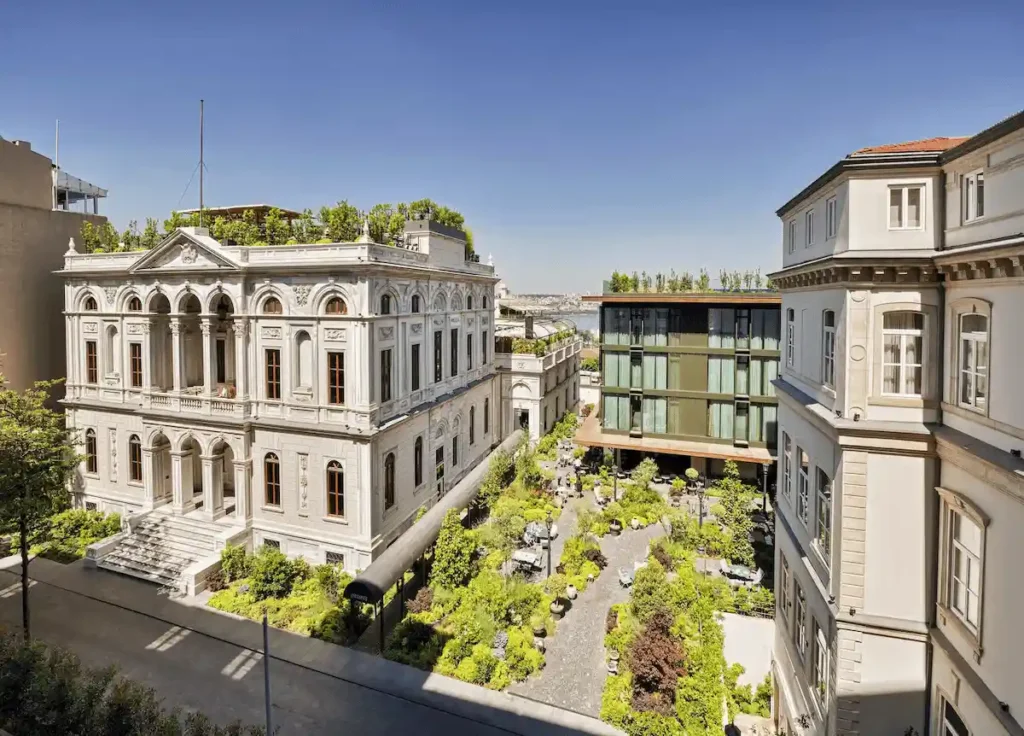
Soho House Istanbul occupies Palazzo Corpi, an 1873 neoclassical landmark that once anchored Beyoğlu’s diplomatic quarter. Originally built as a residential palazzo for European nobility during the Ottoman Empire’s modernization era, the building commanded Istiklal Avenue when this district served as Constantinople’s western embassy row. The palazzo’s Italianate facade—commissioned during Sultan Abdülaziz’s reign—represented the architectural ambitions of a city straddling continents and empires.
Today, this members-only house continues that legacy of exclusivity, transforming 19th-century salons into private working spaces where global creative elites inhabit the same halls once reserved for consuls and merchant princes.
Soho House Istanbul ★★★★★
The 1873 Palazzo Corpi represents Beyoğlu’s most significant period of European influence—when this hillside district evolved from Ottoman Christian quarter into the empire’s cosmopolitan nerve center. Giuseppe Corpi, an Italian merchant with trading concessions throughout the Levant, commissioned this neoclassical residence to project permanence in a city undergoing radical transformation.
Soho House Istanbul is anchored by the 1873 Palazzo Corpi, a stunning former embassy where original frescoes and Carrara marble provide a historic backdrop to the city’s most vibrant creative hub.
The palazzo’s rusticated ground floor and pilastered upper stories followed Genoese palazzo precedents, while its interior staircase—preserved under Soho House ownership—deployed Carrara marble imported specifically to signal membership in Constantinople’s merchant aristocracy.
The 87 bedrooms occupy former residential floors where trading families once maintained seasonal quarters. Rooms feature the palazzo’s original ceiling heights—4.2 meters in piano nobile suites—creating spatial volume rarely available in modern construction. Heritage windows overlook either Istiklal Avenue’s pedestrian flow or internal courtyards that buffered the building from the Ottoman city’s density.
The rooftop pool and terrace command views across the Golden Horn to Topkapı Palace, positioning guests within the exact sightlines that made this hillside valuable to 19th-century observers monitoring maritime traffic through the Bosphorus.
The Cowshed spa occupies basement vaults—original storage cellars adapted with modern thermal systems.
Ground-floor dining spaces retain the palazzo’s enfilade layout, where sequential salons once hosted the commercial negotiations that funded the building’s construction.
Membership requirements filter access to maintain the exclusivity Palazzo Corpi represented in 1873—when only families with verified trading licenses or diplomatic credentials inhabited this address. The building functions as it always has: a private enclave where decision-makers occupy heritage architecture that signals authority through scale, materials, and controlled entry.
Check Availability & Rates →Within Palazzo Corpi’s neoclassical walls, Soho House Istanbul preserves the spatial authority of 19th-century merchant power—where vaulted salons, Carrara staircases, and commanding hillside position continue establishing hierarchy through architecture rather than signage.
FAQ: Soho House Istanbul
What historical building houses Soho House Istanbul?
Soho House Istanbul occupies Palazzo Corpi, an 1873 neoclassical residence built for Italian merchant Giuseppe Corpi during the Ottoman Empire’s late modernization period. The palazzo served Beyoğlu’s European diplomatic and commercial community before its 2015 conversion into a members’ club.
Can non-members stay at Soho House Istanbul?
Rooms at Soho House Istanbul require either Soho House membership (Any House, Local, or Cities Without Houses tiers) or invitation by an existing member. This access structure maintains the building’s historical function as a space reserved for verified commercial and creative elites.
What original architectural features remain from Palazzo Corpi?
The neoclassical facade, Carrara marble main staircase, 4.2-meter ceiling heights in piano nobile rooms, heritage window proportions, and basement vaulting all survive from the 1873 construction. Soho House’s restoration preserved these elements while inserting modern infrastructure.
How does Soho House Istanbul’s location reflect its historical importance?
Palazzo Corpi’s position on Istiklal Avenue placed it within Beyoğlu’s 19th-century diplomatic quarter—the neighborhood where European powers maintained consulates during the Ottoman period. The building’s hillside elevation provided strategic views of Golden Horn maritime traffic, enhancing its value to commercial observers.
The Palazzo Standard
Soho House Istanbul continues Palazzo Corpi’s legacy as Beyoğlu’s definitive address for those who operate through networks rather than publicity—where membership in a physical space grants access to the same authority architecture once conferred on merchant princes navigating Ottoman trade routes.
The building’s 1873 foundations support a contemporary hierarchy structured by invitation, creative output, and verified professional standing.
For additional verified historic properties commanding Istanbul’s historic waterfront, explore Pera Palace Hotel and The Bank Hotel Istanbul.
For more curated itineraries and luxury-focused travel insights, visit Your Luxury Guide. For official travel information and destination updates, visit Turkey tourism-info.
Your Luxury Guide — Where Exceptional Travel Begins.