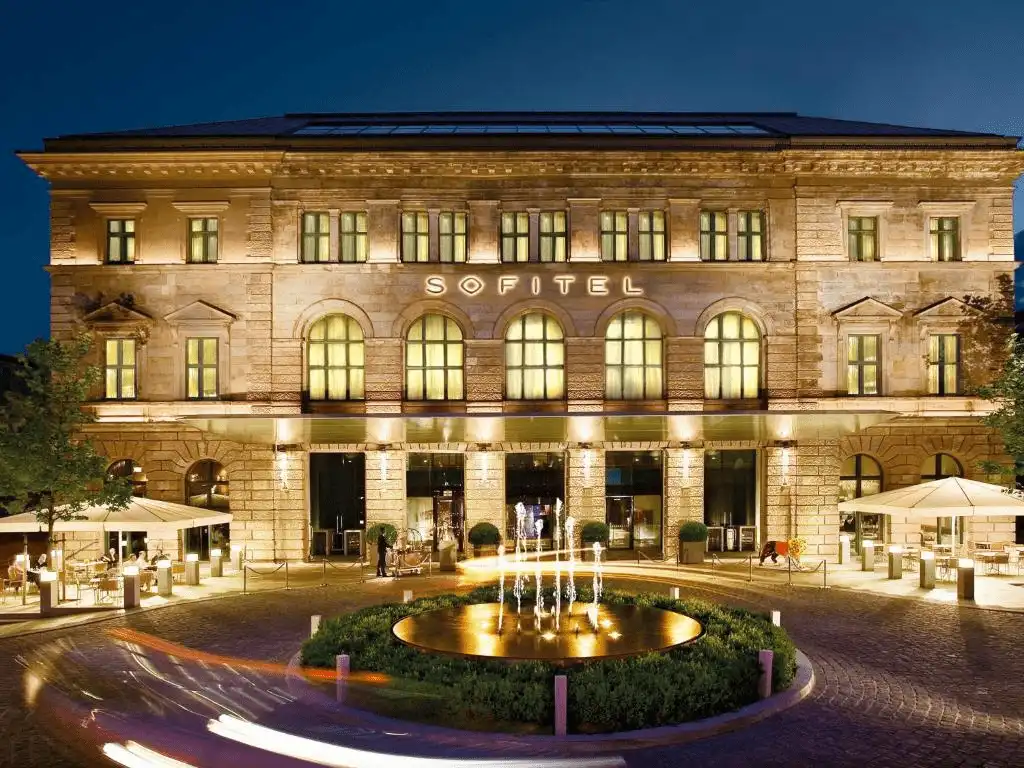
Sofitel Munich Bayerpost occupies the former Royal Bavarian Main Post Office, constructed between 1896 and 1900 as the Kingdom of Bavaria’s most critical communications hub. Unlike any other German region, Bavaria operated an independent postal system until 1920, and this Neoclassical sandstone fortress served as its nerve center. Today, a 27-meter-high atrium pierces through the gutted interior, while the listed facade preserves the architectural authority of the Wittelsbach era.
For travelers seeking accommodations where 19th-century state power meets radical modern luxury, explore the best historic hotels in Munich.
Sofitel Munich Bayerpost ★★★★★
Between 1896 and 1900, architects raised a Neoclassical sandstone colossus to house the Royal Bavarian Main Post Office—the Hauptpostamt—on Munich’s central avenue. This was not mere infrastructure. Bavaria alone among German states maintained full postal sovereignty until 1920, and this building was the Kingdom’s communications fortress.
Every telegram, every imperial dispatch, every cross-border parcel passed through these halls. The Italian High Renaissance facade—with its ordered arcades and monumental proportions—projected technological dominance to rival powers across Europe.
Sofitel Munich Bayerpost is a breathtaking fusion of history and avant-garde design, housed within the former Royal Bavarian Post Office where guests can retreat to the grotto-like So SPA or enjoy French fine dining steps from Munich’s Central Station.
The building operated as a post office until 1993. Then silence. A decade of vacancy followed until Accor’s architects Fred Angerer and Gerald Hadler executed a surgical transformation: the entire interior was gutted, leaving only the protected shell. In its place, they inserted a 27-meter-high atrium—a glass-and-steel void that now functions as the hotel’s gravitational center. The contrast is absolute: 19th-century authority meets 21st-century spatial violence.
Harald Klein’s interior design framework is termed “Avant-Garde.” The materials palette—chrome, colored glass, natural stone—avoids any nostalgia for postal heritage. Instead, the 396 rooms and suites are divided into thematic categories: “Salon Bohème” and “Salon Littérature,” direct references to Munich’s 1920s intellectual salons where writers, artists, and Weimar-era disruptors gathered. You inhabit the aesthetic lineage of Munich’s creative elite, not its bureaucratic past.
The north wing no longer exists in original form. A modern multi-story addition replaced it, and half the accommodations now occupy this new structure. Floor-to-ceiling windows frame views across Munich’s skyline toward the Alps—a geographic advantage that transforms the stay into a territorial vantage point.
The “Oyster” Suite is the property’s spatial anomaly. A 6-meter-high volume designed to resemble the interior of an oyster shell: purple-washed walls, white Corian furniture, sculptural curves. It functions as a private chamber where form overwhelms function—luxury as pure spatial gesture.
Below grade, the So SPA & Grotto Pool occupies 800 square meters. The swimming pool twists through dark, mosaic-tiled walls designed to evoke subterranean grottoes. The aesthetic is deliberate: ancient Roman baths reimagined with contemporary minimalism. You descend from the postal command center into a sensory void.
DÉLiCE La Brasserie holds a “Toque” from Gault&Millau. The menu is French but executed with Munich’s obsessive precision—think modern interpretations of cassoulet, tarte Tatin deconstructed with local apples, foie gras terrines that respect both tradition and Bavarian terroir. The Isarbar, adjacent to the brasserie, features a library wall and a heated outdoor terrace. The gin selection emphasizes “Botanical” infusions—herbaceous, Alpine, distilled with regional flora.
The Nymphenburg Banquet Hall is Munich’s largest pillar-free ballroom within the city center. High-society galas, corporate power summits, and private celebrations occupy this volume. The name references Nymphenburg Palace, the Wittelsbach summer residence—a direct lineage claim to Bavarian royalty.
This is not a hotel that preserves postal history as quaint heritage. The original function has been erased. What remains is the architectural shell as a symbol of state authority, now repurposed for travelers who seek accommodations where Bavarian sovereignty is the aesthetic foundation of their stay.
Check Availability & Rates →You inhabit the preserved authority of Bavaria’s independent postal empire—a Neoclassical command center where 19th-century state power has been replaced by a 27-meter atrium and thematic suites referencing Munich’s 1920s intellectual salons, all beneath a sandstone facade that once projected the Kingdom’s technological dominance across Europe.
FAQ: Sofitel Munich Bayerpost
What is the historical significance of Sofitel Munich Bayerpost?
Sofitel Munich Bayerpost occupies the former Royal Bavarian Main Post Office (Hauptpostamt), constructed between 1896 and 1900. Bavaria maintained an independent postal system until 1920, making this building the Kingdom’s most important communications hub. The Neoclassical facade is a protected monument, while the interior has been transformed into a 27-meter-high atrium luxury hotel.
What architectural style defines Sofitel Munich Bayerpost?
The building features a Neoclassical sandstone facade with Italian High Renaissance architectural elements. The 2004 interior renovation by architects Fred Angerer and Gerald Hadler created a radical contrast: the historic shell remains intact under preservation order, while the interior is a contemporary glass-and-steel atrium designed by Harald Klein with “Avant-Garde” aesthetics.
What makes the “Oyster” Suite unique at Sofitel Munich Bayerpost?
The “Oyster” Suite is a 6-meter-high sculptural volume designed to resemble the interior of an oyster shell. It features purple-washed walls, white Corian furniture, and dramatic curves. This suite functions as a private spatial statement where luxury is expressed through pure architectural form rather than conventional hotel design.
What dining and wellness facilities are available at Sofitel Munich Bayerpost?
DÉLiCE La Brasserie holds a Gault&Millau “Toque” for modern French cuisine with Bavarian precision. The So SPA features an 800 m² grotto-style pool with mosaic-tiled walls. The Isarbar offers botanical gin infusions on a heated terrace. The Nymphenburg Banquet Hall is Munich’s largest pillar-free ballroom, frequently hosting high-society galas and corporate events.
Where Bavaria’s Postal Empire Meets Modern Authority
Sofitel Munich Bayerpost preserves the architectural command of Bavaria’s independent postal sovereignty while replacing its original function with contemporary luxury. The Neoclassical facade remains a protected monument to 19th-century state power, now housing a 27-meter atrium and thematic suites that reference Munich’s intellectual heritage.
Travelers seeking stays where Bavarian royal lineage defines the spatial experience, consider Vier Jahreszeiten Kempinski Munich or Hotel Bayerischer Hof.
For more curated itineraries and luxury-focused travel insights, visit Your Luxury Guide. For official travel information and destination updates, visit Germany tourism-info.
Your Luxury Guide — Where Exceptional Travel Begins.