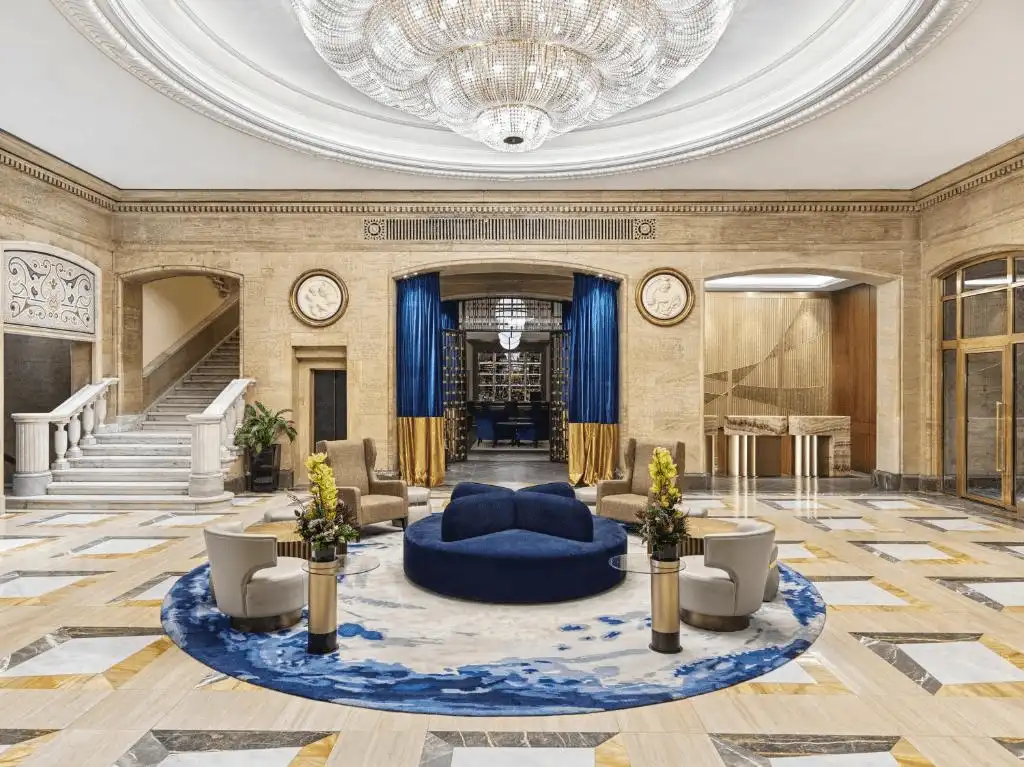
Sofia Balkan Palace stands as the 1956 diplomatic anchor of Bulgaria’s most powerful address—the Largo ensemble. This monumental Socialist Classicist structure forms part of the Presidential Palace complex, where thick-walled mastery and Byzantine-inspired interiors create silent refuge in the capital’s command center. Built atop Roman Serdica’s administrative ruins and immediately adjacent to the President’s Office, it served as Eastern Europe’s first Western-managed hotel, where diplomats and global power brokers have conducted business for seven decades.
Today’s 256 soundproofed rooms and Presidential suites overlook Saint Nedelya Church, offering the rare privilege of residing within the nation’s most protected quarter.
Sofia Balkan Palace ★★★★★
The Sofia Balkan Palace occupies territory no competitor can replicate: the physical center of Bulgarian state power. Opened in 1956 during the architectural boom that reshaped Sofia’s political core, this edifice was engineered with Soviet-era thickness—walls so substantial they deliver natural soundproofing unmatched by modern construction. When Sheraton assumed management in the late 20th century, it became the first Western brand permitted behind the Iron Curtain, establishing the hotel as the mandatory address for international diplomats navigating Cold War Eastern Europe.
Sofia Balkan Palace is a majestic fusion of classical design and lavish décor, standing as an iconic landmark that sits directly atop the ancient Roman ruins of Serdica in the heart of Bulgaria’s capital.
The building’s foundations rest directly on the Roman administrative center of ancient Serdica, third-century ruins still visible in archaeological excavations surrounding the property. Guests walk corridors where heads of state have negotiated treaties, where the Ministry of Education and the President’s Office remain immediate neighbors. The lobby’s winter garden conservatory—designed to evoke Bulgaria’s mountain forests—serves as an informal meeting ground where visiting dignitaries share space with discerning travelers who understand the value of proximity to power.
The 256 rooms include high-ceilinged Executive and Presidential suites offering sight lines to the 4th-century Saint George Rotunda, the oldest building in Sofia. The interior design philosophy draws heavily from Biedermeier elegance, particularly evident in Restaurant Labels, where Byzantine-inspired floor mosaics and gold accents honor Bulgaria’s ancient metallurgical mastery. This is not decorative nostalgia—it is spatial recognition of the cultural authority that defined this region for millennia.
The Royal Ballroom spans 7,000 square feet of crystal-chandelier grandeur, hosting Sofia’s most significant gala events under soaring ceilings that communicate institutional permanence. The wellness center provides both traditional and contemporary therapies tailored to the international executive schedule, while the fully equipped gym maintains the standards expected by those who govern their physical routines as precisely as their professional obligations.
Location defines dominance. The hotel delivers walking-distance access to Alexander Nevsky Cathedral and the National Museum of Archaeology, but more critically, it positions guests within the Largo ensemble—Sofia’s presidential and ministerial nerve center. The Saint Nedelya Church stands as your immediate landmark, the President’s Office as your neighbor, and the ruins of Roman governance as your literal foundation. This is not mere adjacency; it is institutional integration into the capital’s command architecture.
The property’s transformation from Cold War gateway to contemporary five-star residence demonstrates adaptive permanence. Where diplomats once navigated ideological divisions, today’s guests navigate Sofia’s resurgent cultural economy from a position of historical authority. The thick-walled silence, the Byzantine design language, the archaeological substrate—these are not amenities. They are competitive advantages derived from Sofia’s most consequential address, where seven decades of diplomatic history have established a legacy that cannot be fabricated elsewhere.
Check Availability & Rates →Within walls built to witness the reshaping of Eastern Europe, where Roman administrators once governed and modern diplomats still convene, the Sofia Balkan Palace offers residence in the unchanging center of Bulgarian authority—silent, substantial, and strategically irreplaceable.
FAQ: Sofia Balkan Palace
What makes Sofia Balkan Palace historically significant?
Opened in 1956 as part of Sofia’s Largo ensemble, it became Eastern Europe’s first Western-managed hotel under Sheraton during the Cold War, serving as the primary diplomatic gateway for international visitors. Built atop the ruins of Roman Serdica’s administrative center and integrated into the Presidential Palace complex, it has functioned as Sofia’s institutional hospitality anchor for seven decades.
Where exactly is Sofia Balkan Palace located?
The hotel occupies the absolute center of Sofia’s governmental quarter, immediately adjacent to the President’s Office and the Ministry of Education. It sits within the Largo ensemble, with Saint Nedelya Church as its visual landmark and the 4th-century Saint George Rotunda sharing its courtyard. Walking distance includes Alexander Nevsky Cathedral and the National Museum of Archaeology.
What are the most distinguished rooms at Sofia Balkan Palace?
The Presidential and Executive suites feature exceptionally high ceilings and views of Saint Nedelya Church, designed in Biedermeier-inspired elegance. All 256 rooms benefit from 1950s-era thick-wall construction that provides superior natural soundproofing, creating silent refuge within the capital’s busiest administrative district.
What dining and event facilities does the hotel offer?
Restaurant Labels serves international cuisine with Bulgaria’s finest boutique wines in a space featuring Byzantine-inspired mosaics and gold accents. The 7,000-square-foot Royal Ballroom, with crystal chandeliers and soaring ceilings, functions as Sofia’s premier venue for diplomatic receptions and gala events.
The Command Center Legacy
Sofia Balkan Palace delivers what modern construction cannot replicate: institutional integration into the capital’s historical and contemporary power structure. From its Roman foundations to its Cold War diplomatic prominence, this is residence within the unchanging center of Bulgarian authority.
Those seeking similar prestigious addresses in the region, explore the refined elegance of Grand Hotel Sofia or the historic distinction of Grand Hotel London Varna, each offering their own interpretation of the luxury heritage.
For more curated itineraries and luxury-focused travel insights, visit Your Luxury Guide. For official travel information and destination updates, visit Bulgaria tourism-info.
Your Luxury Guide — Where Exceptional Travel Begins.