Six Senses Rome establishes its authority in a meticulously restored 18th-century palazzo, steps from Piazza di Spagna. This is not adaptive reuse for aesthetic purposes—this is the transformation of an aristocratic Roman residence into a contemporary wellness destination that maintains the architectural command of its original noble inhabitants.
The palazzo’s historic salons, frescoed ceilings, and palatial proportions now frame a hospitality experience where Rome’s layered history becomes the foundation for modern luxury. For travelers seeking best hotels in Rome that deliver both historical gravitas and contemporary wellness infrastructure, Six Senses Rome presents an uncompromising marriage of patrimony and precision.
Six Senses Rome ★★★★★
The palazzo that houses Six Senses Rome operated within Rome’s aristocratic power structure for over two centuries. Its owners were not merchants seeking status—they were established Roman nobility who commissioned architects to build a residence reflecting their social position within papal society.
The building’s monumental staircase, coffered ceilings, and reception salons were designed as spatial declarations of authority. These architectural elements remain intact, now serving as the structural framework for 96 guest rooms and suites that preserve the palazzo’s original proportions while integrating Six Senses’ signature wellness infrastructure.
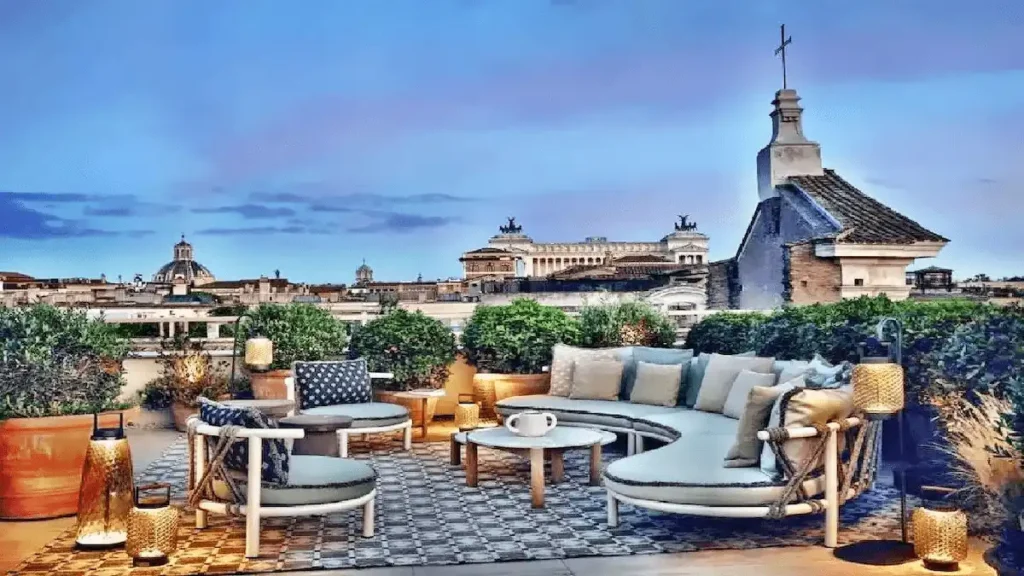
Six Senses Rome breathes new life into the 18th-century Palazzo Salviati Cesi Mellini, fusing ancient Roman heritage with world-class wellness and a spectacular rooftop oasis overlooking the Eternal City.
The restoration did not sanitize history—it exposed it. Original frescoes were uncovered during renovation, revealing 18th-century artistic programs that once communicated the family’s cultural sophistication to visiting dignitaries. These restored artworks now anchor guest suites where floor-to-ceiling windows overlook Rome’s terracotta rooftops and baroque church domes.
The rooms are not decorated with history—they are constructed from it. Hand-painted ceilings, terrazzo floors, and original architectural moldings define living spaces where contemporary design elements defer to the palazzo’s inherited grandeur rather than compete with it.
The wellness facilities occupy the palazzo’s former ground-floor service quarters, transformed into a 16,000-square-foot spa complex that includes a Roman bath circuit, ice fountain, and biohacking recovery lounge. This is wellness infrastructure embedded within 18th-century masonry—hydrotherapy pools installed in vaulted cellars where noble families once stored wine and provisions. The treatment menu combines traditional Roman bathing rituals with Six Senses’ global wellness protocols, creating a therapeutic experience anchored by both the palazzo’s historic function as a private sanctuary and modern physiological science.
Dining occurs in the palazzo’s former reception halls, where chef operates two restaurants that source ingredients from Six Senses’ partner farms in the Roman countryside. The Bivium Restaurant occupies the ground-floor salon, its original stuccoed walls and period chandeliers framing contemporary Italian cuisine executed with farm-to-table rigor. Above, the Notos Rooftop overlooks the Spanish Steps, transforming the palazzo’s uppermost terraces—once reserved for private family gatherings—into a dining venue where guests command views of Rome’s historic center while inhabiting the building’s original vertical hierarchy of power.
The location is tactical. Piazza di Spagna sits 200 meters away. The Trevi Fountain is a six-minute walk. Via Condotti’s luxury retail corridor borders the palazzo. But Six Senses Rome functions as a self-contained environment—guests can remain entirely within the palazzo’s historic walls while accessing world-class wellness treatments, Michelin-level dining, and rooftop lounges.
This is not a hotel leveraging proximity to Rome’s monuments—this is a monument unto itself, where the property’s aristocratic lineage provides exclusivity that external attractions cannot replicate.
Check Availability & Rates →Within Six Senses Rome, the palazzo’s 18th-century architecture doesn’t accommodate luxury—it commands it, transforming noble domestic spaces into a wellness sanctuary where historical authority and contemporary rigor converge beneath frescoed ceilings and within stone walls that have housed Rome’s elite for generations.
FAQ: Six Senses Rome
What makes Six Senses Rome historically significant?
Six Senses Rome occupies an 18th-century palazzo built for Roman nobility, featuring original frescoes, monumental staircases, and reception salons that functioned as centers of aristocratic power for over two centuries. The restoration preserved these architectural elements while integrating modern wellness infrastructure.
Where is Six Senses Rome located in the city?
The palazzo stands 200 meters from Piazza di Spagna in Rome’s historic center, with the Trevi Fountain six minutes away and Via Condotti’s luxury retail corridor immediately adjacent. The location provided strategic social positioning for the palazzo’s original noble owners.
What wellness facilities does Six Senses Rome offer?
The 16,000-square-foot spa occupies the palazzo’s former service quarters, featuring a Roman bath circuit, ice fountain, biohacking recovery lounge, and treatment rooms installed within vaulted 18th-century cellars where provisions were once stored.
How many rooms does Six Senses Rome have?
The hotel contains 96 guest rooms and suites distributed throughout the palazzo’s original residential floors, each preserving historic proportions, ceiling heights, and architectural details including hand-painted frescoes and terrazzo floors.
Rome’s Historic Palazzo Hotels: A Legacy Selection
Six Senses Rome demonstrates how 18th-century aristocratic architecture translates into contemporary hospitality authority. For travelers comparing Rome’s heritage properties, the Anantara Palazzo Naiadi Rome Hotel occupies ruins of the Baths of Diocletian, while the St. Regis Rome operates from a 19th-century palazzo designed for papal nobility—each property anchoring modern luxury in verified historical infrastructure that defines Rome’s most exclusive accommodations.
For more curated itineraries and luxury-focused travel insights, visit Your Luxury Guide. For official travel information and destination updates, visit Italy tourism-info.
Your Luxury Guide — Where Exceptional Travel Begins.