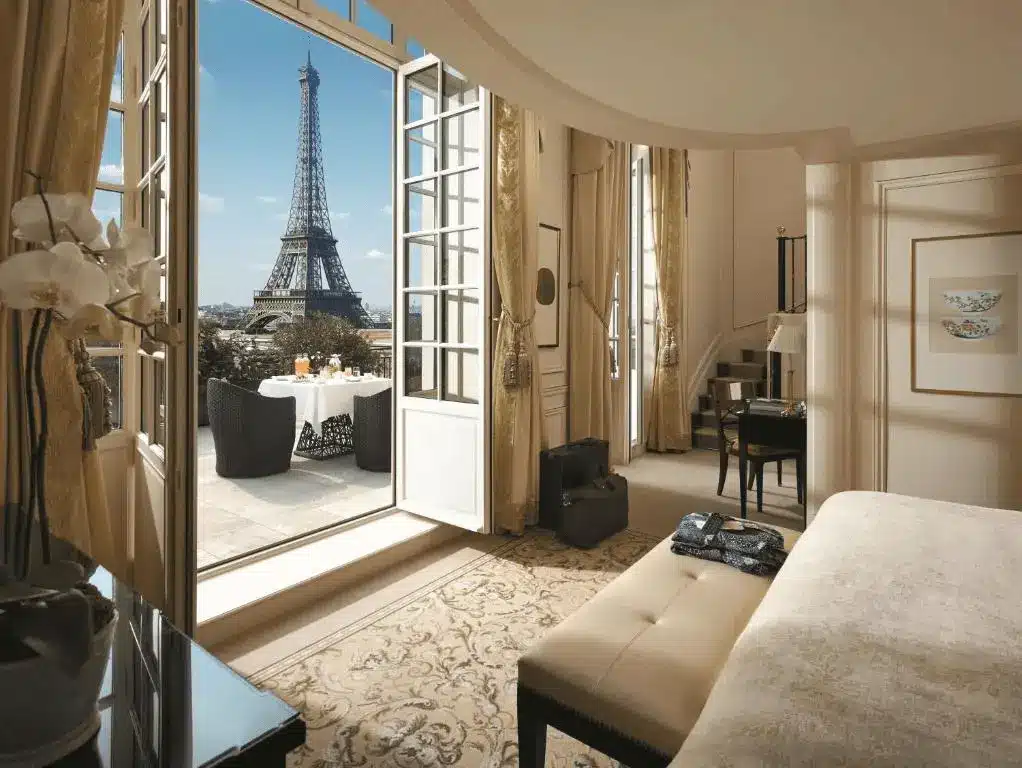
Shangri-La Paris occupies the former residence of Prince Roland Bonaparte, grandnephew of Napoleon I, built in 1896 as a monument to imperial prestige and scientific authority. This isn’t a hotel styled to resemble a palace—it is the authenticated seat of Bonaparte lineage, where global power was exercised and intellectual society convened.
The property’s position at 10 Avenue d’Iéna represents the deliberate territorial command of Trocadéro’s elite quarter, directly facing the Eiffel Tower from what remains Paris’s most strategically significant vantage point. You inhabit the same halls where European aristocracy negotiated empire, where Bonaparte’s geographic society shaped colonial expansion, and where the wealth of an imperial dynasty was architecturally manifested. This is documented authority made available as modern accommodation.
Shangri-La Paris ★★★★★
Prince Roland Bonaparte—scientist, geographer, president of the Société de Géographie—commissioned architect Ernest Janty in 1896 to construct a residence befitting his dual status as imperial heir and intellectual authority. The resulting structure wasn’t merely residential; it was a headquarters for geographic expeditions, a repository for botanical collections from five continents, and a salon where the scientific elite documented the expansion of French colonial influence.
Shangri-La Paris offers a regal stay within the former palace of Prince Roland Bonaparte, featuring some of the city’s most iconic private terrace views of the Eiffel Tower.
Bonaparte’s choice of Avenue d’Iéna was strategic: the address commanded unobstructed views of Gustave Eiffel’s tower while establishing territorial presence in the 16th arrondissement’s most exclusive enclave, adjacent to embassies and ministerial residences.
The property’s 81 rooms and suites occupy the original palace structure, preserving Bonaparte’s grand staircase—a sweeping marble ascent designed for theatrical arrivals—and the ornate salons where geographic societies convened. Suite La Suite Impériale retains Bonaparte’s private study chambers, with restored wood paneling and ceiling frescoes depicting cartographic achievements. The windows frame the Eiffel Tower precisely as Bonaparte commissioned: an architectural dialogue between his residence and Eiffel’s engineering triumph, both symbols of French technical supremacy during the Belle Époque.
La Bauhinia restaurant operates within Bonaparte’s former winter garden, where exotic specimens from his expeditions were displayed as living proof of imperial reach. The glass-vaulted space—original ironwork intact—now serves Cantonese cuisine beneath the botanical architecture that once housed rare orchids from Indochina. L’Abeille, occupies the ground-floor reception halls where Bonaparte hosted the geographic elite, its modern French haute cuisine served in rooms where colonial maps were unveiled and expedition funding secured.
The spa descends into Bonaparte’s original basement vaults—stone chambers designed for temperature-controlled storage of geographic instruments and pressed botanical specimens. These same spaces, with their 19th-century masonry and vaulted ceilings, now house the pool where contemporary guests swim beneath the foundation stones of imperial authority. The fitness facilities occupy Bonaparte’s former laboratory spaces, where scientific equipment was maintained between expeditions.
Room amenities translate historic grandeur into contemporary utility: suites average 50-60 square meters with ceiling heights reaching 4.5 meters in original palace chambers, marble bathrooms featuring both rainfall showers and deep soaking tubs, and floor-to-ceiling windows providing Eiffel Tower sightlines that Bonaparte himself engineered into the building’s orientation. The property maintains Bonaparte’s original library—now a private lounge—its floor-to-ceiling shelves still housing geographic journals and expedition records.
The rooftop terrace, added during modern restoration but built atop Bonaparte’s original structure, extends the palace’s historic command of the Trocadéro viewshed.
This is the authenticated seat of Bonaparte authority, where every spatial element descends from documented imperial occupation.
Check Availability & Rates →To occupy Shangri-La Paris is to inhabit the deliberate territorial assertion of Bonaparte lineage—where imperial authority engineered its most commanding Parisian presence, and where that calculated dominance remains architecturally intact as the foundation of your contemporary stay.
FAQ: Shangri-La Paris
Was Shangri-La Paris actually a Bonaparte residence?
Yes. Prince Roland Bonaparte, grandnephew of Napoleon I and president of the Société de Géographie, commissioned architect Ernest Janty in 1896 to build the residence at 10 Avenue d’Iéna. The structure served as both private palace and headquarters for Bonaparte’s geographic expeditions and scientific societies, documented in Paris municipal archives and the Société de Géographie’s historical records.
What original Bonaparte architectural elements remain in the hotel?
The grand marble staircase, ornate ceiling frescoes in the Imperial Suite (Bonaparte’s private chambers), the winter garden’s glass-vaulted ironwork structure (now La Bauhinia restaurant), basement stone vaults (now spa facilities), and the original library with Bonaparte’s geographic journal collection all retain their 1896 construction elements, verified through heritage preservation documentation.
Why is Shangri-La Paris’s location historically significant?
Bonaparte deliberately selected 10 Avenue d’Iéna for unobstructed Eiffel Tower views and territorial command of Trocadéro’s diplomatic quarter. The 1896 address positioned him adjacent to embassies and ministerial residences while establishing architectural dialogue with Eiffel’s tower—both symbols of French Belle Époque supremacy. This viewshed and geographic positioning were strategic assertions of imperial authority.
How does the hotel preserve Bonaparte’s scientific legacy?
The basement laboratories where Bonaparte maintained expedition equipment now house spa facilities within original vaulted chambers. The winter garden that displayed botanical specimens from five continents operates as La Bauhinia restaurant, preserving the glass-iron architecture. Bonaparte’s library remains intact as a guest lounge, and the Imperial Suite occupies his actual study chambers where geographic societies convened and colonial expeditions were planned.
The Bonaparte Command Endures
Shangri-La Paris functions as the unmodified seat of imperial calculation—where Bonaparte lineage engineered its most commanding Parisian presence and where that territorial authority remains your foundation. You don’t reference history here; you inhabit its authenticated continuation.
Experience similar imperial authority at Plaza Athénée Paris or discover Le Bristol Paris.
For more curated itineraries and luxury-focused travel insights, visit Your Luxury Guide. For official travel information and destination updates, visit France tourism-info.
Your Luxury Guide — Where Exceptional Travel Begins.