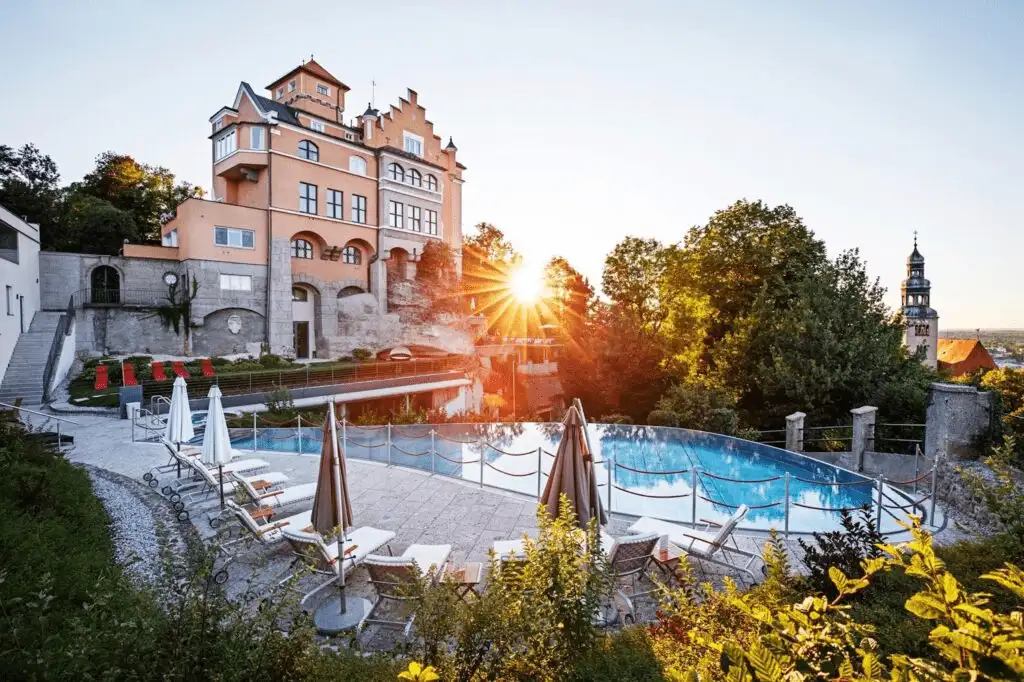
Hotel Schloss Mönchstein occupies the summit of Mönchsberg, a 14th-century fortified estate where Salzburg’s prince-archbishops established territorial oversight. The castle’s clifftop position 60 meters above the city enforced physical separation from the urban realm below—a defensive architecture that now delivers absolute privacy. The 24-room property retains the original stonework and defensive sightlines that defined Habsburg-era command. This is not a converted manor. This is a seat of alpine authority where the mountain enforces exclusivity.
Hotel Schloss Mönchstein ★★★★★
Hotel Schloss Mönchstein commands Mönchsberg’s clifftop plateau, where 14th-century fortifications established the physical barrier between ecclesiastical authority and the merchant city below. The estate’s positioning 60 meters above Salzburg’s Altstadt was strategic—the vertical separation enforced territorial control while the mountain’s natural moat prevented approach. This was the defensive architecture of power, and the castle retains that spatial dominance today.
Hotel Schloss Mönchstein preserves its heritage as a noble retreat, perched atop the Mönchsberg hill to offer a secluded sanctuary overlooking the spires of Salzburg’s Old Town.
The Habsburg prince-archbishops who commissioned the estate understood altitude as authority. The castle’s stone walls rise from the cliff face itself, anchoring the structure to the mountain in a display of geological command. The original tower foundations date to 1358, when Archbishop Ortolf von Weißeneck secured the summit as a hunting lodge for the ruling elite.
By the 19th century, the estate had transitioned through Bavarian nobility—the Counts of Moy—who expanded the manor without compromising its fortress character. The thick masonry, vaulted ceilings, and defensive sightlines remain intact.
Today’s 24 suites occupy chambers where territorial strategy was conducted. The Mönchstein Suite spans 80 square meters across the tower’s upper level, its stone archways original to the 14th-century construction. Floor-to-ceiling windows exploit the same sightlines that once monitored the valley—now overlooking Salzburg’s baroque skyline and the Untersberg massif. The king-size beds rest beneath frescoed ceilings painted for Bavarian counts.
The Michelin-starred Restaurant Schloss Mönchstein occupies the castle’s grand hall, where original timber beams span 12 meters overhead. Chef translates alpine terroir into prix-fixe menus served beneath 17th-century chandeliers. The wine cellar descends into the mountain itself—stone-vaulted chambers where 15,000 bottles rest in the same conditions that once preserved Habsburg provisions.
The 15-acre mountain park surrounds the castle with gardens laid in the formal Austrian tradition. Gravel paths lead through sculptural terraces to the infinity pool, suspended over the cliff edge with uninterrupted views across Salzburg’s spires. The spa occupies the castle’s lower chambers, where stone walls provide thermal mass for the Finnish sauna and hammam. Massage suites overlook the vertical gardens that cascade down the cliff face.
Private butlers manage arrivals through the castle’s original iron gates, where the cobblestone courtyard has received carriages since the 14th century. The helipad on the northern terrace accommodates direct alpine transfers—maintaining the estate’s legacy of controlled access for the ruling class.
Check Availability & Rates →Schloss Mönchstein translates 14th-century territorial command into the ultimate clifftop sanctuary, where Habsburg defensive architecture now enforces absolute privacy above Salzburg’s baroque realm.
FAQ: Schloss Mönchstein
What is the historical significance of Schloss Mönchstein?
Schloss Mönchstein was established in 1358 as a fortified hunting lodge for Archbishop Ortolf von Weißeneck, occupying Mönchsberg’s strategic summit 60 meters above Salzburg. The castle served as a territorial command post for Habsburg prince-archbishops, with defensive architecture designed to enforce physical separation from the city below. The estate’s clifftop position and original stone fortifications remain central to its exclusivity today.
What makes Schloss Mönchstein’s location unique?
The castle occupies the summit of Mönchsberg, a 540-meter-high cliff that rises vertically from Salzburg’s Altstadt. This positioning creates a natural moat effect—the mountain itself enforces privacy and restricted access. The estate’s 15-acre grounds span the entire clifftop plateau, with unobstructed views across the Salzach Valley and the Untersberg massif.
How many rooms does Schloss Mönchstein have?
Schloss Mönchstein operates as an intimate 24-suite property, occupying the castle’s original chambers and tower levels. The Mönchstein Suite spans 80 square meters in the 14th-century tower, featuring original stone archways, frescoed ceilings, and floor-to-ceiling windows exploiting the castle’s defensive sightlines. Each suite retains period masonry while integrating modern luxury infrastructure.
Does Schloss Mönchstein have a restaurant?
The Michelin-starred Restaurant Schloss Mönchstein occupies the castle’s grand hall beneath original 17th-century timber beams. Chef Markus Mayr delivers alpine-focused tasting menus, with ingredients sourced from Salzburg’s mountain terroir. The wine cellar descends into the mountain’s stone vaults, housing 15,000 bottles in chambers that once preserved Habsburg provisions.
Alpine Authority Secured: Austria’s Clifftop Estates
Schloss Mönchstein demonstrates how vertical dominance translates medieval fortification into modern exclusivity—where the mountain itself enforces the separation between command and the common realm.
For guests seeking alternative alpine strongholds, Schloss Hotel Fernsteinsee commands the Tyrolean pass where Habsburg trade routes enforced territorial control, while Rosewood Schloss Fuschl occupies the lakeside estate where Mozart premiered operas for Salzburg’s ruling archbishops.
For more curated itineraries and luxury-focused travel insights, visit Your Luxury Guide. For official travel information and destination updates, visit Austria tourism-info.
Your Luxury Guide — Where Exceptional Travel Begins.