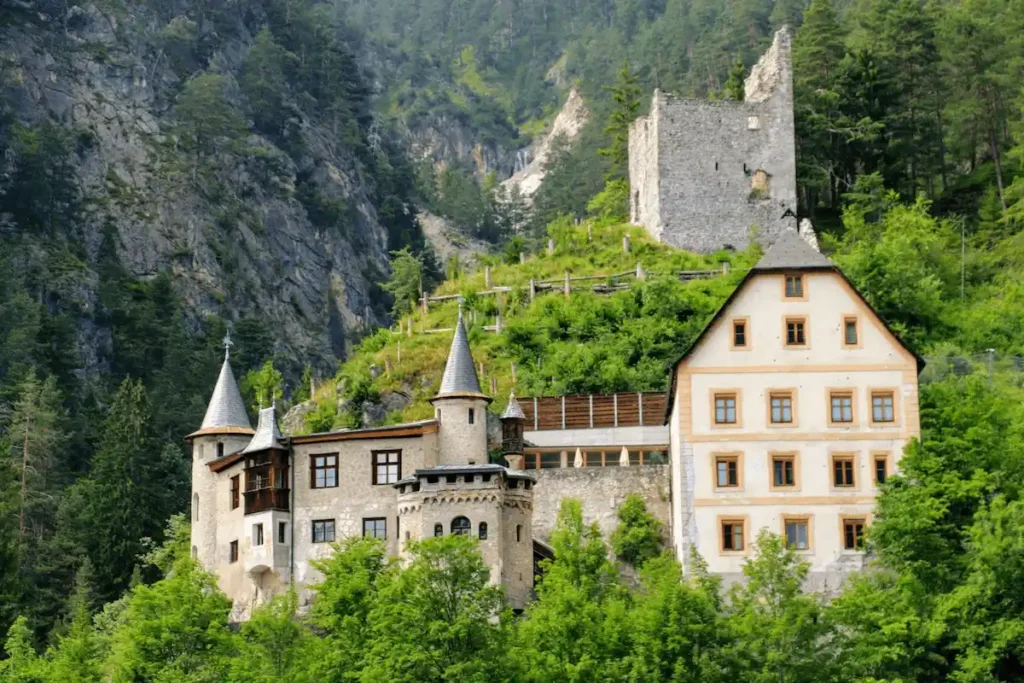
Schloss Hotel Fernsteinsee occupies the Fernpass, the strategic Alpine crossing that has governed movement between northern and southern Europe for centuries. This four-star castle hotel, operational since 1856, was purpose-built as a private retreat during the final years of Habsburg imperial authority.
Positioned at 1,300 meters, the fortress overlooks Fernsteinsee Lake and the ancient trade corridor that connected Innsbruck to Italy—a route that medieval merchants, military convoys, and imperial courtiers traversed under the watchful presence of fortified outposts. Today’s guests inherit territorial dominance: sweeping views of jagged Tyrolean peaks, engineered stone walls that enforce absolute privacy, and interiors where Habsburg-era formality meets modern Alpine utility.
The property functions as a private mountain command—where stone, altitude, and historical positioning combine to create a sovereign retreat above the common routes. Discover more elite properties in our guide to the best castle stays across Austria.
Schloss Hotel Fernsteinsee ★★★★
Schloss Hotel Fernsteinsee was built in 1462 by Duke Sigmund, positioned deliberately on the Fernpass summit where Habsburg authority once regulated mountain passage. The masonry reflects defensive imperatives: thick limestone walls, minimal ground-floor apertures, and a fortified base designed to withstand Alpine weather extremes. This is engineered isolation, where the building’s physical mass creates a barrier between the guest and the exposed mountain environment.
The castle’s strategic value derives from its elevation. At 1,300 meters, the property commands unobstructed sight lines across the Fernsteinsee glacial lake and the surrounding Wetterstein and Mieming ranges. Medieval merchants traveling the Fernpass route paid tolls at fortified checkpoints precisely because this corridor was indefensible without territorial control. Habsburg engineers understood this. Schloss Fernsteinsee’s siting replicates that logic: guests occupy the literal high ground, with the trade route now transformed into a scenic motorway far below.
Schloss Hotel Fernsteinsee anchors its legacy in the heart of the Tyrolean Alps, offering a regal stay within a castle estate that sits beneath the dramatic ruins of a medieval island fortress.
Interior spaces preserve early 20th-century Alpine formality. Stone-vaulted hallways amplify the fortress atmosphere—low ceilings, exposed masonry, and narrow windows that frame the mountain landscape in controlled segments. The main hall retains original wood paneling, wrought-iron fixtures, and hunting trophies that reference the Tyrolean hunting culture Habsburg nobility cultivated.
Suites feature heavy timber furnishings, ceramic-tiled heating stoves (Kachelofen), and bathrooms retrofitted with modern amenities while preserving period stonework.
This subterranean positioning inverts the typical spa experience—rather than panoramic views, guests retreat into the mountain itself, surrounded by masonry that predates modern tourism.
Dining at Schloss Fernsteinsee emphasizes Tyrolean game and mountain-sourced ingredients. The castle’s restaurant, positioned within the original great hall, maintains Habsburg-era dining protocols: formal table settings, ceremonial wine service, and a menu structure that reflects aristocratic hunting culture. Venison, chamois, and trout sourced from Alpine rivers appear alongside regional grains and preserved vegetables—ingredients that sustained fortress garrisons for centuries.
The surrounding estate includes direct lake access, forest trails that trace medieval trade paths, and unmarked routes to higher elevations. The castle functions as base camp for Alpine sovereignty—where guests depart into Tyrolean wilderness and return to engineered shelter. The modern cable car to Zugspitze, Germany’s highest peak, lies 15 kilometers north, but the castle’s positioning eliminates the need for external validation.
The property itself is the destination.
Check Availability & Rates →Schloss Hotel Fernsteinsee enforces Alpine isolation through Habsburg-era masonry—where stone walls, summit positioning, and glacial lake views create a private mountain command severed from common access. This is territorial authority in its most physical form.
FAQ: Schloss Hotel Fernsteinsee
What makes Schloss Hotel Fernsteinsee a historic castle property?
Schloss Hotel Fernsteinsee was built in 1462 as a private Habsburg-era stronghold on the Fernpass summit, a strategic Alpine crossing used since medieval times to control trade and military movement between northern and southern Europe. Its defensive masonry, elevated positioning, and fortress-style architecture reflect engineered isolation principles used in Tyrolean fortifications.
What historical significance does the Fernpass location hold?
The Fernpass has served as a critical Alpine trade and military corridor for over a millennium. Medieval merchants paid tolls at fortified checkpoints to traverse this route safely. Habsburg authorities maintained control over the pass through strategic outposts, and Schloss Fernsteinsee’s 1906 construction replicated that territorial logic—occupying the high ground to command the surrounding valley and lake basin.
What are the primary features of the castle’s accommodations?
Accommodations retain early 20th-century Alpine formality: stone-vaulted ceilings, exposed masonry, heavy timber furnishings, and ceramic-tiled Kachelofen heating stoves. Bathrooms integrate modern fixtures while preserving original stonework. Suites provide controlled mountain views through narrow fortress-style windows, maintaining the property’s defensive architectural character.
How does the castle’s wellness area differ from standard hotel spas?
The wellness area is carved into the castle’s foundation, featuring stone-walled sauna chambers and thermal relaxation spaces that replicate medieval vault architecture. Rather than panoramic views, the design emphasizes total isolation—guests retreat into the mountain itself, surrounded by thick masonry that provides complete acoustic and visual separation from external environments.
Conclusion: Habsburg Alpine Authority at Austria’s Strategic Summit
Schloss Hotel Fernsteinsee delivers territorial sovereignty through documented historical positioning and defensive architecture. This is not a resort—it is a private Alpine command where Habsburg-era engineering, summit elevation, and glacial lake access combine to create total environmental control. Guests occupy the literal high ground of Tyrolean history, inhabiting a stronghold that has regulated mountain passage for over a century.
Those seeking elite Austrian castle experiences, explore Schloss Mönchstein Salzburg or Schloss Fuschl, each representing distinct expressions of Austrian fortified legacy.
For more curated itineraries and luxury-focused travel insights, visit Your Luxury Guide. For official travel information and destination updates, visit Austria tourism-info.
Your Luxury Guide — Where Exceptional Travel Begins.