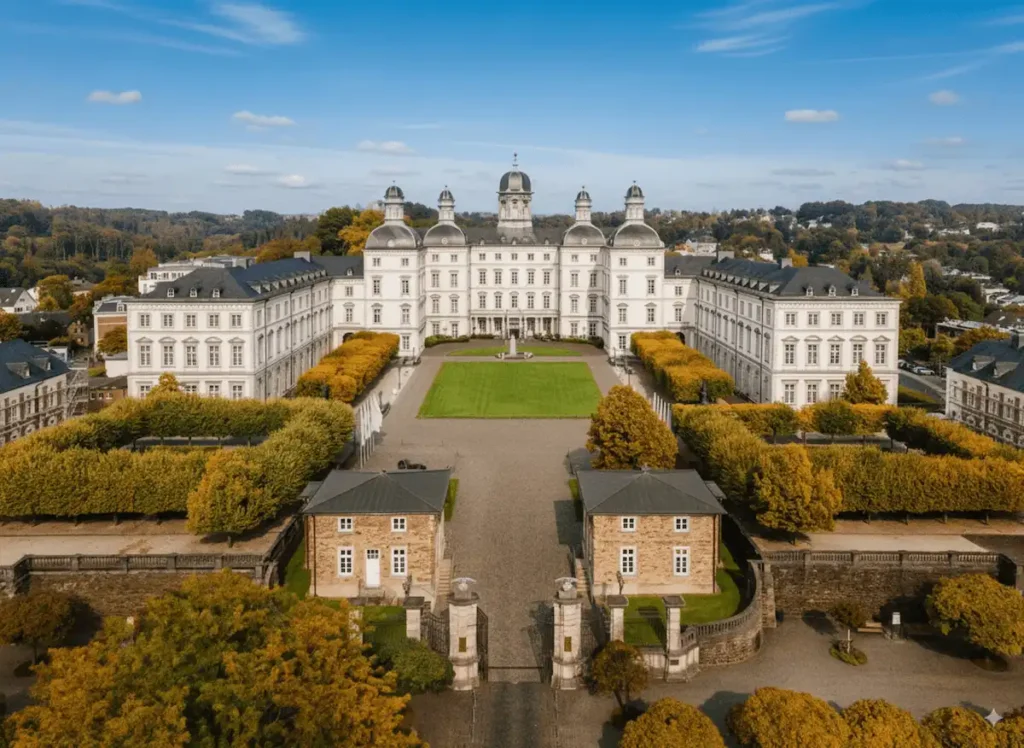
Grandhotel Schloss Bensberg rises from the Bergisch Gladbach highlands as the 1711 hunting command of Johann Wilhelm II, Elector Palatine—a territorial sovereign whose 120-room baroque fortress surveyed the Rhine’s commercial arteries from its hilltop throne. The palace’s symmetrical wings, hewn from regional sandstone, enforced architectural dominance across a landscape where competing powers monitored river trade routes.
This is accommodation within a documented seat of regional authority, where the physical infrastructure of 18th-century statecraft becomes the framework for modern prestige.
Discover Germany’s best luxury castle hotels for comparative territorial estates.
Althoff Grandhotel Schloss Bensberg ★★★★★
The palace’s origin as a hunting command center establishes its enduring character. Johann Wilhelm II commissioned court architect Matteo Alberti to create a structure that would assert Palatine sovereignty across the Bergisch territories—a region contested between Catholic and Protestant powers throughout the Thirty Years’ War.
Alberti’s design employed French baroque principles: a 145-meter façade with projecting central pavilion, flanked by symmetrical residential wings that housed the Elector’s retinue of 200 courtiers, diplomats, and military advisors. The palace’s elevated position—210 meters above the Rhine plain—provided strategic surveillance of Cologne’s merchant traffic while positioning the Elector above the Archbishop-Elector’s rival seat of authority.
Schloss Bensberg converts this 18th-century electoral palace into a high-density stronghold of European Baroque prestige and architectural absolute power.
The Grand Staircase remains the palace’s primary power declaration. Twin flights of Carrara marble rise through three levels beneath a 12-meter ceiling vault, the plasterwork depicting allegorical scenes of Palatine military victories. This wasn’t decorative excess—it was staged political theater where visiting nobles were forced to ascend toward the Elector’s receiving chambers, their subordinate status reinforced at every landing.
Today’s guests traverse this same spatial hierarchy to access suites positioned in the palace’s historic piano nobile, where ceiling heights reach 4.2 meters and original parquet floors of oak and cherry wood demonstrate 18th-century craft mastery.
The palace’s 120 suites and rooms occupy the Elector’s original residential quarters. The Bensberg Suite—110 square meters across the southeast corner—preserves Johann Wilhelm’s private apartments, including hand-painted wall coverings depicting Rhine valley hunting scenes and a marble bathroom carved into what served as the Elector’s map room.
Freestanding bathtubs position beneath restored ceiling frescoes showing Palatine heraldry, while floor-to-ceiling windows frame direct sightlines to Cologne Cathedral’s Gothic towers—the same view the Elector monitored to track his rival’s ecclesiastical power. Every suite maintains this territorial logic: Nespresso machines and rainfall showers integrated into rooms where territorial commanders once planned military campaigns and marriage alliances.
Vendôme, the palace’s three-Michelin-star restaurant, operates within the former State Dining Hall—a 200-square-meter chamber where the Elector hosted diplomatic banquets beneath gilded stucco ornamentation. Chef’s 18-course tasting menus are served on Rosenthal porcelain at tables positioned beneath the original 1711 crystal chandeliers.
The wine cellar maintains the palace’s territorial power narrative: 30,000 bottles stored in vaulted sandstone chambers that once secured the Elector’s Rhine wine monopoly revenues. Service staff navigate these same corridors where Johann Wilhelm’s sommelier managed liquid assets worth more than annual peasant tax revenues.
The Wellness & Spa descends into the palace’s foundation level—1,000 square meters of vaulted cellars transformed into thermal treatment rooms. The indoor pool occupies the former wine storage vault, its 18-meter length carved through three-meter-thick load-bearing walls. Original stone archways frame heated loungers and steam chambers, while treatment rooms utilize the cellars’ natural temperature regulation—the same climate control that preserved the Elector’s vintage collection for decades. Massage tables rest where oak wine barrels once aged Riesling destined for diplomatic gift exchanges across European courts.
The palace’s baroque gardens extend across 40 hectares of terraced grounds designed by Dominique Girard, Le Nôtre’s protégé from Versailles. Geometric hedge rows and axial sight lines replicate French royal garden principles adapted to Rhine valley topography. The central fountain—a 1712 commission featuring Neptune commanding sea horses—served dual purposes: aesthetic display and hydraulic engineering demonstration that proved Palatine technical sophistication. Today’s guests access these grounds via the same gravel pathways where the Elector’s hunting parties assembled before dawn expeditions into the surrounding Königsforst woodland—4,000 hectares of preserved forest still accessible from the palace’s eastern gate.
The palace’s conversion respects every architectural power marker while providing infrastructure expected by contemporary luxury travelers. The Business Center occupies the former War Room—mahogany-paneled chambers where military strategy sessions occurred—now equipped with fiber-optic connectivity and soundproofed conference facilities. The palace’s original bell tower, which once summoned courtiers to diplomatic receptions, now serves as a private dining venue for groups requiring absolute discretion within a space designed for sovereign-level negotiations.
Check Availability & Rates →Schloss Bensberg remains what Johann Wilhelm II engineered it to be: an architectural assertion of territorial command, where baroque spatial logic—grand staircases, vaulted reception halls, and hilltop positioning—translates 18th-century sovereign authority into 21st-century accommodation prestige. The guest doesn’t visit history here; they occupy the physical infrastructure where Rhineland power was administered for three centuries.
FAQ: Schloss Bensberg
What makes Schloss Bensberg historically significant?
Commissioned in 1711 by Johann Wilhelm II, Elector Palatine, Schloss Bensberg served as a strategic hunting palace and diplomatic command center overlooking the Rhine valley. The 120-room baroque structure demonstrated Palatine sovereignty through French-influenced architecture and hilltop positioning that monitored Cologne’s rival ecclesiastical power eight kilometers west.
Which original palace features remain in guest accommodations?
Guest suites occupy the Elector’s original piano nobile residential quarters, preserving 4.2-meter ceiling heights, hand-painted wall coverings depicting Rhine hunting scenes, heraldic ceiling frescoes, and parquet floors of 18th-century oak and cherry wood. The Grand Staircase’s Carrara marble flights and the State Dining Hall’s gilded stucco ornamentation remain intact.
What distinguishes Vendôme’s three-Michelin-star dining experience?
Chef operates within the palace’s 200-square-meter State Dining Hall beneath original 1711 crystal chandeliers. The 30,000-bottle wine cellar utilizes vaulted sandstone chambers that secured the Elector’s Rhine wine monopoly revenues, maintaining the territorial power narrative through liquid assets once valued above annual tax collections.
How does the spa utilize the palace’s historic architecture?
The 1,000-square-meter wellness facility descends into the palace’s foundation cellars, where the 18-meter indoor pool occupies the former wine storage vault. Three-meter-thick load-bearing walls and original stone archways create thermal treatment rooms using the same natural temperature regulation that preserved the Elector’s vintage collection for decades.
The Elector’s Estate Secured for Modern Command
Grandhotel Schloss Bensberg delivers accommodation within authenticated sovereign infrastructure—where baroque spatial hierarchy, strategic hilltop positioning, and preserved diplomatic chambers provide territorial prestige unchanged since 1711. The palace operates as functional power architecture for guests who recognize that true luxury requires documented lineage.
For comparable territorial estates, consider Schlosshotel Kronberg‘s Prussian royal quarters or Schlosshotel Hugenpoet‘s moated Ruhr valley command post.
More curated itineraries and luxury-focused travel insights at Your Luxury Guide. For official travel information and destination updates, visit Germany tourism-info.
Your Luxury Guide — Where Exceptional Travel Begins.