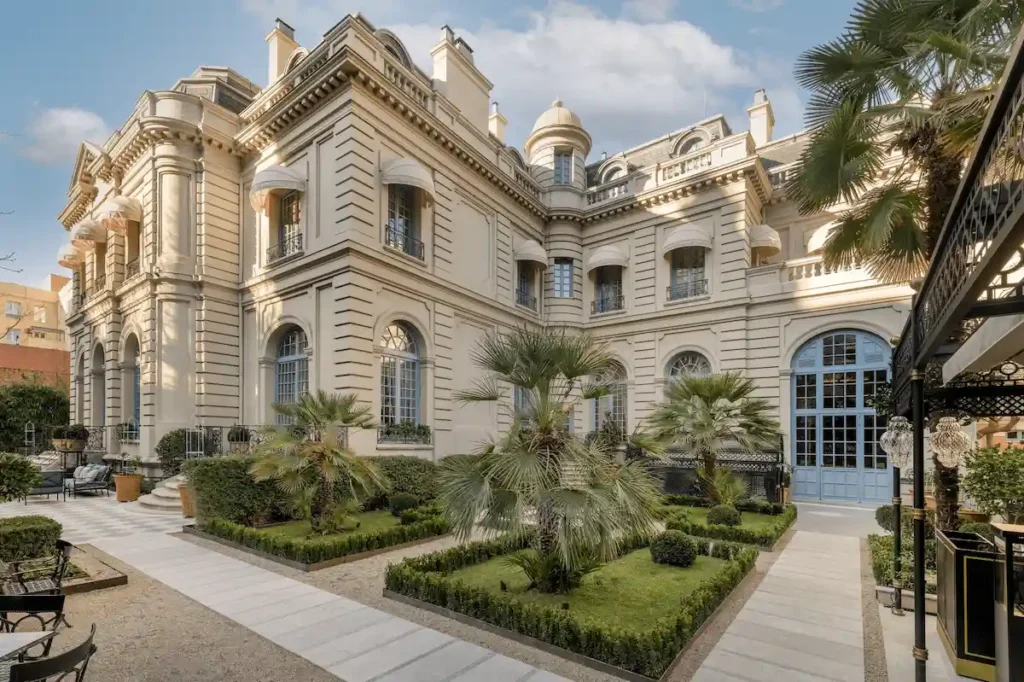
Santo Mauro Madrid occupies the 1899 residence of Mariano Fernández de Henestrosa, 1st Duke of Santo Mauro—a courtier to King Alfonso XIII who commissioned architect Juan Bautista Lázaro de Diego to build not a Spanish palazzo but a Parisian petit hôtel in the heart of Madrid’s noble Chamberí quarter.
This is the palace where the Beckhams lived for years, where diplomats avoid the Ritz’s visibility, and where century-old chestnut trees shield three historic buildings from the capital’s noise. This is power that doesn’t announce itself.
Santo Mauro, a Luxury Collection Hotel, Madrid ★★★★★
The Santo Mauro is Madrid’s study in architectural discretion—a 19th-century French mansion built between 1899 and 1902 for a Duke who preferred Belle Époque Paris to Spanish grandeur. Juan Bautista Lázaro de Diego delivered a three-building estate: the Main Palace (the Duke’s private quarters), the Mansion (for his daughter), and the Stables (now garden suites flooded with natural light). The compound mirrors the rhythm of Parisian hôtels particuliers—intimate scale, theatrical interiors, and a walled garden that functions as an urban fortress.
Santo Mauro Madrid is an intimate French-style palace in the noble Chamberí district, offering a sophisticated retreat within the Duke’s original library and the city’s most exclusive private garden.
In 2021, Spanish interiorist Lorenzo Castillo stripped the property back to its Belle Époque bones, then layered it with silk wall coverings, Art Deco brass fixtures, and crimson floral motifs that reference the Duke’s personal collection of Oriental art.
The Luxury Suites feature ceiling frescoes that survived a century intact. The Chinese Lounge displays artifacts the Duke acquired during diplomatic travels across Asia. Every material decision—from the oak paneling in La Biblioteca to the Parma Gray kiosks in the garden—reinforces a single thesis: this is not a hotel that inherited prestige. This is a residence that created it.
The Library Restaurant occupies the Duke’s original oak-paneled study, now recognized as one of Europe’s most architecturally significant dining rooms. Its 19th-century shelving, leather-bound volumes, and coffered ceilings remain undisturbed—guests dine surrounded by the Duke’s actual literary collection.
The Hidden Garden, redesigned by landscaper Fernando Valero, is anchored by century-old chestnut trees and neoclassical fountains. It is Madrid’s most sophisticated outdoor room, accessible only to hotel guests.
The Gin Bar—an Art Deco homage to New York speakeasies—has become a power address for Madrid’s finance and political elite. The Wine Cellar, housed in the palace’s former private chapel, offers tastings beneath original vaulted stone ceilings.
The guest rooms occupy the Duke’s private wing, the daughter’s mansion, and the converted stables. Each category reflects a different era of the estate’s evolution: the Palace Suites retain 19th-century ceiling frescoes and silk damask walls, while the Garden Rooms feature floor-to-ceiling glass that dissolves the boundary between interior luxury and the estate’s walled grounds.
Lorenzo Castillo’s 2021 intervention preserved every architectural artifact—marble fireplaces, wrought-iron balconies, original parquet floors—while introducing modern infrastructure invisible to the guest experience.
The Santo Mauro’s legacy as Madrid’s “discreet palace” was established by Mariano Fernández de Henestrosa himself—a courtier who wielded influence through proximity to Alfonso XIII but avoided public spectacle. That philosophy persists: David and Victoria Beckham made this their Madrid home during his years at Real Madrid, precisely because it offered privacy the Ritz could not.
Diplomats, European royalty, and heads of state continue to choose the Santo Mauro for the same reason the Duke built it—because true authority never performs for an audience.
Check Availability & Rates →The Santo Mauro does not compete with Madrid’s grand hotels because it occupies a different category entirely—this is the residence where Spain’s courtiers and diplomats have always exercised power without witnesses, where the Beckhams lived undisturbed, and where century-old chestnut trees still guard the Duke’s original garden from a city that has grown too loud.
FAQ: Santo Mauro Madrid
What makes Santo Mauro Madrid historically significant?
Santo Mauro Madrid is the 1899 residence of the 1st Duke of Santo Mauro, a courtier to King Alfonso XIII. Architect Juan Bautista Lázaro de Diego built it as a French Belle Époque petit hôtel rather than a Spanish palace—a deliberate choice that reflected the Duke’s preference for Parisian sophistication over Madrid’s traditional grandeur. The estate’s three buildings, oak-paneled library, and walled garden remain architecturally intact.
Who designed the Santo Mauro’s current interiors?
Spanish interiorist Lorenzo Castillo completed a total redesign in 2021, preserving all 19th-century architectural elements—original frescoes, parquet floors, marble fireplaces—while introducing silk wall coverings, Art Deco fixtures, and his signature Parma Gray outdoor furniture. Castillo’s work restored the Duke’s Belle Époque vision while adding theatrical layers that reference the palace’s history as a diplomat’s private residence.
Why is the Santo Mauro called Madrid’s most discreet palace hotel?
The Santo Mauro was built for discretion—the Duke of Santo Mauro wielded influence through proximity to the Spanish crown, not public visibility. That legacy continues: David and Victoria Beckham lived here during his Real Madrid years because it offered privacy the city’s grand hotels could not. The walled garden, private chapel wine cellar, and Chamberí location ensure the property remains inaccessible to Madrid’s tourist circuits.
What is La Biblioteca at Santo Mauro Madrid?
La Biblioteca is the Duke’s original 19th-century oak-paneled library, now the hotel’s flagship restaurant. It is considered one of Europe’s most architecturally significant dining rooms—guests dine surrounded by the Duke’s actual book collection, beneath coffered ceilings and within the same leather-paneled walls where Alfonso XIII’s courtiers once gathered. The space has never been altered from its original residential function.
The Palace That Never Performs
Santo Mauro Madrid operates on a principle the Duke established in 1899—that true authority is exercised in private, behind walls thick enough to keep the outside world at a manageable distance. The Beckhams understood this. So do the diplomats, financiers, and European royalty who continue to choose the Duke’s residence over Madrid’s more visible alternatives. The oak library, the walled garden, the chapel wine cellar—these are not hotel amenities. They are the architectural infrastructure of discretion, preserved across a century because power has always preferred privacy to performance.
Explore similar estates at The Palace Madrid and Palacio de los Duques Gran Meliá.
For more curated itineraries and luxury-focused travel insights, visit Your Luxury Guide. For official travel information and destination updates, visit Spain tourism-info.
Your Luxury Guide — Where Exceptional Travel Begins.