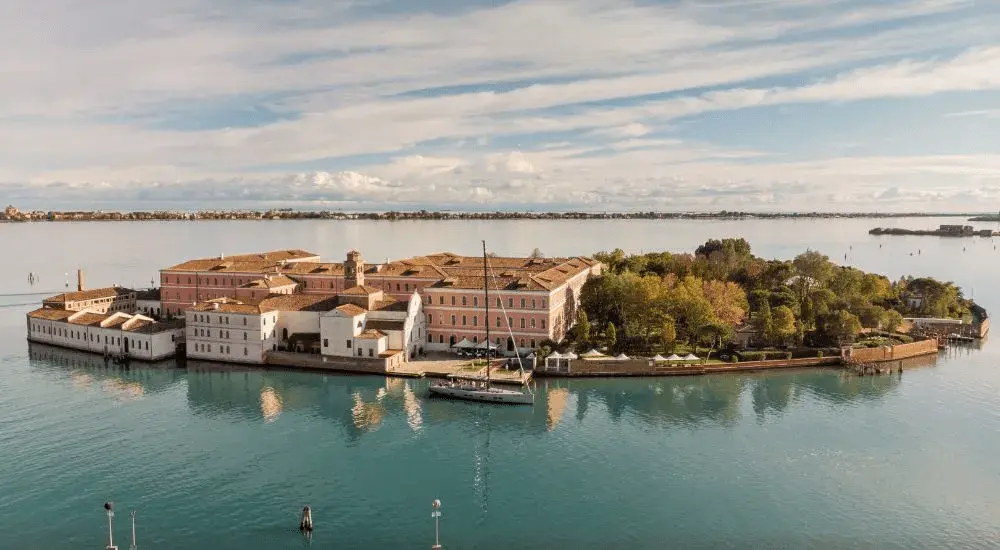
San Clemente Palace Venice occupies a 7-hectare private island in the Venetian Lagoon, anchored by the San Clemente Church—a consecrated Romanesque structure completed in 1131 AD. For eight centuries, this was a closed monastic estate and the mandatory diplomatic landing point for foreign royalty entering Venice. The Doge himself conducted state receptions within these walls, establishing the island as Venice’s gateway command center.
Today, the restored 12th-century monastery houses 190 suites across seven ancient courtyards, offering the largest residential footprint and greenspace in Venice—17.3 acres of land-controlled privacy that cannot be replicated in the lagoon. Where Venetian nobility once exercised absolute authority, modern guests now inhabit a fully operational island estate.
San Clemente Palace Venice ★★★★★
San Clemente Palace Venice is not a conversion project—it is a preserved 12th-century monastic complex functioning as a private island estate. The structural core dates to 1131 AD, when the San Clemente Church was consecrated as a Romanesque masterpiece.
For 800 years, this 7-hectare island operated as a closed ecclesiastical world, later becoming the mandatory first stop for foreign heads of state arriving in Venice. The Doge personally received monarchs here before allowing entry to the city—a diplomatic protocol that positioned San Clemente as Venice’s official gateway fortress.
San Clemente Palace Venice is an 1131 AD monastic estate and the lagoon’s only 17-acre private island, providing a historic scale and territorial isolation that no Grand Canal property can physically replicate.
The island’s architecture was designed for absolute control. Seven interior courtyards, vaulted stone corridors, and a 1652 naval monument façade by Andrea Cominelli—featuring monumental reliefs of the Battle of Lepanto—physically document Venice’s 1571 victory over the Ottoman Empire. Inside the church, a rare 1643 replica of the Holy House of Loreto exists as a church-within-a-church, commissioned by Venetian nobility to fulfill a plague vow.
During the 20th century, San Clemente housed Ida Dalser, Mussolini’s first wife, and served as a high-status medical sanctuary for European aristocracy. The island’s physical separation from Venice—combined with its monastic quiet zone—created the largest undisturbed green space in the lagoon, a 15-acre heritage park that remains the only land of this scale in the Venetian archipelago.
Modern utility is embedded within this historic footprint. Standard rooms begin at 36–47 m² with 3-meter ceilings, delivering cubic volume per guest that exceeds any mainland luxury hotel. Specialized monastic suites—Tiepolo and Tintoretto—feature original 17th-century larch-wood beams and 4-meter vertical clearance, a structural asset modern construction cannot replicate. The estate operates the only full-scale heated outdoor lagoon pool in Venice, shielded from winds by the ancient monastic walls.
The island’s land utility extends beyond accommodation. A 3-hole pitch and putt course, professional tennis courts, and a 1,500-meter jogging track occupy the grounds—athletic infrastructure impossible in the city center. Acquerello, the waterfront fine-dining venue, features a massive over-water deck and private pier, allowing guests to transit 30 meters from boat-to-table.
The Clemente Bar and Sunset Terrace are oriented for the Golden Hour view of the Venetian skyline, while The Merchant of Venice Spa operates across 380 m² utilizing exclusive noble oils modeled after 14th-century Venetian trade routes.
The operational advantage is zero-vibration island living. Unlike mainland hotels subjected to constant vaporetti wake and pedestrian foot traffic, San Clemente’s island isolation eliminates structural vibration—a critical asset for sleep quality and residential comfort. An 8-minute private launch service provides direct, no-wait access to a dedicated pier at San Marco, solving the isolation problem while preserving the island’s residential silence.
The consecrated San Clemente Church functions as a private event venue, offering acoustics and historic weight that standard ballrooms cannot match. This is where Venetian nobility exercised spiritual and political authority. Guests now inhabit the same vaulted halls where the Doge received kings, within a land-controlled estate that has defined Venetian power for nine centuries.
Check Availability & Rates →To stay at San Clemente Palace is to occupy Venice’s original seat of diplomatic command—a 900-year-old island fortress where the Republic’s elite received foreign monarchs, isolated by 7 hectares of consecrated land that still functions as the lagoon’s most exclusive residential estate.
FAQ: San Clemente Palace Venice
What makes San Clemente Palace a private island hotel?
San Clemente Palace occupies a 7-hectare private island in the Venetian Lagoon, operating as a fully self-contained estate with 190 suites, a consecrated 1131 AD Romanesque church, seven courtyards, athletic facilities, and the largest green space in Venice. Access is exclusively via private launch.
How old is the San Clemente Church?
The San Clemente Church was consecrated in 1131 AD, making it 893 years old. It remains a functioning consecrated space and houses a rare 1643 replica of the Holy House of Loreto, commissioned by Venetian nobility. The church is available as a private event venue.
What was San Clemente Palace’s role in Venetian history?
For eight centuries, San Clemente served as a closed monastic estate and the mandatory first diplomatic stop for foreign royalty entering Venice. The Doge personally received heads of state here before granting entry to the city, establishing the island as Venice’s official gateway fortress.
How does the private launch service work?
San Clemente Palace operates a dedicated fleet of high-speed launches providing 8-minute direct transit to a private pier at San Marco. The service eliminates wait times and offers no-vibration island isolation while maintaining immediate city access.
The Last Island of Venetian Authority
San Clemente Palace Venice preserves the physical infrastructure where the Republic exercised absolute diplomatic control—a 900-year-old island fortress that still operates as Venice’s most exclusive residential estate. To walk the same vaulted corridors where the Doge received monarchs is to inhabit the architectural legacy of Venetian supremacy.
For those seeking Venice’s ultimate land-controlled privacy, the island remains unmatched. Continue your Venetian exploration at Londra Palace Venezia or discover the elegance of St Regis Venice.
For more curated itineraries and luxury-focused travel insights, visit Your Luxury Guide. For official travel information and destination updates, visit Italy tourism.
Your Luxury Guide — Where Exceptional Travel Begins.