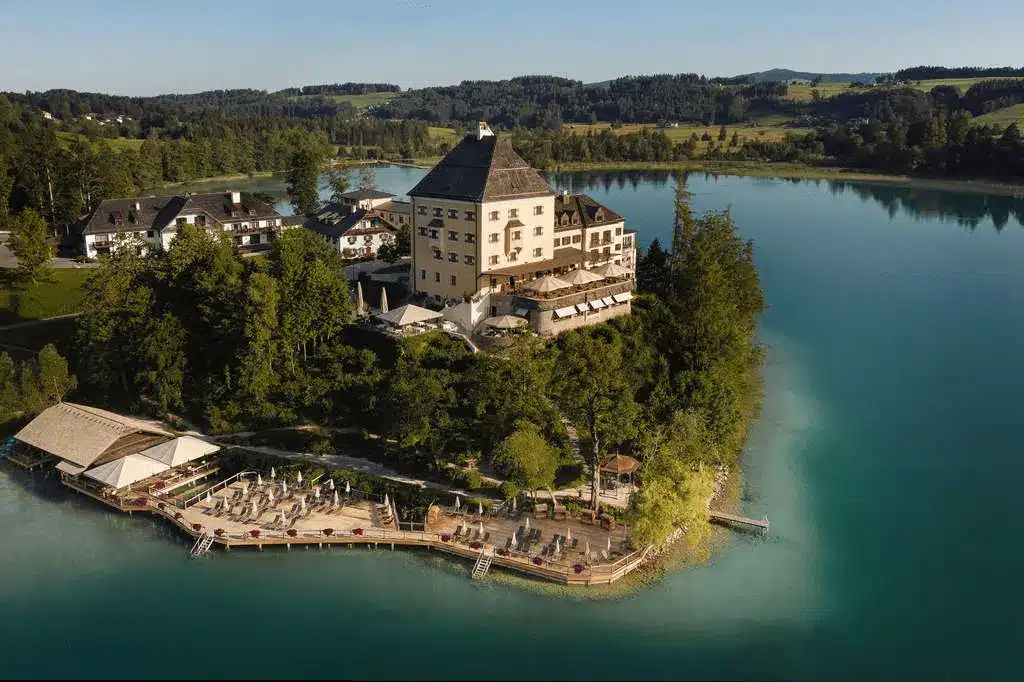
Rosewood Schloss Fuschl commands the eastern shore of Fuschlsee from foundations laid in 1461 as the private hunting estate of Salzburg’s Prince-Archbishops. The castle’s strategic positioning—elevated above the lake with direct territorial sight lines—enforced ecclesiastical authority across the Salzkammergut region for four centuries.
Today’s 67 suites occupy the original residential quarters where archbishops governed temporal and spiritual domains. The property’s documented lineage includes Habsburg hunting parties and post-war occupation by American command before Rosewood’s 2014 restoration preserved the lakeside authority inherent in its stone.
Rosewood Schloss Fuschl ★★★★★
Rosewood Schloss Fuschl operates from the exact seat where Salzburg’s Prince-Archbishops consolidated territorial power through strategic hunting lodges. Built in 1450 under Archbishop Sigismund I, the castle functioned as both recreational estate and regional command post—hunting served as diplomatic theater where ecclesiastical authority was reinforced through displays of wealth and territorial control.
Rosewood Schloss Fuschl honors its 1461 origins as a grand archiepiscopal hunting lodge—and its cinematic fame as the backdrop for the Sissi trilogy—by blending meticulously restored Alpine heritage with a modern, lake-focused wellness retreat.
The castle’s architecture reflects its dual mandate. Thick stone walls—typical of 15th-century defensive construction—provided physical security while elevated positioning granted unobstructed views across Fuschlsee. The archbishops who commissioned this stronghold weren’t merely seeking leisure; they were mapping dominance across a landscape they governed as both spiritual and temporal rulers of Salzburg’s prince-bishopric.
Habsburg connections deepened the property’s aristocratic credentials. Emperor Franz Josef I hunted these grounds repeatedly in the late 19th century, transforming Schloss Fuschl into a favored retreat for Vienna’s imperial circle. The castle witnessed the final decades of Austro-Hungarian sovereignty, hosting the elite who governed Central Europe before 1918’s political collapse.
Post-war history added American military command to the property’s legacy when U.S. officers occupied the castle during Austria’s occupation period. This military presence—though brief—reinforced the building’s strategic value: even in defeat, the castle remained worth commanding.
Rosewood’s 2014 restoration maintained the structural authority while installing 67 suites within the original residential wings. Guest rooms occupy chambers where archbishops once held private counsel.
The lakeside spa—built within the castle’s lower stone chambers—translates medieval fortification into modern sanctuary. Vaulted ceilings and preserved masonry remind guests they’re inhabiting authenticated power, not theatrical reconstruction.
The property’s 17 acres extend territorial possession beyond the castle walls. Private lake access provides the same controlled waterfront the archbishops secured in 1450. The Schloss Fuschl Golf Course—adjacent to the estate—operates on land historically controlled by the ecclesiastical authorities who built this stronghold.
Dining at Schloss Fuschl occurs in rooms where Habsburg hunting parties celebrated successful expeditions. The Salzkammergut Restaurant occupies space with documented connections to imperial gatherings, while the lakeside terrace—with direct water views—positions guests exactly where archbishops surveyed their domain five centuries ago.
Check Availability & Rates →To occupy Schloss Fuschl is to inhabit the strategic elevation where Salzburg’s Prince-Archbishops translated ecclesiastical authority into territorial command—a documented seat of sovereignty where stone walls, lakeside positioning, and Habsburg legacy converge into Austria’s most authenticated castle stay.
FAQ: Rosewood Schloss Fuschl
What is the historical significance of Rosewood Schloss Fuschl?
Rosewood Schloss Fuschl was built in 1461 as a hunting lodge for Salzburg’s Prince-Archbishops, serving as both recreational estate and regional command post. The castle functioned as a seat of ecclesiastical-temporal authority for over 400 years, later hosting Habsburg imperial hunting parties including Emperor Franz Josef I, and served as U.S. military command headquarters during Austria’s post-WWII occupation.
When was Schloss Fuschl originally constructed?
The castle was established in 1450 under Prince-Archbishop Sigismund I of Salzburg. The original 15th-century stone structure remains intact, with Rosewood’s 2014 restoration preserving the defensive masonry, vaulted chambers, and lakeside fortifications that defined the property’s strategic positioning.
What makes Rosewood Schloss Fuschl architecturally distinctive?
The castle’s architecture reflects 15th-century defensive construction with thick stone walls, elevated positioning above Fuschlsee, and preserved vaulted chambers. The strategic lakeside location provided territorial sight lines while the fortified structure enforced physical security—architectural features that distinguished ecclesiastical hunting lodges from mere recreational estates.
How does Rosewood maintain the castle’s historical integrity?
The 67 suites occupy original residential wings where archbishops held private counsel. Preserved stone masonry, vaulted ceilings, and the lakeside positioning remain unchanged. The spa utilizes lower stone chambers originally built for castle operations, translating medieval fortification into modern amenity without compromising structural authenticity.
The Sovereign Inheritance
Rosewood Schloss Fuschl delivers what few properties can document—continuous territorial command from 1461 to present day. The guest inhabits the exact elevation where Salzburg’s ecclesiastical authorities governed the Salzkammergut, where Habsburg emperors reinforced aristocratic networks, and where post-war victors claimed Austria’s most strategic private estate. This is possession of the stronghold itself.
For travelers seeking authenticated castle experiences, consider Schloss Hotel Fernsteinsee in Tyrol or Hotel Schloss Mönchstein overlooking Salzburg’s fortress city.
For more curated itineraries and luxury-focused travel insights, visit Your Luxury Guide. For official travel information and destination updates, visit Austria tourism-info.
Your Luxury Guide — Where Exceptional Travel Begins.