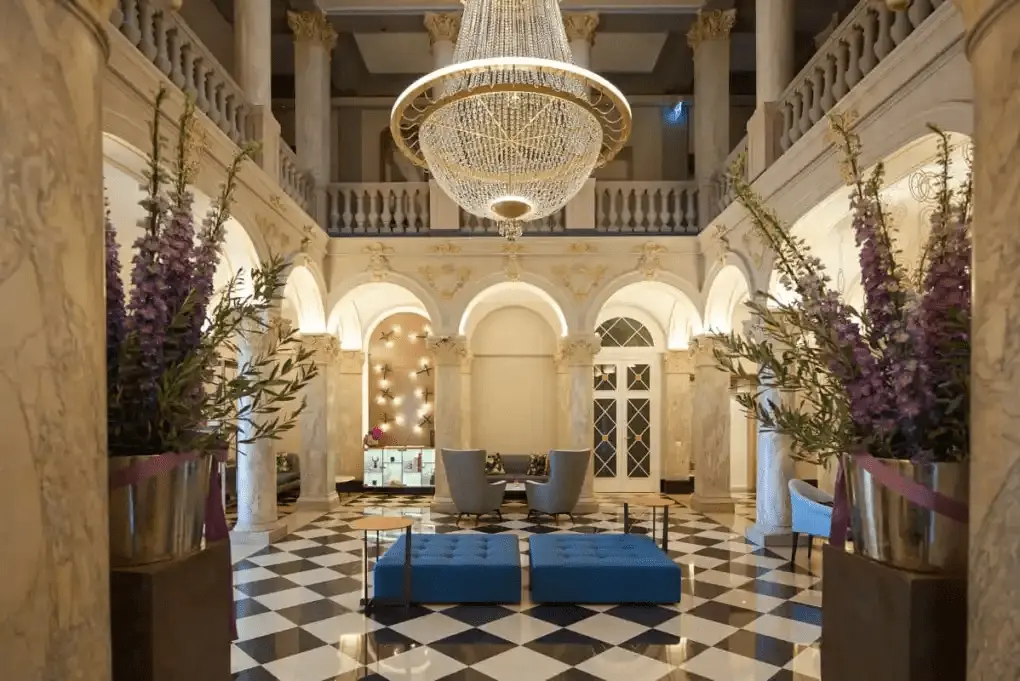
Ritz-Carlton Hotel de la Paix Geneva occupies the 1865 Italianate palazzo where the Alabama Claims arbitration established Geneva as the global seat of diplomatic resolution. Architect Jean-Marie Gignoux designed this lakefront structure as a statement of international authority—a building conceived to host the architects of peace treaties, not leisure tourists. The 1872 arbitration banquet between the United States and Great Britain marked the first modern mediation of its kind, a legacy that defines the property’s position among the world’s most politically significant addresses. Discover why this remains one of the best historic hotels in Geneva.
Ritz-Carlton Hotel de la Paix Geneva ★★★★★
The Ritz-Carlton Hotel de la Paix Geneva is not a hotel repurposed from diplomatic history—it was built for it. In 1865, architect Jean-Marie Gignoux delivered an Italianate palazzo on the shores of Lake Geneva precisely as the city emerged as Europe’s neutral ground for international arbitration. The name “de la Paix” was not marketing; it was political positioning. Geneva was becoming the capital of mediated power, and this building was designed to house the delegations who would write the treaties.
The Ritz-Carlton Hotel de la Paix Geneva is a historic 1865 Italianate palace on Lake Geneva, famous for hosting the Alabama Claims banquet and the signature Grace Kelly Suite.
The Alabama Claims arbitration of 1872—the first binding international mediation between the United States and Great Britain—was sealed with an official banquet held in these halls. That event established a precedent: disputes between global powers would no longer require war. They required a neutral city, a discreet venue, and a building designed to project authority without ostentation. This property delivered all three. The six-story central atrium, supported by superimposed columns and open galleries, was conceived as a statement of vertical dominance—a spatial declaration that important people conduct important business here.
In 1908, architect Alfred Olivet merged the original structure with the adjacent residential building, creating a unified estate that expanded the hotel’s capacity to host extended delegations and royal entourages. The consolidation was not aesthetic—it was operational. More suites meant more simultaneous missions. Geneva’s role as the seat of the League of Nations (and later the United Nations European headquarters) required properties capable of housing competing interests under one roof without diplomatic incident. The Ritz-Carlton Hotel de la Paix became that address.
The property’s Grace Kelly Suite is a direct link to 20th-century aristocratic power. The Princess of Monaco was a frequent guest, and the suite now displays family photographs alongside Art Deco gold-leaf gilding—a design vocabulary reserved for heads of state. Orson Welles, Victor Hugo, and Giuseppe Garibaldi all occupied these rooms during their respective careers, each leveraging Geneva’s neutrality for political or creative refuge. The hotel’s “Galerie du Temps Suspendu” now features contemporary tapestries of these figures in the hallways, transforming circulation spaces into a curated timeline of European influence.
The 2017 redesign by Il Prisma stripped the property of heavy Belle Époque decor and installed a sleek palette of icy blues and cool grays—a deliberate rejection of nostalgia in favor of contemporary executive utility. The original 150-year-old walnut floors remain in The Living Room bar, anchored by a massive antique fireplace that once warmed post-treaty negotiations. The juxtaposition is intentional: modern luxury built on verified historical command.
Fiskebar, Geneva’s first Nordic-fusion restaurant, operates within the property as a Scandinavian counterpoint to French formality—fresh fish counters, minimalist design, and the fictional narrative of “Fred,” a traveling aristocrat whose eclectic collectibles line the bar. The lobby houses an outpost of Swiss Master Chocolatier Philippe Pascoët, offering artisanal confections as a continuation of Geneva’s centuries-old tradition of hosting Europe’s most discerning palates.
In 2016, The Ritz-Carlton brand formalized its first Swiss property by signing this estate—a recognition that the building’s diplomatic legacy aligned with the company’s positioning as the preferred address for global executives. The property does not offer an on-site spa; instead, it provides privileged access to the wellness facilities at the nearby Hotel President Wilson, maintaining its focus on in-suite privacy and the fitness center for guests who prioritize discretion over resort-style amenities.
This is not a lakefront escape. It is the physical address where binding arbitration replaced battlefield diplomacy, where Grace Kelly’s family photographs still occupy the Presidential Suite, and where 1865 Italianate authority continues to define Geneva’s role as the city where power is brokered, not broadcast.
Check Availability & Rates →The Ritz-Carlton Hotel de la Paix Geneva is the architectural proof that Geneva earned its neutrality through infrastructure, not ideology—1865 Italianate columns built to host the delegations who would rewrite the rules of international conflict resolution.
FAQ: Ritz-Carlton Hotel de la Paix Geneva
What is the historical significance of the Ritz-Carlton Hotel de la Paix Geneva?
The Ritz-Carlton Hotel de la Paix Geneva is the 1865 Italianate palazzo where the Alabama Claims arbitration of 1872 was concluded with an official banquet—the first binding international mediation between the United States and Great Britain. Architect Jean-Marie Gignoux designed the property as Geneva emerged as Europe’s neutral diplomatic capital, establishing the hotel as a deliberate seat of authority for treaty negotiations and extended royal delegations.
Who were notable guests at the Ritz-Carlton Hotel de la Paix Geneva?
Grace Kelly, Princess of Monaco, was a frequent guest; the Presidential Suite now bears her name and displays family photographs alongside Art Deco gold-leaf gilding. Orson Welles, Victor Hugo, and Giuseppe Garibaldi also occupied suites during their respective careers, using Geneva’s neutrality as political or creative refuge. The hotel’s hallways now feature contemporary tapestries of these historical figures in the “Galerie du Temps Suspendu.”
What architectural elements define the Ritz-Carlton Hotel de la Paix Geneva?
The property features a six-story central atrium with superimposed columns and open galleries designed by Jean-Marie Gignoux in 1865. In 1908, architect Alfred Olivet merged the original structure with an adjacent residential building to create a unified diplomatic estate. The 2017 Il Prisma redesign replaced traditional decor with icy blues and cool grays, while preserving the original 150-year-old walnut floors in The Living Room bar and the building’s antique fireplace.
Does the Ritz-Carlton Hotel de la Paix Geneva have a spa?
The property focuses on in-suite treatments and a fitness center, maintaining its emphasis on privacy and discreet service for executive guests. Visitors seeking full spa facilities receive privileged access to the wellness amenities at the nearby Hotel President Wilson, ensuring access to comprehensive treatments without compromising the boutique hotel’s architectural integrity or intimate scale.
Legacy Verified: Geneva’s Diplomatic Authority Continues
The Ritz-Carlton Hotel de la Paix Geneva remains the physical address where arbitration replaced war, where Grace Kelly’s suite still holds her family archive, and where 1865 architecture continues to define what it means to occupy a position of neutral global command.
For guests seeking properties where history is not decor but documented authority, consider the lakefront grandeur of Four Seasons Hotel des Bergues Geneva or the belle époque diplomacy of Beau-Rivage Genève.
For more curated itineraries and luxury-focused travel insights, visit Your Luxury Guide. For official travel information and destination updates, visit Switzerland tourism-info.
Your Luxury Guide — Where Exceptional Travel Begins.