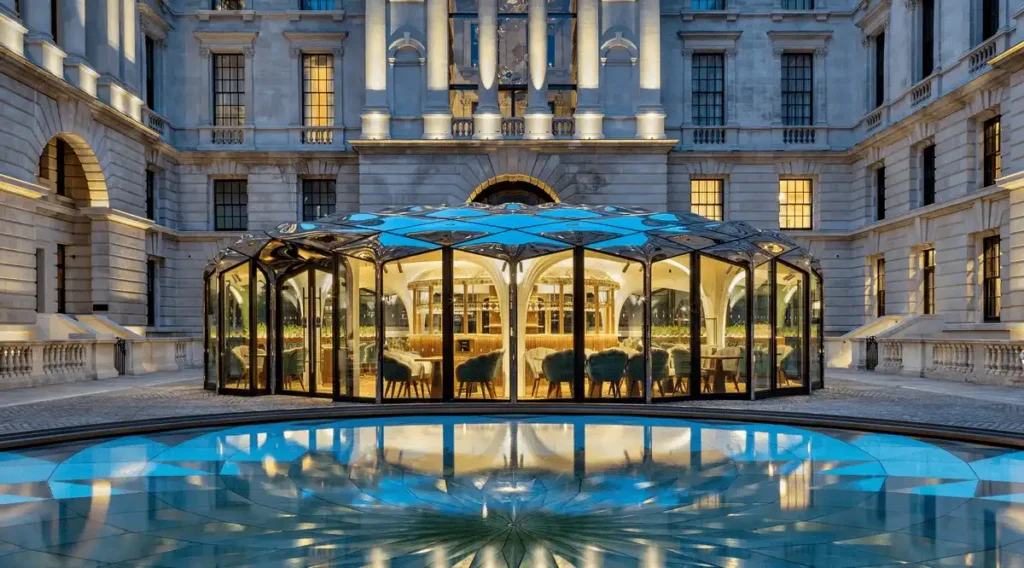
Raffles London at The OWO occupies the 1906 Old War Office—the administrative seat of the British Empire’s military dominance through two World Wars. Churchill directed global strategy from these corridors. Fleming conceived the 007 mythology within these walls. The building’s transformation from the nerve center of British intelligence into London’s most historically weighted residence delivers an experience that cannot be replicated: you inhabit the physical architecture of British imperial command.
This is not heritage decoration—this is the verified seat of 20th-century power, now accessible as 120 suites and residences where every corridor, every marble step, every wood-paneled suite retains the authority of its original function. See the complete collection of best historic hotels in London.
Raffles London at The OWO ★★★★★
The 1906 Old War Office was not designed for comfort—it was engineered for dominance. Architect William Young constructed an Edwardian Baroque fortress that required 25 million bricks and 26,000 tons of Portland stone. The trapezoidal footprint spans an irregular site with 1,100 original rooms and 2.5 miles of internal corridors. Four asymmetrical corner domes mask the building’s non-uniform geometry.
The structure was purpose-built to house the entire administrative apparatus of the British Army at the apex of imperial reach. From 1906 to 1964, every major military decision—World War I trench warfare, World War II strategic bombing, post-colonial redeployment—was planned, authorized, and executed from these offices.
Raffles London at The OWO is a monumental Edwardian masterpiece situated at the heart of British power, a former War Office where Winston Churchill directed military strategy and Ian Fleming found the inspiration for James Bond among its 2.5 miles of secret corridors.
The building’s secondary function was equally decisive: in 1909, the Secret Service Bureau established its first headquarters here, eventually splitting into MI5 and MI6. The original “Spies Entrance” on Whitehall Court remains intact. Ian Fleming worked in Naval Intelligence within these walls during WWII; the building’s labyrinthine corridors, clandestine meeting rooms, and high-security protocols directly inspired the James Bond novels.
T.E. Lawrence drafted specialized maps of the Sinai Peninsula in the Map Department before transforming into “Lawrence of Arabia.” Mansfield Cummings—the first chief of the Secret Intelligence Service and the real-life template for “M”—ran covert operations from a third-floor suite.
Winston Churchill occupied a grand office suite as Secretary of State for War (1919–1921) and returned repeatedly during WWII to direct Allied strategy. The physical evidence of his occupation—the wood paneling, the proportions of the rooms, the sight lines to Whitehall—has been preserved and integrated into five Heritage Suites. These are not replicas; they are the original chambers where Churchill made command decisions, now available as overnight accommodations with 14-foot ceilings and period oak finishes.
The Hinduja Group’s 8-year restoration employed 1,500 specialized artisans. The Grand Staircase—a ceremonial centerpiece of translucent Carrara marble with Brescia marble handrails and Derbyshire alabaster balusters—was hand-restored to its 1906 specifications. Hand-laid mosaic floors were reconstructed tile-by-tile. New subterranean excavations extend 20 meters below ground, creating a double-height Whitehall Ballroom (capacity: 600) and the UK’s first Guerlain Spa, a 2,500 m² four-story wellness complex with a 20-meter pool.
The Spy Bar occupies former MI5 interrogation rooms in the subterranean levels. A 1960s Aston Martin DB5—the vehicle associated with early Bond films—serves as the visual anchor. The Guards Bar honors the building’s link to the Household Cavalry; the signature “London Sling” and LOUIS XIII cognac service reference the luxury protocols of military command hierarchies.
The 120 suites are not standard luxury accommodations—they are carved from the administrative offices where global power was exercised. The scale, the materials, the spatial authority: these are the environments where the British Empire made its final strategic calculations.
The site itself predates the 1906 structure. The Old War Office was built atop the remains of Whitehall Palace, once Europe’s largest palace and the location where Henry VIII died in 1547.
The layering of royal, military, and intelligence functions across five centuries creates a density of historical authority that is architecturally unique in London.
Check Availability & Rates →You do not stay in a building that resembles power—you occupy the verified chambers where Churchill, Fleming, and Cummings exercised it. The marble underfoot, the paneling on the walls, the corridors that once transmitted classified intelligence: this is not curated heritage, this is the irreplaceable architecture of British imperial command.
FAQ: Raffles London at The OWO
What is the historical significance of Raffles London at The OWO?
The Old War Office served as the administrative headquarters of the British Army from 1906 to 1964 and housed the Secret Service Bureau (precursor to MI5 and MI6) from 1909. Winston Churchill maintained offices here while directing military strategy during both World Wars. Ian Fleming worked in Naval Intelligence within the building during WWII, and the setting directly inspired the James Bond novels. The structure represents the physical seat of British military and intelligence power throughout the 20th century.
What architectural features define the building’s design?
Designed by architect William Young in 1906, the building is an Edwardian Baroque masterpiece requiring 25 million bricks and 26,000 tons of Portland stone. The irregular trapezoidal site contains 1,100 original rooms and 2.5 miles of corridors. The Grand Staircase is constructed from translucent Carrara marble with Derbyshire alabaster balusters. Four asymmetrical corner domes mask the non-uniform geometry. An 8-year restoration by 1,500 artisans preserved original mosaics, carved marble, and wood paneling.
What unique amenities does the hotel offer?
The Spy Bar occupies former MI5 interrogation rooms and features a 1960s Aston Martin DB5. The UK’s first Guerlain Spa spans 2,500 m² across four subterranean floors with a 20-meter pool. Five Heritage Suites are located in Winston Churchill’s original wood-paneled offices with 14-foot ceilings. The Whitehall Ballroom is a double-height event space for 600 guests, accessed via the ceremonial Grand Staircase. The Guards Bar serves LOUIS XIII cognac in honor of the Household Cavalry.
Who were the key historical figures associated with the building?
Winston Churchill served as Secretary of State for War (1919–1921) from a suite of offices here and returned during WWII to direct Allied strategy. Ian Fleming worked in Naval Intelligence and used the building as inspiration for James Bond. Mansfield Cummings, the first chief of the Secret Intelligence Service and real-life model for “M,” ran operations from the third floor. T.E. Lawrence (Lawrence of Arabia) worked in the Map Department creating specialized Sinai maps.
The Authority Remains
The Old War Office was never a ceremonial building—it was an operational fortress. Every suite, every corridor, every limestone block was engineered to support the machinery of imperial command. The transformation into Raffles London preserves that architectural authority while integrating the utility required by modern power. You are not visiting a museum; you are occupying the same spatial command hierarchy that directed two World Wars.
Explore comparable estates at The Lanesborough London and Brown’s Hotel London.
For more curated itineraries and luxury-focused travel insights, visit Your Luxury Guide. For official travel information and destination updates, visit Britain tourism-info.
Your Luxury Guide — Where Exceptional Travel Begins.