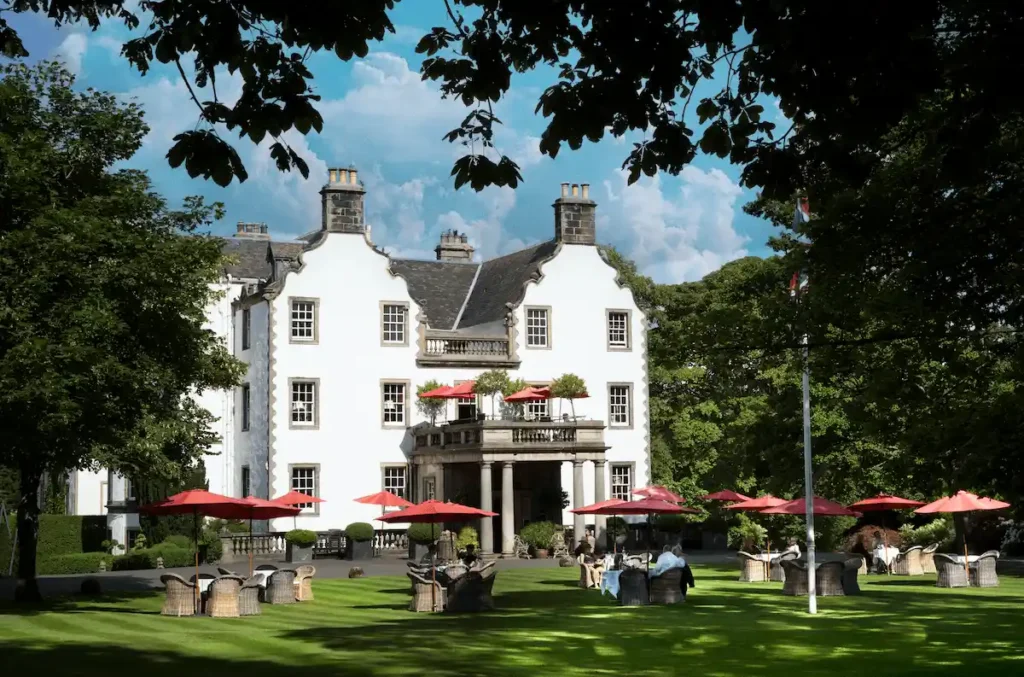
Prestonfield House is not a hotel conversion; it is the 1687 seat of Edinburgh’s Lord Provost, designed by Sir William Bruce—architect of the Palace of Holyroodhouse—to receive royalty and shape diplomatic outcomes. The same Italian craftsmen who decorated the Crown’s chambers executed the plasterwork here. Benjamin Franklin walked these halls as a guest of the Dick baronetcy, a family that held this estate for 250 years and maintained direct lines to the Scottish throne.
You occupy their architecture, their social access, and the 20 acres of parkland where peacocks still roam as they did when this was the private domain of Scotland’s governing class. For context on Edinburgh’s elite architectural lineage, see our collection of the best historic hotels in Edinburgh.
Prestonfield House ★★★★★
Sir William Bruce built Prestonfield in 1687 for Sir James Dick, Lord Provost of Edinburgh, creating a Baroque command center disguised as a country house. The curvilinear Dutch gables and white-harled walls mark it as premier 17th-century Scottish architecture, but the real authority lies in the interiors: Italian plasterwork executed by the same masters who worked the Palace of Holyroodhouse. This was not decorative; it was a calculated display of equivalence with the Crown itself.
Prestonfield House is a 1687 Baroque masterpiece set within 20 acres of private parkland beneath Arthur’s Seat, a historic mansion where Benjamin Franklin once stayed and where the first rhubarb in Scotland was cultivated.
The Dick family baronetcy occupied this estate for over 250 years, using it as a staging ground for royal visits and diplomatic negotiations. When Benjamin Franklin arrived in 18th-century Edinburgh, he stayed here—not at an inn, but as a guest of the baronetcy, embedded within Scotland’s power structure. The property has hosted monarchs, shaped trade agreements, and functioned as a satellite court for over three centuries.
James Thomson’s 2003 acquisition reinvented the mansion with maximalist interiors—rich silks, velvets, 17th-century antiques—that amplify rather than soften the historical weight. Each of the 23 chambers is individually designed; there are no “standard” rooms because the architecture itself resists standardization. The Leather Room features intact 17th-century cordwain panels from Córdoba—stamped leather walls that have survived 300 years. This is not preservation theater; it is continuity of material authority.
The 20-acre parkland operates as a private estate within the city. Free-roaming peacocks and Highland cattle maintain the agricultural footprint of the original holdings. The estate introduced rhubarb to Scotland in the 18th century, brought from China by a family member and cultivated here before spreading across the country. The converted 19th-century circular stables now host events for up to 500 guests, but the bones remain those of a working aristocratic compound.
Rhubarb Restaurant occupies two Regency-style rooms overlooking the gardens, serving fine dining in what was once the family’s private entertaining space. The Yellow Room—bright, opulent, lined with original family portraits—functions as the afternoon tea salon, with service extending into the gardens during summer. The wood-paneled Whisky Bar offers rare malts in an intimate setting that replicates the private clubs where Scotland’s governing class conducted actual business.
The architecture is experiential, not decorative. The grand hallways, historic staircases, and vaulted ceilings map the spatial hierarchies that defined 17th-century power. You move through the same passages that carried Franklin, the same rooms that hosted royal audiences. The estate’s position at the foot of Arthur’s Seat—Edinburgh’s volcanic prominence—gave the Dick family both symbolic elevation and strategic sightlines over the city.
This is the physical infrastructure of Scotland’s Baroque governing elite, now monetized for occupation. The Italian plasterwork, the leather walls, the parkland—all are original assets, maintained because they represent durable markers of historical dominance. You are inhabiting the architecture that created Scotland’s diplomatic relationships with England and continental Europe during the period when Edinburgh functioned as a sovereign capital.
Check Availability & Rates →Prestonfield operates as Edinburgh’s living argument that political authority and architectural permanence are inseparable—a Baroque mansion where Franklin negotiated ideas with Scotland’s governing class, and where the Italian plasterwork still commands the same visual hierarchy it did when the Crown’s craftsmen installed it in 1687.
FAQ: Prestonfield House
What is the historical significance of Prestonfield House?
Prestonfield House was built in 1687 by Sir William Bruce, architect of the Palace of Holyroodhouse, as the private residence of Sir James Dick, Lord Provost of Edinburgh. The mansion served as a diplomatic and royal entertaining venue for over 250 years under the Dick baronetcy, hosting figures including Benjamin Franklin. Its Italian plasterwork, executed by the same craftsmen who worked the royal palace, establishes it as one of Scotland’s premier examples of 17th-century Baroque architecture with direct Crown connections.
Who designed Prestonfield House and what makes its architecture unique?
Sir William Bruce designed Prestonfield House in 1687 using distinctive curvilinear Dutch gables and white-harled walls that define 17th-century Scottish Baroque. The interiors feature original Italian plasterwork installed by royal craftsmen, and the Leather Room contains intact 17th-century cordwain panels from Córdoba, Spain. The architecture was purpose-built to host royalty and diplomats, functioning as an extension of Edinburgh’s governing infrastructure rather than a standard country house.
What modern amenities exist within the historic estate?
The estate maintains 20 acres of parkland with free-roaming peacocks and Highland cattle. Rhubarb Restaurant occupies two Regency rooms serving fine dining, while The Yellow Room hosts afternoon tea surrounded by original family portraits. The Whisky Bar offers rare malts in a wood-paneled private club setting. The converted 19th-century circular stables accommodate events for up to 500 guests, and all 23 chambers feature unique maximalist interiors with silks, velvets, and 17th-century antiques—no standard rooms exist.
Why was Benjamin Franklin a guest at Prestonfield House?
Benjamin Franklin stayed at Prestonfield during his 18th-century visits to Edinburgh as a guest of the Dick baronetcy, which maintained close ties to Scotland’s governing and intellectual elite. The house functioned as a diplomatic and social hub where visiting figures of Franklin’s stature were embedded within Scotland’s power structure rather than housed in commercial accommodations, facilitating the exchange of political and scientific ideas with the Scottish Enlightenment’s key participants.
The Architecture That Governed Scotland
Prestonfield House translates 337 years of Scottish diplomatic authority into overnight occupation. Sir William Bruce built it to receive monarchs; you occupy that infrastructure. For equivalents in Edinburgh’s baronial lineage, explore The Witchery by the Castle or The Caledonian Edinburgh—both properties that similarly monetize Scotland’s architectural command.
For more curated itineraries and luxury-focused travel insights, visit Your Luxury Guide. For official travel information and destination updates, visit Britain tourism-info.
Your Luxury Guide — Where Exceptional Travel Begins.