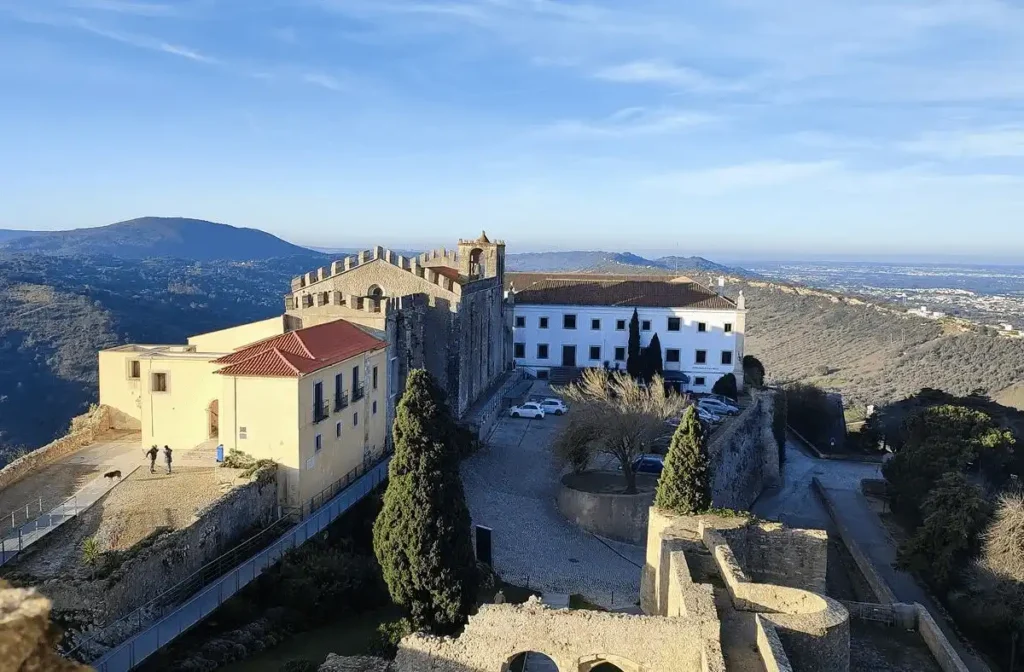
Pousada Castelo de Palmela occupies a 12th-century fortress that dominated the strategic high ground above the Setúbal Peninsula for over eight centuries. Built by the Knights of the Order of Santiago, this military stronghold commanded territorial control over the Atlantic trade routes and the surrounding agricultural valleys. The castle’s elevation and defensive masonry—battlements, watchtowers, and fortified courtyards—established it as an unassailable seat of regional authority.
Today, the fortress operates as a castle hotel where guests inhabit the same command position that once projected military and economic dominance across southern Portugal. For travelers seeking properties that embody territorial power, explore the best castle stays across Portugal.
Pousada Castelo de Palmela ★★★★
This fortress was not built for comfort—it was engineered for dominance. The Knights of Santiago constructed Pousada Castelo de Palmela in the 12th century as a military installation designed to control the Setúbal Peninsula and defend against Moorish incursions. The castle’s elevation—positioned on the Serra da Arrábida’s commanding heights—provided unobstructed sightlines across the Atlantic approaches and the fertile plains below.
This was a seat of strategic surveillance, where territorial control was maintained through physical superiority and geographic advantage.
Pousada Castelo de Palmela offering a monumental retreat within the walls of a strategic Moorish-founded fortress.
The defensive architecture reinforces the fortress’s original purpose. Thick stone battlements encircle the property, while watchtowers mark each cardinal point of surveillance. The castle’s courtyards, originally designed for military assembly and cavalry staging, now serve as open-air terraces where guests occupy the same elevated vantage points that once monitored trade routes and agricultural production.
The fortified walls, still intact, create a physical barrier that separates the property from the surrounding landscape—an architectural statement of sovereignty that remains as effective today as it was eight centuries ago.
The rooms occupy the castle’s historic living quarters, where the Order of Santiago’s commanders directed regional military operations. Vaulted stone ceilings, wrought-iron fixtures, and narrow archer windows preserve the fortress’s austere military character. The spatial experience is one of enclosure and security—guests inhabit chambers designed to withstand siege conditions, where the thickness of the masonry provides absolute acoustic and visual privacy.
The property’s restoration has maintained these defensive qualities while integrating modern climate control and contemporary bathrooms concealed within the original stone infrastructure.
The dining hall operates within the castle’s former refectory, a vaulted chamber where military officers and visiting nobility once took meals. The space retains its monastic severity—stone walls, minimal ornamentation, and long communal tables that emphasize the fortress’s hierarchical social structure. The kitchen produces traditional Portuguese cuisine anchored by ingredients sourced from the Setúbal Peninsula’s agricultural estates, maintaining the castle’s historic role as a provisioning hub for the region’s landholding elite.
The property’s terrace commands panoramic views across the Setúbal Peninsula, the Sado Estuary, and the Atlantic horizon. This vantage point—the same elevation that provided the Knights of Santiago with tactical superiority—now offers guests unobstructed sightlines that extend for dozens of kilometers. The spatial experience reinforces the castle’s original purpose: this is a position of territorial observation, where geographic dominance translates directly into social authority.
Guests inhabit the same command post that once directed regional military and economic power, occupying a legacy of strategic supremacy that remains embedded in the fortress’s physical architecture.
Check Availability & Rates →Pousada Castelo de Palmela stands as Portugal’s most authentic military fortress hotel—a 12th-century stronghold where territorial command remains the defining experience. Guests occupy the Knights of Santiago’s strategic command post, inhabiting a seat of regional authority that has projected power across the Setúbal Peninsula for over 800 years.
FAQ: Pousada Castelo de Palmela
What makes Pousada Castelo de Palmela historically significant?
Built in the 12th century by the Knights of the Order of Santiago, Pousada Castelo de Palmela functioned as a military fortress controlling the Setúbal Peninsula. Its strategic elevation provided surveillance over Atlantic trade routes and agricultural territories, establishing it as a regional seat of military and economic authority for over eight centuries.
What defensive features define the castle’s architecture?
The fortress includes original battlements, watchtowers positioned at cardinal surveillance points, fortified courtyards designed for cavalry staging, and thick stone walls engineered for siege resistance. These defensive elements create a physical barrier that separates the property from the surrounding landscape, reinforcing the castle’s position of territorial dominance.
What views does the castle command?
The property’s elevation provides unobstructed panoramic sightlines across the Setúbal Peninsula, the Sado Estuary, and the Atlantic Ocean. This vantage point—the same used by the Knights of Santiago for tactical surveillance—extends for dozens of kilometers, offering guests the strategic observation position that once directed regional military operations.
How does the property preserve its military character?
Rooms occupy the fortress’s original living quarters, featuring vaulted stone ceilings, archer windows, and austere military architecture. The dining hall operates within the castle’s former refectory, maintaining its monastic severity. Modern restorations integrate contemporary amenities within the original defensive infrastructure without compromising the fortress’s architectural integrity.
Territorial Command Preserved in Stone
Pousada Castelo de Palmela represents Portugal’s most complete expression of military fortress architecture adapted for contemporary hospitality. Guests inhabit the Knights of Santiago’s strategic command post, occupying a position of territorial authority that has projected regional dominance for over 800 years.
Travelers seeking similar expressions of defensive power and elevated command, Pousada Castelo de Óbidos offers medieval fortress dominance within royal defensive walls, while Pousada Castelo de Estremoz provides 13th-century royal citadel authority above the Alentejo plains.
For more curated itineraries and luxury-focused travel insights, visit Your Luxury Guide. For official travel information and destination updates, visit Portugal tourism-info.
Your Luxury Guide — Where Exceptional Travel Begins.