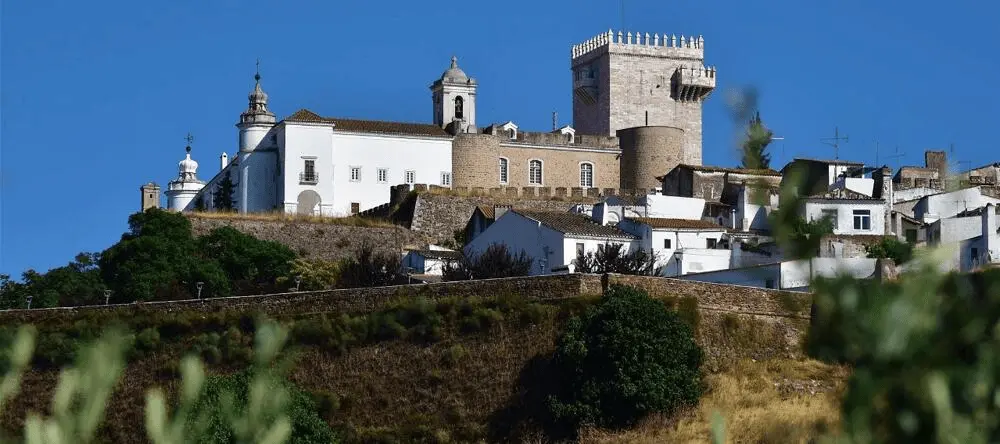
Pousada Castelo de Estremoz occupies the 13th-century royal castle where King Dinis reinforced Portuguese sovereignty over the strategic Alentejo frontier. The original fortifications—battlements, the three-story Torre das Três Coroas, and the Chapel of Queen Saint Isabel—establish this pousada as a seat of documented monarchical authority.
The 33 suites inhabit the castle’s defensive masonry, where guests occupy rooms designed to enforce territorial command. This is not a hotel experience—this is occupancy of a verified seat of power. Discover more exceptional properties in our guide to the best castle hotels across Portugal.
Pousada Castelo de Estremoz ★★★★
The castle’s construction commenced in 1258 under King Afonso III, completed by King Dinis in 1281 as the primary defensive structure controlling the Portuguese-Spanish borderlands. The fortress architecture reflects absolute military dominance: walls exceeding 2.5 meters in thickness, a strategic hilltop position commanding 360-degree surveillance of the Alentejo plains, and the Torre das Três Coroas—a three-story keep that functioned as the royal residence and command center during Portugal’s territorial consolidation campaigns.
Queen Saint Isabel of Aragon died within these walls in 1336, establishing the castle’s permanent status as a pilgrimage site and royal memorial. The Chapel of Queen Saint Isabel, with its 17th-century azulejo panels depicting scenes from her life, anchors the spiritual authority of the complex alongside its military legacy.
Pousada Castelo de Estremoz preserves royal heritage within a magnificent marble stronghold that serves as the architectural crown of the Alentejo’s “white city.”
The physical dominance of the castle remains uncompromised. The battlements provide direct visual command over Estremoz’s marble quarries—the economic engine that funded the Iberian aristocracy for six centuries. The defensive moat, now a formal garden, reinforces the castle’s separation from civilian access, preserving the sovereign isolation that defined medieval royal life.
The 33 suites occupy the castle’s historic apartments and noble quarters, where vaulted ceilings, Manueline windows, and period furnishings maintain the aesthetic authority of the original royal residence. The Pousada’s restaurant operates within the former palace dining hall, where 15th-century frescoes and heraldic emblems confirm the lineage of every meal served beneath monarchical iconography.
The Audience Hall—where King Dinis received ambassadors and issued territorial decrees—functions today as the pousada’s primary reception space. Guests traverse the same marble floors where diplomatic authority was exercised for three centuries. The castle’s library preserves manuscripts detailing the fortress’s role in the War of Portuguese Restoration (1640–1668), when these walls repelled Spanish siege attempts.
This is not merely accommodation within a historic building. This is territorial occupancy of the fortress that secured Portuguese independence, where the physical architecture enforces absolute privacy through defensive masonry designed to repel invasion.
The castle’s grandeur does not rely on metaphor—it is quantified by wall thickness, documented military victories, and verifiable royal residency spanning four centuries.
Check Availability & Rates →“To occupy Pousada Castelo de Estremoz is to inhabit the sovereign command center of the Alentejo—a fortress where Portuguese monarchs governed territorial expansion, diplomatic negotiations, and military campaigns from the same battlements that today offer panoramic authority over the marble plains that built an empire.”
FAQ: Pousada Castelo de Estremoz
What is the historical significance of Pousada Castelo de Estremoz?
Pousada Castelo de Estremoz is a 13th-century royal fortress commissioned by King Afonso III and completed by King Dinis in 1281 to secure Portuguese sovereignty over the Alentejo frontier. Queen Saint Isabel of Aragon died within the castle in 1336, establishing it as both a military stronghold and royal memorial site. The Torre das Três Coroas served as the royal command center during Portugal’s territorial consolidation campaigns.
What makes Pousada Castelo de Estremoz a luxury castle hotel?
The pousada occupies the original royal apartments and noble quarters within the 13th-century fortress, where 33 suites feature vaulted ceilings, Manueline windows, and period furnishings. Guests access the battlements for panoramic views over the Alentejo plains, dine within the former palace hall beneath 15th-century frescoes, and occupy the same marble-floored Audience Hall where King Dinis received ambassadors and issued territorial decrees.
Can guests access the Torre das Três Coroas at Pousada Castelo de Estremoz?
Yes. The three-story Torre das Três Coroas—the castle’s original royal keep—is accessible to guests and provides direct visual command over Estremoz’s historic marble quarries and the surrounding Alentejo plains. The tower functioned as the primary residence and strategic observation post for Portuguese monarchs during the fortress’s operational centuries.
What original architectural features are preserved at Pousada Castelo de Estremoz?
The pousada preserves the castle’s 2.5-meter-thick defensive walls, the Chapel of Queen Saint Isabel with 17th-century azulejo panels, the marble-floored Audience Hall with heraldic emblems, the battlements offering 360-degree surveillance, and the former palace dining hall with 15th-century frescoes. The defensive moat, now a formal garden, maintains the fortress’s spatial separation from civilian access.
The Seat of Sovereign Command
Pousada Castelo de Estremoz delivers territorial authority through verified defensive architecture and documented royal residency. The castle’s physical dominance—quantified by military victories, wall thickness, and monarchical occupancy—establishes this pousada as the definitive fortress stay in Portugal’s Alentejo region. For additional distinguished castle properties, explore Pousada Castelo de Óbidos and Pousada Castelo de Palmela.
For more curated itineraries and luxury-focused travel insights, visit Your Luxury Guide. For official travel information and destination updates, visit Portugal tourism-info.
Your Luxury Guide — Where Exceptional Travel Begins.