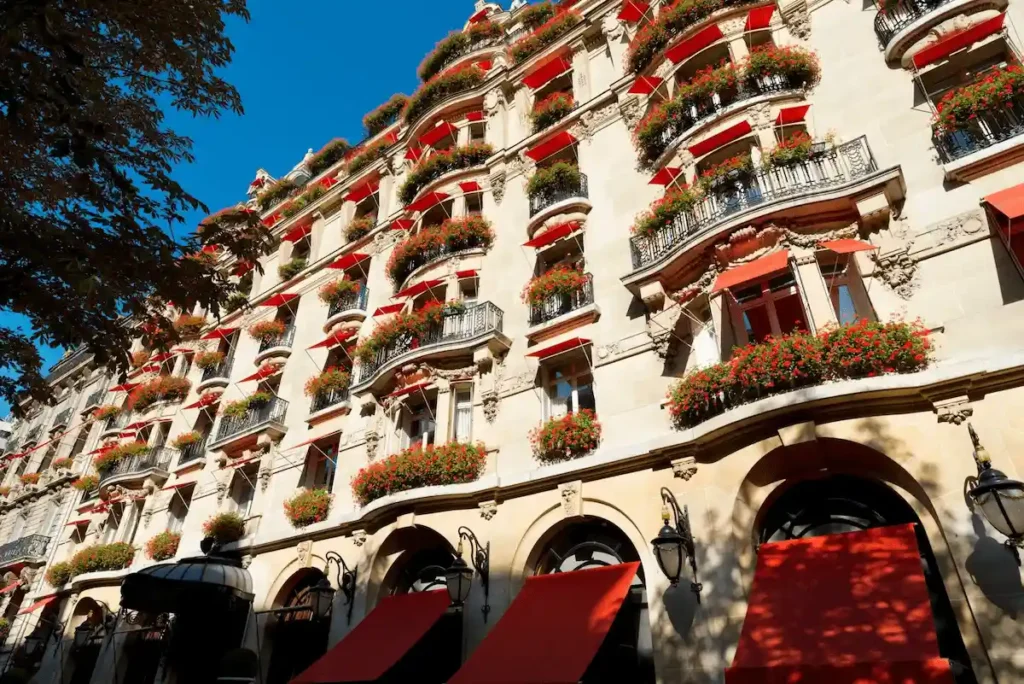
Avenue Montaigne commands Paris’s Golden Triangle—the three-block radius where global luxury is defined, negotiated, and executed. Since 1913, Plaza Athénée Paris has anchored this axis of elite commercial power, positioning guests at the center of Haute Couture’s historical seat of influence. The building functions as the operational headquarters for those who shape luxury markets, not merely consume them.
Hôtel Plaza Athénée – Dorchester Collection ★★★★★
The facade presents 1913 Parisian Haussmann architecture—balconied limestone that established Avenue Montaigne as the commercial corridor for European aristocracy’s post-Belle Époque restructuring. You’re occupying the same address where Christian Dior established his 1947 “New Look” headquarters directly opposite at number 30, fundamentally altering post-war fashion economics.
Hôtel Plaza Athénée epitomizes Parisian “Haute Couture” hospitality, serving as a glamorous sanctuary on Avenue Montaigne where the signature red awnings have welcomed the worlds of fashion and cinema since 1913.
The hotel functioned as the operational residence for Dior’s American buyers, Hollywood costume directors, and European textile heirs who financed the Haute Couture resurrection. This isn’t heritage storytelling—it’s documented market dominance.
The 208 rooms translate Belle Époque spatial hierarchy into contemporary executive utility. Suites retain original molded ceilings, Directoire paneling, and the grand proportion that signaled financial authority in 1913 Paris. The Eiffel Tower suites command direct sightlines to Gustave Eiffel’s 1889 iron monument—the visual axis of French engineering prestige.
Your morning espresso overlooks the same balcony vantage where Marlene Dietrich negotiated film contracts and Josephine Baker held post-performance salons. The Louis XV sitting rooms, the marble-appointed baths, and the private terraces function as theatrical spaces for conducting high-stakes transactions under conditions of absolute discretion.
Avenue Montaigne’s ground-floor positioning delivers immediate access to Dior, Chanel, Valentino, and Louis Vuitton flagship maisons—the institutional headquarters where seasonal collections are previewed to select clients before public release. You’re walking the same 200-meter corridor that Coco Chanel traversed from her Ritz residence to her Rue Cambon atelier.
The hotel’s concierge operates as your transactional intermediary, securing private showroom appointments, after-hours atelier access, and front-row positioning at Fashion Week shows. This is operational advantage, not tourist privilege.
Alain Ducasse au Plaza Athénée holds three Michelin stars—a designation awarded for technical mastery and sustained excellence in French culinary execution. Ducasse’s “naturalité” philosophy, implemented in 2014, eliminated meat and refined sugar, repositioning the menu around vegetable-forward haute cuisine before it became industry standard.
You’re dining in the same restaurant where Jacqueline Kennedy held private dinners and where contemporary heads of state conduct off-record negotiations. The Relais Plaza brasserie functions as Avenue Montaigne’s social clearing-house—where fashion editors, luxury brand CEOs, and private equity principals conduct morning intelligence exchanges over café crème.
The Dior Institut spa occupies 2,300 square meters of subterranean space, retrofitted with La Prairie treatment protocols and private hammam chambers. This isn’t wellness theater—it’s precision recovery infrastructure for executives operating under transatlantic time zones. The indoor pool, heated to 28°C year-round, features underwater music systems and private cabanas.
Check Availability & Rates →Plaza Athénée doesn’t offer Parisian luxury—it defines the terms under which global elites access French cultural authority. You’re inhabiting the operational command post where fashion dynasties, diplomatic negotiations, and entertainment industry contracts have been structured since 1913. This is institutional power, executed through Belle Époque architecture.
FAQ: Plaza Athénée Paris
What makes Plaza Athénée Paris historically significant?
Opened 1913, the hotel anchored Avenue Montaigne during its transformation into Paris’s Haute Couture headquarters. Christian Dior established his 1947 “New Look” atelier directly opposite, with Plaza Athénée housing his international buyers and Hollywood costume designers. The property functioned as the residential-operational hub for post-war fashion industry restructuring, positioning guests within the commercial center of luxury goods production.
Which rooms offer the best historic experience at Plaza Athénée?
The Eiffel Tower Suites retain 1913 architectural elements—original molded ceilings, Directoire paneling, and private terraces with direct Eiffel Tower sightlines. These rooms replicate the spatial hierarchy used by European aristocracy and entertainment industry executives who resided here during Belle Époque and Jazz Age Paris. The Louis XV décor and grand proportions mirror the hotel’s function as a diplomatic-commercial meeting ground.
How does Plaza Athénée’s location provide access to Paris luxury infrastructure?
Avenue Montaigne positions guests within 200 meters of Dior, Chanel, Valentino flagship maisons—the institutional headquarters where pre-release collections are previewed. The hotel’s concierge secures private showroom access, after-hours atelier appointments, and Fashion Week front-row positioning. This proximity replicates the operational advantage historically held by fashion editors and luxury brand executives.
What dining authority does Plaza Athénée maintain?
Alain Ducasse’s three-Michelin-star restaurant pioneered “naturalité” cuisine in 2014, eliminating meat and refined sugar before industry adoption. The Relais Plaza brasserie functions as Avenue Montaigne’s social hub where fashion industry principals, luxury CEOs, and diplomatic staff conduct morning intelligence exchanges. Jacqueline Kennedy held private dinners here; contemporary heads of state maintain this tradition.
Avenue Montaigne Command: Where Luxury Markets Are Structured
Plaza Athénée doesn’t compete for Paris luxury positioning—it established the standard in 1913 and continues to define the operational terms. You’re inhabiting the same address where Christian Dior’s American buyers financed post-war French fashion resurrection, where Marlene Dietrich negotiated MGM contracts, and where contemporary fashion dynasties structure seasonal collection launches. This is institutional authority, not boutique charm.
For additional Golden Triangle command posts, review Hotel de Crillon and Shangri-La Paris.
For more curated itineraries and luxury-focused travel insights, visit Your Luxury Guide. For official travel information and destination updates, visit France tourism-info.
Your Luxury Guide — Where Exceptional Travel Begins.