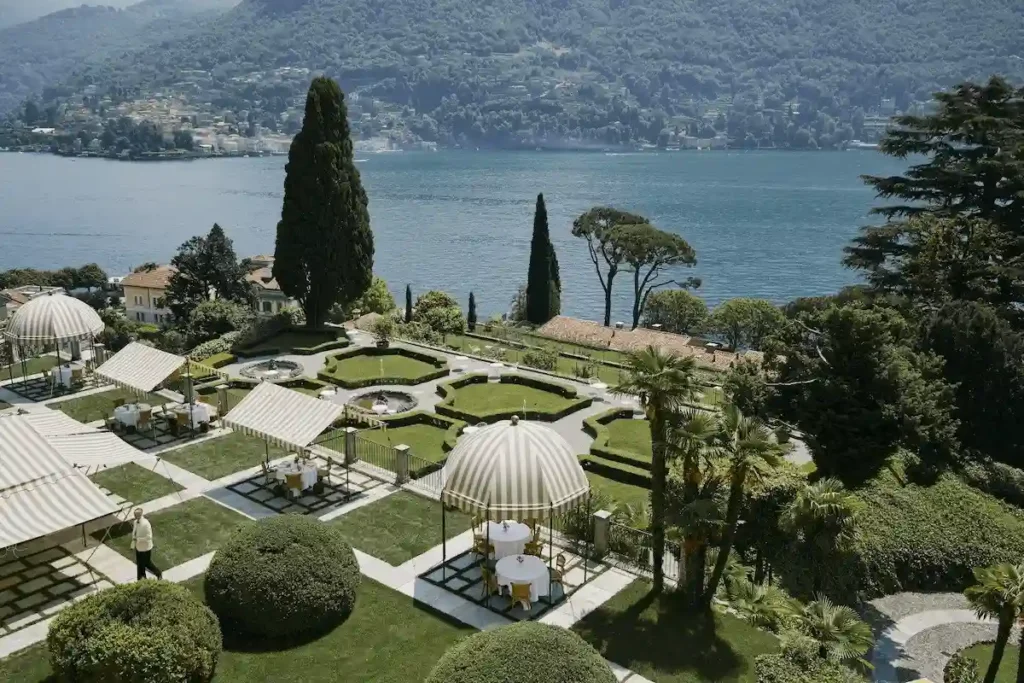
Passalacqua occupies land that served as a papal retreat before its foundations were laid in 1787. Designed by Milanese architect Carlo Felice Soave for Count Andrea Lucini-Passalacqua, this estate became a seat of power where Napoleon Bonaparte chose to conduct high-level negotiations away from Milan. Composer Vincenzo Bellini lived here in 1829, writing Norma and La Sonnambula in the villa’s music room.
After a meticulous restoration by the De Santis family, Passalacqua reopened in 2022 as a 24-suite hotel that preserves the estate’s authority while delivering contemporary luxury. The property combines its diplomatic and artistic legacy with terraced gardens, underground tunnels, and vintage motor launches. For travelers seeking historic estates that shaped European culture, explore the best historic hotels in Lake Como.
Passalacqua – ★★★★★
Passalacqua’s 24 suites occupy three distinct buildings across seven acres of terraced gardens. The Villa retains its 18th-century frescoes and vaulted ceilings—spaces where Napoleon once met with advisors and where Bellini’s music still resonates. The Palazz, converted from the original stables, features exposed timber beams and stone walls, while Casa al Lago sits directly on the waterfront with private gardens and immediate lake access.
Passalacqua is a prestigious lakeside estate that offers guests the rare privilege of residing within a restored neoclassical villa, blending its 18th-century aristocratic heritage with seven acres of terraced gardens that descend to the shores of Lake Como.
The estate’s 15 fountains and centuries-old cedars establish the scale of the original grounds. The organic vegetable garden supplies the kitchens, where Chef prepares alta cucina di casa—elevated home cooking served without formal menus. Guests walk into the kitchen, review what was harvested that morning, and discuss preparations directly with the chef. This removes the transactional structure of traditional dining and replicates the experience of owning the estate.
The restoration sourced 20 varieties of Italian marble, including Breccia Pontificia, the same stone used in Vatican construction. Bed linens are woven from birch fiber by Beltrami—a wood-based fabric that surpasses both silk and linen in texture and breathability. Murano “crinoline” chandeliers required reinforced ceiling beams to support their weight. These are not decorative upgrades; they are historically accurate restorations that maintain the villa’s material authority.
The spa operates within the original vaults and stable foundations, featuring Dr. Barbara Sturm treatments and a humid area accessed through a 300-year-old underground tunnel. This passage was originally built for servants to move between the villa and lakefront without being seen. Today, it functions as a climate-controlled walkway that connects the main buildings to the water.
The pool terrace overlooks Lake Como from an elevated garden position. Designer JJ Martin of La DoubleJ created custom umbrellas and lounge cushions using vintage Milanese prints, making the space a curated visual experience. The fitness area sits within an olive grove facing the lake, alongside a red clay tennis court and bocce court.
Two vintage motor launches—the Giumello II and the sportier Didi—remain docked at the private pier. Both are wood-carved vessels maintained in showroom condition, accompanied by a private boatman for lake excursions. These aren’t rental boats; they are floating artifacts that extend the estate’s heritage onto the water.
Bellini’s grand piano still occupies the music room where he composed “Casta Diva.” The acoustics and garden views that inspired him remain unchanged. The estate doesn’t advertise this as a museum piece; it’s an active instrument available to guests who understand its significance.
Passalacqua was named “The World’s Best Hotel” in 2023, but the award reflects what the property has always been: a private estate where European power brokers and artists sought refuge from public life. The De Santis family’s restoration returned the villa to its original function—a place where guests inhabit legacy rather than simply observe it.
Check Availability & Rates →Built on papal ground and shaped by diplomats and composers, Passalacqua remains what it was in 1787: a private command post on Lake Como where authority and artistry converge within stone walls and terraced gardens.
FAQ: Passalacqua
What makes Passalacqua historically significant?
Passalacqua was built in 1787 on land that served as a retreat for Pope Innocent XI. Napoleon Bonaparte stayed here to conduct diplomatic work away from Milan, and composer Vincenzo Bellini wrote his operas Norma and La Sonnambula in the villa’s music room in 1829.
How many suites does Passalacqua have?
The estate features 24 suites distributed across three buildings: The Villa with original frescoes, The Palazz converted from stables with exposed beams, and Casa al Lago with direct lakefront access and private gardens.
What amenities are available at Passalacqua?
Guests access seven acres of terraced gardens with 15 fountains, a panoramic pool designed by JJ Martin, a spa in the original vaults with underground tunnel access, a lakefront gym, tennis and bocce courts, and two vintage motor launches with a private boatman.
Does Passalacqua have a restaurant?
There are no formal menus or dining hours. Chef invites guests into the kitchen to discuss what was harvested from the organic garden that morning, creating a personalized alta cucina di casa experience that replicates private estate living.
Where Historic Estates Meet Modern Precision
Passalacqua demonstrates how an 18th-century villa can function as a contemporary luxury property without compromising its architectural and historical authority. The estate’s papal origins, diplomatic history, and artistic legacy provide the foundation, while the De Santis restoration ensures that every material detail—from birch fiber linens to Vatican-grade marble—supports the guest experience.
Travelers who prioritize verified heritage and spatial immersion, Grand Hotel Villa Serbelloni and Grand Hotel Tremezzo offer equally documented estates with distinct architectural legacies on Lake Como.
More curated itineraries and luxury-focused travel insights at Your Luxury Guide. For official travel information and destination updates, visit Italy tourism.
Your Luxury Guide — Where Exceptional Travel Begins.