Park Hyatt Vienna commands the 1915 headquarters of the Niederösterreichische Escompte-Gesellschaft, one of Austria’s seven largest banks during the Monarchy. The Neo-Classical structure rises from Am Hof square in Vienna’s First District—a UNESCO World Heritage Site where the Habsburg Imperial War Council (Hofkriegsrat) administered military authority across Central Europe.
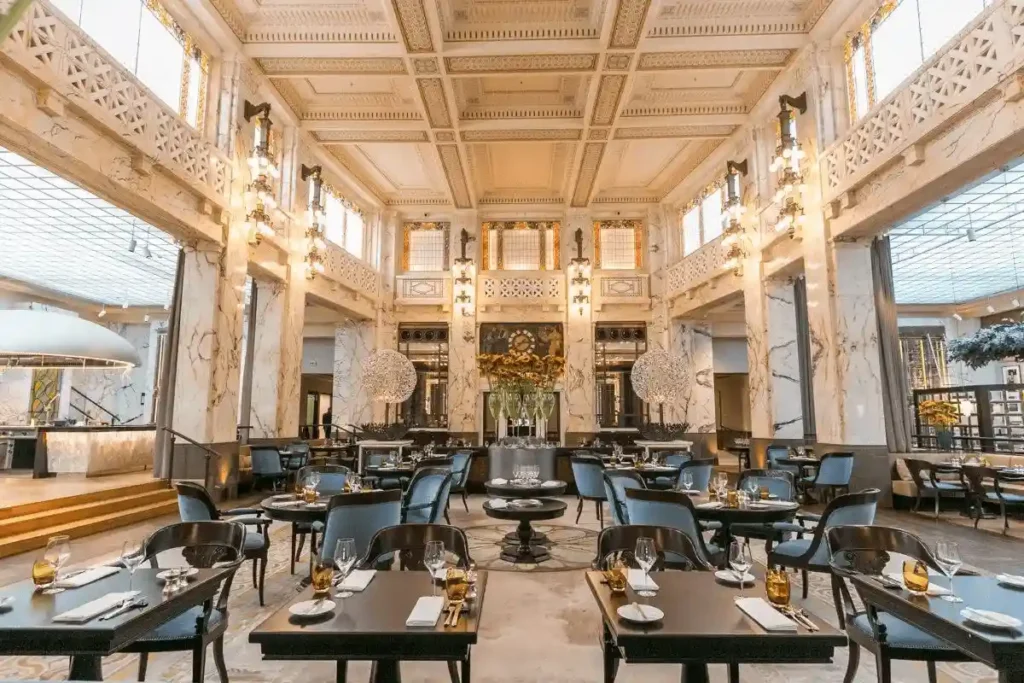
Massive marble pillars frame the original Grand Cashier Hall, now housing The Bank Brasserie. The 15-meter pool occupies the former bullion vault, gold-tiled flooring intact. This is not adaptive reuse; this is architectural preservation as competitive advantage.
For context on Vienna’s commanding historic properties, see our overview of the best historic hotels in Vienna.
Park Hyatt Vienna ★★★★★
The 1915 façade presents uncompromised Neo-Classical authority—stone columns, symmetrical fenestration, the institutional weight of a building designed to safeguard imperial capital during the final decade of Habsburg rule. The Niederösterreichische Escompte-Gesellschaft selected this Am Hof location deliberately: the square had housed the Hofkriegsrat since 1602, making it the administrative nerve center for Habsburg military campaigns across three centuries. When the bank commissioned this structure, they inherited not just real estate but 313 years of documented command authority.
Park Hyatt Vienna is a 100-year-old former bank headquarters in the UNESCO-listed First District, famously housing a gold-tiled swimming pool within its original bank vault.
FJStijl’s 2014 restoration preserved the spatial hierarchy that defined early 20th-century financial architecture. The Grand Cashier Hall—now The Bank Brasserie & Bar—retains its original 8-meter ceilings and brass accents where transactions once moved millions in Austro-Hungarian Kronen.
Heavy vault doors, engineered to withstand siege-level force, now frame the entrance to Arany Spa, a 1,000 sqm wellness complex occupying the former bullion treasure room. The 15-meter indoor pool sits precisely where gold reserves were stored under armed guard, its gold-tiled floor a calculated homage to the space’s original function.
The 143 guest rooms occupy what were once executive banking suites and administrative chambers. Standard rooms begin at 45 sqm—Vienna’s most generous baseline—while the Royal Penthouse spans 820 sqm across two floors, secured by systems originally designed for diplomatic-level protection. Technology integration follows the “invisible” doctrine: televisions hidden behind mirrors, climate controls concealed within original millwork, charging stations embedded in 100-year-old desks. This is spatial intelligence—modern infrastructure subordinated to historic architecture, not competing with it.
The Living Room functions as a cigar and whisky lounge, its dark walnut paneling and leather seating replicating the aesthetic codes of 19th-century Habsburg power circles. Café Am Hof extends onto the square where Franz II dissolved the Holy Roman Empire in 1806, offering direct visual access to the Mariensäule column commemorating that transition. Every sightline from this property connects to documented moments of imperial authority.
The 2011 fire that halted construction became an archival advantage. Post-blaze forensic analysis exposed original foundation work from the Hofkriegsrat era, allowing architects to integrate 17th-century stonework into the spa’s lower level. What was crisis became provenance—physical evidence layering Habsburg military administration beneath Habsburg financial infrastructure beneath contemporary luxury hospitality.
This is not a hotel with historic details. This is a financial fortress repurposed for guests who understand that authority compounds across centuries. You sleep in suites where banking executives once controlled Austria’s liquidity during the First World War. You swim where national gold reserves sat under military guard. The building’s function has evolved; its command presence has not.
Check Availability & Rates →In a city of imperial palaces, Park Hyatt Vienna presents the rarer asset—not where emperors resided, but where their financial and military power was administered, preserved as a fortress hotel where authority remains architectural fact.
FAQ: Park Hyatt Vienna
What makes Park Hyatt Vienna historically significant?
Park Hyatt Vienna occupies the 1915 Neo-Classical headquarters of the Niederösterreichische Escompte-Gesellschaft, one of Austria’s seven largest banks during the Habsburg Monarchy. The building stands on the site of the Imperial War Council (Hofkriegsrat), the Habsburg military’s administrative center from 1602 to 1848, making it a layered monument to 313 years of documented imperial authority in Vienna’s UNESCO-protected First District.
What is the Arany Spa’s connection to the building’s past?
Arany Spa (Hungarian for “Gold”) occupies the former bullion treasure room where the bank stored national gold reserves under armed guard. The 15-meter indoor pool sits inside the original vault, featuring gold-tiled flooring as a direct reference to the space’s function during the First World War. The 1,000 sqm complex includes saunas and steam rooms within chambers engineered for maximum security.
How large are the suites at Park Hyatt Vienna?
The Royal Penthouse Suite spans 820 sqm across two floors, making it one of Europe’s most expansive hotel accommodations. Standard rooms begin at 45 sqm, with 35 suites reaching up to 170 sqm—among Vienna’s largest. These dimensions reflect the building’s original design as executive banking suites requiring space for confidential high-stakes negotiations during the Austro-Hungarian Monarchy.
Where is Park Hyatt Vienna located in Vienna?
The hotel occupies Am Hof square in Vienna’s First District, a UNESCO World Heritage Site at the historic center of Habsburg power. The square has hosted imperial proclamations since 1806, when Franz II dissolved the Holy Roman Empire. The location provides direct access to the Hofburg Palace, St. Stephen’s Cathedral, and the Graben, all within a 5-minute walk.
The Legacy Continues in Vienna’s Hotel Elite
Park Hyatt Vienna demonstrates how financial and military infrastructure translates into contemporary dominance—143 rooms occupying a building where imperial authority was both financed and administered.
For travelers seeking Vienna’s most established aristocratic properties, Hotel Imperial Vienna offers the former Prince of Württemberg residence with 138 years of unbroken luxury service, while Hotel Sacher Wien presents the Original Sachertorte birthplace with direct proximity to the Vienna State Opera. These are not alternatives; they are the triad of Vienna’s documented power hotels.
For more curated itineraries and luxury-focused travel insights, visit Your Luxury Guide. For official travel information and destination updates, visit Austria tourism-info.
Your Luxury Guide — Where Exceptional Travel Begins.