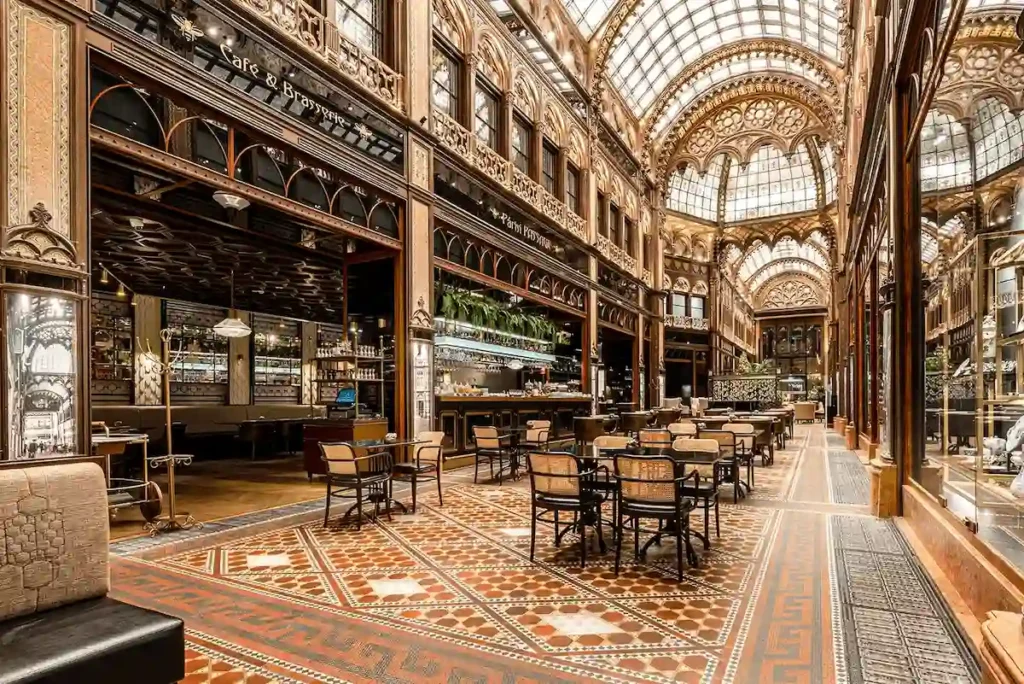
Párisi Udvar Hotel Budapest occupies Henrik Schmahl’s 1913 architectural monument—a Gothic-Moorish-Art Nouveau banking palace that served as the Central Savings Bank headquarters until the mid-20th century. Originally built on the site of the 1817 “Brudern House” (inspired by Paris’s Passage des Panoramas), the structure features thousands of hand-restored Zsolnay ceramic tiles and a 10-story mahogany-and-glass atrium.
Reopened in 2019 after comprehensive restoration, the 110-room property anchors Ferenciek tere, steps from the Danube. The building’s honey bee mascot—preserved from its banking era—marks Budapest’s transformation of financial authority into contemporary luxury.
Párisi Udvar Hotel Budapest ★★★★★
The Párisi Udvar was never designed to blend in. When Henrik Schmahl completed the structure in 1913, Budapest’s financial elite commissioned an eclectic monument that would announce the Central Savings Bank’s dominance through architectural excess. Gothic arches meet Moorish filigree beneath Art Nouveau ironwork—a deliberate display of institutional power disguised as Oriental fantasy. The original honey bee mascot, still visible throughout the restored interiors, represented the bank’s accumulation philosophy: industrious, systematic, unstoppable.
Párisi Udvar Hotel Budapest is a breathtaking architectural jewel of the Unbound Collection by Hyatt, meticulously restored to showcase its legendary glass-domed passage and a mesmerizing fusion of Arabic, Moorish, and Gothic design elements in the heart of Pest.
The building’s foundation rests on the site of the 1817 Brudern House, which introduced Budapest to the Parisian arcade concept—enclosed luxury shopping beneath ornamental glass. When the Central Savings Bank absorbed the property in 1906, they preserved the passage structure but elevated its materials.
The Zsolnay factory produced hundreds of thousands of individual ceramic tiles in metallic glazes, each one numbered and positioned according to Schmahl’s specifications. The result was a facade that shifted color with the sun’s movement, announcing financial authority through chromatic dominance.
The 10-story hexagonal atrium remains the building’s spatial anchor. Thousands of mahogany panels and colored glass sections filter natural light into constantly changing patterns—a kaleidoscopic effect that transforms throughout the day. The Párisi Passage Café & Brasserie occupies the ground level beneath this vaulted space, positioning guests within the same vertical axis where banking executives once conducted transactions that shaped Hungary’s pre-WWI economy.
The 2019 restoration preserved the building’s institutional scale while converting administrative floors into 110 guest rooms and 18 suites. The Paris and Budapest Presidential Suites occupy the uppermost levels, featuring private rooftop terraces with jacuzzis and unobstructed views across the Danube to Gellért Hill and the Basilica. These aren’t standard penthouse additions—they’re inhabitations of the building’s original power geometry, where financial directors once surveyed the city their institution financed.
The Zafír Spa translates the bank’s former vault-level security into contemporary wellness exclusivity. Finnish sauna, steam bath, and infrared treatments operate within the same foundation that once protected national deposits. ÉTOILE Champagne Bar occupies a restored hall where senior bankers negotiated terms; today’s curated champagne labels and French-influenced appetizers maintain the space’s transactional sophistication.
The Párisi Passage Restaurant’s open-kitchen concept operates where administrative departments once coordinated across floors. Modern Hungarian-international fusion is prepared in view of guests dining beneath the restored Zsolnay tilework and original ironwork chandeliers. The 24-hour Technogym fitness studio maintains accessibility standards established when the building operated without closure during banking crises.
Budapest’s first modern shopping mall evolved into one of its most architecturally significant financial institutions, then transformed into a luxury hotel that preserves both lineages. The building’s triple heritage—retail innovation, banking authority, contemporary hospitality—creates layered authenticity that generic palace conversions cannot replicate.
Check Availability & Rates →Schmahl’s 1913 monument to Budapest’s financial ascendancy now offers 110 residences within the same eclectic geometry that once signaled institutional permanence—Moorish arches, Zsolnay tiles, and hexagonal light filtering through a 10-story atrium where banking executives commanded Hungary’s pre-war economy.
FAQ: Párisi Udvar Hotel Budapest
What makes Párisi Udvar Hotel architecturally significant?
Henrik Schmahl’s 1913 design blends Gothic, Moorish, and Art Nouveau styles using hundreds of thousands of hand-crafted Zsolnay ceramic tiles. The 10-story hexagonal atrium with mahogany and colored glass panels creates a kaleidoscopic light effect throughout the day, representing one of Budapest’s most ambitious eclectic-style monuments.
What was the building’s original purpose before becoming a hotel?
Constructed as the Central Savings Bank headquarters in 1906, replacing the 1817 Brudern House shopping arcade. The honey bee mascot from the banking era remains visible throughout the restored property. It served as a financial institution until mid-20th century before decades of neglect preceded the 2019 luxury hotel conversion.
What distinguishes the Presidential Suites?
The Paris and Budapest Presidential Suites occupy the uppermost floors with private rooftop terraces featuring jacuzzis and 360-degree views of Budapest’s skyline, including the Danube, Gellért Hill, and Basilica. These represent the largest and most exclusive accommodations in the 110-room property.
Where is Párisi Udvar Hotel located in Budapest?
Situated at Ferenciek tere in Budapest’s historic center, steps from the Danube River and Váci utca shopping district. The location positions guests within the former financial district’s architectural core, with direct access to both riverfront promenades and commercial heritage zones.
Heritage Authority Maintained Through Architectural Permanence
Henrik Schmahl’s 1913 banking palace continues operating as Budapest’s most architecturally complex hospitality structure—where Moorish tilework, Gothic arches, and Art Nouveau ironwork preserve the financial authority that commissioned them. The Central Savings Bank’s institutional geometry now frames 110 contemporary residences within the same eclectic monument that announced pre-war economic dominance.
Travelers seeking comparable architectural lineage, explore Matild Palace Budapest and Anantara New York Palace Budapest, where similar institutional-to-luxury transformations maintain Budapest’s heritage hospitality landscape.
For more curated itineraries and luxury-focused travel insights, visit Your Luxury Guide. For official travel information and destination updates, visit Hungary tourism-info.
Your Luxury Guide — Where Exceptional Travel Begins.