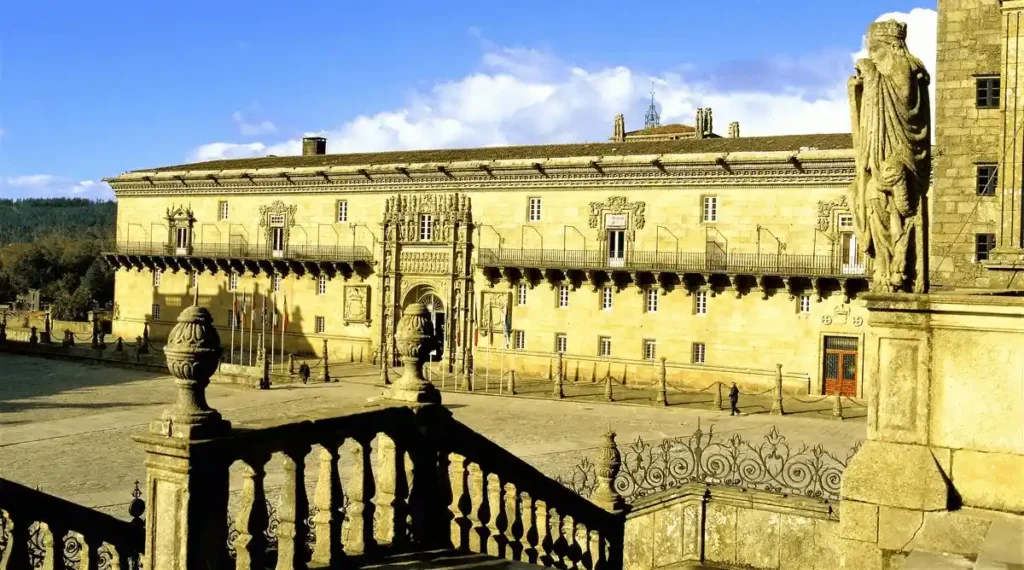
The Parador de Santiago occupies the former Royal Hospital of the Catholic Monarchs, commissioned in 1499 as the most ambitious pilgrimage infrastructure in Europe. Ferdinand and Isabella ordered this fortress of mercy at the terminus of the Camino de Santiago—not as charity, but as territorial assertion. The building’s four Renaissance courtyards, Gothic chapel, and vaulted refectory were designed to process 3,000 pilgrims annually while projecting Castilian authority across the northern frontier.
Today, the estate functions as Spain’s flagship parador, converting royal administrative architecture into 137 suites where guests inhabit the physical seat of Catholic power at Christianity’s third-holiest site. This is the luxury terminus of medieval Europe’s greatest pilgrimage—verified stone, documented sovereignty, absolute prestige.
Parador de Santiago – Hostal Reis Catolicos ★★★★★
The Parador de Santiago was never intended as accommodation—it was designed as infrastructure of empire. When Ferdinand and Isabella commissioned architect Enrique Egas in 1499, they created the most sophisticated medical and logistical complex on the Iberian Peninsula. The Royal Hospital processed pilgrims arriving from across Europe, providing 90 days of recovery, meals, and spiritual counsel—all under the administrative gaze of the Crown.
Parador de Santiago transforms its origins as a 15th-century royal pilgrim hospice into a monumental sanctuary that anchors the spiritual and architectural climax of the Camino de Santiago.
The building’s four courtyards (named for the Evangelists) functioned as segregated medical wards, each with its own fountain, arcade, and chapel access. The Gothic Capilla Mayor, consecrated in 1509, served as the spiritual nucleus where royal chaplains administered last rites to those who completed the Camino but did not survive the journey’s toll.
The architecture enforces hierarchy through stone. Granite façades span 100 meters along the Plaza del Obradoiro, directly facing Santiago Cathedral—a deliberate spatial assertion that placed royal authority in permanent visual dialogue with ecclesiastical power. The main portal, carved with Ferdinand and Isabella’s coat of arms, functions as territorial branding: every pilgrim entering the hospital passed beneath Castilian heraldry, a physical reminder that mercy was administered by monarchs, not bishops.
Modern conversion has preserved this command structure. The former wards now house 137 suites, each positioned along corridors that once directed pilgrims to treatment. Original stone vaulting spans guest rooms, some with carved wooden ceilings transported from dissolved monasteries.
The Dos Reis restaurant occupies the historic refectory, where vaulted ceilings rise 12 meters above diners seated at tables positioned along the original meal lines. Breakfast service beneath 16th-century frescoes is not theatrical—it is spatial continuity. Guests dine where institutional power was once exercised through the distribution of bread.
The hotel’s spa occupies the former hospital crypts, utilizing the same thermal principles that regulated medieval patient recovery. Granite walls maintain constant humidity and temperature, creating microclimates that Spanish royal physicians understood as therapeutic.
The fitness facilities are integrated into the lower courtyards, where natural light filters through Renaissance arcades onto contemporary equipment positioned within 500-year-old stone frameworks.
This is not a hotel that references history—it is history that now functions as luxury. The stone corridors, the vaulted ceilings, the Gothic chapel, and the heraldic portal are not preserved as museum artifacts but as the operational architecture of Spain’s most prestigious pilgrimage-era estate.
Guests here occupy the final territorial marker of the Camino, sleeping in suites where royal authority was once translated into institutional mercy at the edge of the known world.
Check Availability & Rates →The Parador de Santiago functions as living proof that the Catholic Monarchs understood architecture as permanent policy—stone courtyards and vaulted halls do not expire. Ferdinand and Isabella built infrastructure that would outlast kingdoms, and guests today inhabit the physical dominance they commissioned at Christianity’s western threshold.
FAQ: Parador de Santiago
What makes the Parador de Santiago historically significant?
The Parador de Santiago occupies the Royal Hospital of the Catholic Monarchs, commissioned in 1499 by Ferdinand and Isabella as Europe’s most advanced pilgrimage infrastructure. The building served as a medical, logistical, and spiritual complex processing 3,000 annual pilgrims at the terminus of the Camino de Santiago. Its four Renaissance courtyards, Gothic chapel, and royal heraldry established Castilian authority at Christianity’s third-holiest site.
What original architectural features remain in the Parador de Santiago?
The hotel preserves its four Evangelist courtyards with original fountains and arcades, the Gothic Capilla Mayor consecrated in 1509, and granite façades spanning 100 meters. Guest rooms retain 16th-century stone vaulting, carved wooden ceilings, and corridor layouts that mirror the original hospital ward structure. The main dining hall occupies the historic refectory with 12-meter vaulted ceilings and Renaissance frescoes.
How does the Parador de Santiago relate to the Camino de Santiago pilgrimage?
The Royal Hospital was built as the official terminus infrastructure for the Camino de Santiago, providing 90 days of medical care, meals, and spiritual counsel to pilgrims. Its location directly facing Santiago Cathedral on the Plaza del Obradoiro established it as the final institutional waypoint of medieval Europe’s greatest pilgrimage route. Modern guests occupy the same spatial axis that pilgrims entered after completing their journey.
What dining experience does the Parador de Santiago offer?
The Dos Reis restaurant operates within the original hospital refectory, where vaulted ceilings rise 12 meters above diners. Breakfast and meals are served beneath 16th-century frescoes along tables positioned according to the historic meal distribution lines. The menu emphasizes Galician seafood and traditional Camino-era recipes, maintaining culinary continuity with the building’s pilgrimage function.
The Enduring Authority of Royal Infrastructure
The Parador de Santiago translates 525 years of documented sovereignty into modern prestige through verified stone and institutional architecture. Ferdinand and Isabella did not build decoration—they built permanence, and that permanence now defines Spain’s most prestigious historic hotel.
This is the luxury of inhabiting power structures that have outlasted empires, where every courtyard and vaulted hall enforces the spatial dominance of Catholic Spain’s territorial apex.
Those seeking verified historic estates with royal provenance, continue to Parador de Cuenca or Parador de Jaén.
For more curated itineraries and luxury-focused travel insights, visit Your Luxury Guide. For official travel information and destination updates, visit Spain tourism-info.
Your Luxury Guide — Where Exceptional Travel Begins.