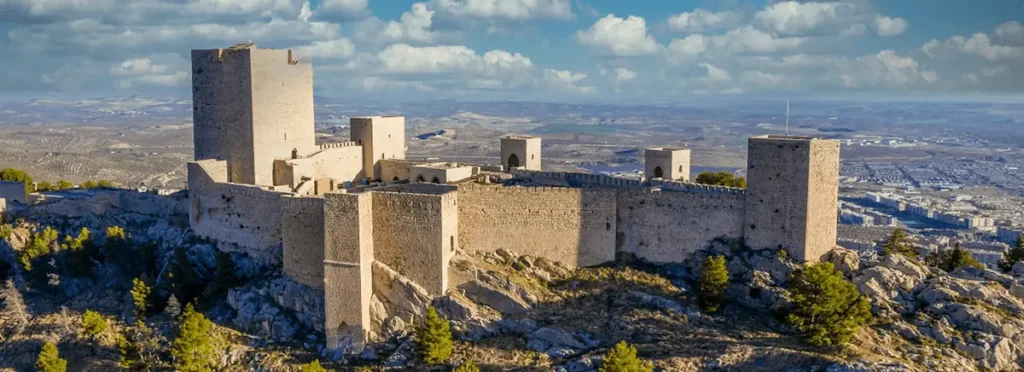
The Parador de Jaén is not a repurposed castle—it is an active continuation of a 13th-century military stronghold that has commanded the approach to Andalusia’s eastern frontier for eight centuries. Built as a forward observation post during the Reconquista, this fortress was engineered for territorial dominance: its clifftop position overlooks 60 kilometers of olive groves and mountain passes that once marked the border between Christian Castile and Moorish Granada.
The original Arab fortifications were absorbed and expanded by Christian military architects, creating a layered defensive complex where stone walls, watchtowers, and strategic sight lines remain intact. Today, guests occupy the same elevated vantage point that generals and governors used to monitor troop movements and control trade routes. This is not a hotel with a view—it is a seat of geographic authority where you inhabit the command center of a contested landscape.
Parador de Jaén ★★★★
The Parador de Jaén’s architectural language speaks in military absolutes. Battlements frame 360-degree visibility across the Sierra Morena and Jaén’s historic center below—a spatial configuration designed for surveillance, not scenery. The fortress layout follows 13th-century tactical logic: vaulted stone corridors funnel movement through defensible choke points; arched windows are positioned to maximize light while maintaining wall integrity; the central courtyard serves as both gathering space and interior defensive perimeter.
Every room in Parador de Jaén occupies a section of the original fortress structure—you sleep within walls that were built to withstand siege engines and maintain command during protracted conflict.
The interior design honors the building’s military heritage without romanticizing it. Stone walls remain exposed where load-bearing masonry defines the structure; period furnishings reference the Reconquista’s aristocratic military class; heavy wooden doors and wrought iron fixtures echo the fortress’s original utilitarian rigor. This is not decorative medievalism—it is spatial honesty where modern comfort operates within an environment engineered for control and permanence.
The on-site restaurant operates in the former officers’ dining hall, where vaulted ceilings and stone columns frame contemporary Andalusian cuisine. Floor-to-ceiling windows exploit the fortress’s elevated position: meals are taken with unobstructed views across olive valleys that once represented contested territory. The wine list emphasizes regional selections from Jaén’s Sierra Sur vineyards—estates that have supplied the fortress’s tables since its founding.
Guest rooms follow the fortress’s cellular layout: each chamber is carved from the original defensive architecture, with stone walls measuring over a meter thick. The thermal mass of the masonry provides natural climate regulation, a passive environmental system that predates mechanical engineering by seven centuries. Bathrooms are modernized but spatial volumes honor the fortress’s proportions: high ceilings, deep-set windows, and stone flooring maintain architectural continuity with the military past.
The outdoor terrace extends the fortress’s defensive perimeter into leisure space. Positioned along the cliff edge where medieval sentries once maintained watch, this elevated platform delivers the same strategic visibility that made the site militarily valuable: from this vantage point, you command views that encompass Jaén Cathedral, the Sanctuary of the Virgen de la Cabeza, and the Sierra Mágina mountain range.
The fortress pool occupies a terraced section of the outer battlements—you swim within the same stone walls that once defined the castle’s defensive envelope.
Check Availability & Rates →The Parador de Jaén does not invite you into history—it positions you at the apex of a landscape engineered for command. You occupy the same elevated threshold where military authority was exercised for eight centuries, where vision equaled power, and where the fortress’s stone permanence declared territorial dominance across Andalusia’s contested eastern frontier.
FAQ: Parador de Jaén
What is the historical significance of Parador de Jaén?
Parador de Jaén occupies a 13th-century fortress built during the Reconquista to control the frontier between Christian Castile and Moorish Granada. Its clifftop position provided strategic surveillance over trade routes and military movements across 60 kilometers of Andalusian territory. The fortress absorbed original Arab defensive architecture and was expanded by Christian military engineers, creating a layered command post that remained militarily relevant for centuries.
What makes the location of Parador de Jaén unique?
The fortress sits 1,250 meters above sea level on a cliff overlooking Jaén’s historic center and surrounding olive valleys. This elevated position was chosen for maximum territorial visibility—medieval commanders could monitor approach routes from the Sierra Morena and coordinate defensive operations across the eastern Andalusian frontier. Today, guests occupy the same vantage point, with unobstructed views spanning mountain ranges, agricultural valleys, and Jaén’s monumental skyline.
How does the architecture reflect the building’s military origins?
The Parador preserves original 13th-century battlements, watchtowers, vaulted stone corridors, and meter-thick defensive walls. The fortress layout follows tactical logic: defensible choke points, strategic window placement for surveillance, and a central courtyard designed as an interior defensive perimeter. Guest rooms occupy sections of the original military structure where the thermal mass of medieval masonry provides passive climate control.
What amenities maintain the fortress’s historic character?
The restaurant operates in the former officers’ dining hall with vaulted stone ceilings and panoramic windows overlooking contested historical territory. The outdoor terrace and pool are integrated into the original battlements, allowing guests to swim and dine within the fortress’s defensive envelope. All public spaces preserve exposed stonework, arched passageways, and architectural elements that demonstrate the castle’s engineering permanence.
Experience Territorial Command Where Military Architecture Defines Modern Prestige
The Parador de Jaén delivers what no conventional hotel can replicate: the physical occupation of a landscape’s command center, where eight centuries of documented military authority translate into modern exclusivity. This is not a themed property—it is the continued use of a fortress engineered for dominance, where your room assignment places you within walls built to control a kingdom’s frontier.
For travelers who recognize that true luxury is measured in centuries of verified power, continue your journey through Spain’s most historically significant properties: the Parador de Granada within the Alhambra complex, and the Parador de Santiago, a medieval pilgrimage hospital that has hosted European royalty since the 15th century.
For more curated itineraries and luxury-focused travel insights, visit Your Luxury Guide. For official travel information and destination updates, visit Spain tourism-info.
Your Luxury Guide — Where Exceptional Travel Begins.