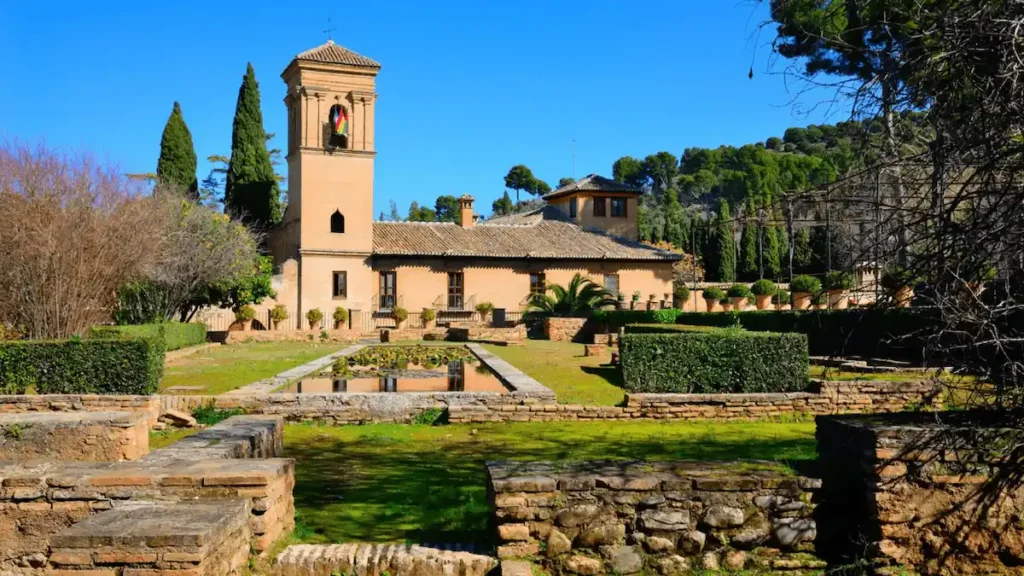
The Parador de Granada operates within a 15th-century convent commissioned by the Catholic Monarchs immediately after the Reconquista. Built on Nasrid foundations within the Alhambra’s fortified perimeter, this property represents the architectural assertion of sovereign transition—the physical conversion of Islamic Granada into a seat of Catholic royal authority.
You occupy rooms where Ferdinand and Isabella’s court first established governance over the last Moorish kingdom in Western Europe. This is not adjacency to heritage; this is residence within one of Europe’s most contested territorial landmarks.
Discover more premier properties among the best castle stays in Andalusia.
Parador de Granada ★★★★
The Parador de Granada’s location inside the Alhambra UNESCO World Heritage Site grants exclusive after-hours access to grounds closed to 2.7 million annual visitors after sunset. The building itself—a Franciscan convent founded in 1492—rests atop the former Nasrid palace complex.
Masonry from the original Moorish structure integrates into the monastery’s foundations; archaeological excavations beneath the chapel reveal Nasrid-era ceramic work and hydraulic systems that fed the palace gardens.
The Catholic Monarchs chose this precise site to symbolize religious and territorial dominance—your suite occupies a deliberate architectural statement of dynastic succession.
Parador de Granada preserves its unique legacy as a 15th-century convent built upon a Nasrid palace, offering an immersive stay that anchors guests directly within the monumental history of the Alhambra.
The Parador retrofitted the monastery’s cloistered galleries into guest corridors without compromising the original arcade proportions. Vaulted ceilings maintain 15th-century stone corbels; devotional frescoes line the refectory-turned-dining hall. Suites overlook the Generalife gardens through windows cut into walls three feet thick—defensive masonry repurposed for controlled views of the Darro River valley.
The building’s position within the Alhambra’s outer fortifications provided strategic elevation; you inherit that tactical geography as private vantage over Granada’s roofscape.
Modern renovations preserve the monastery’s spatial hierarchy. The former chapter house now functions as a lounge with exposed timber beams dated to the late 1400s. Stone flooring throughout the property retains wear patterns from five centuries of foot traffic—Franciscan friars, Spanish nobility, and Republican-era political figures all traversed these corridors.
The hotel’s thermal system operates beneath original floor tiles; climate control integrates into 500-year-old walls without visible intrusion. This is controlled preservation: historical fabric maintained through concealed infrastructure.
The property’s chapel remains consecrated ground. Ferdinand and Isabella’s remains rested here temporarily before transfer to the Royal Chapel downtown—a documented 11-year interment that established the monastery as a pilgrimage site.
You breakfast in the refectory where Renaissance courtiers received audiences. The Parador’s southern terrace—built atop Nasrid garden terraces—permits evening access to the Alhambra when floodlit ramparts loom over emptied plazas. Other guests queue at dawn; you reside within the monument after it empties.
Check Availability & Rates →Within the Alhambra’s fortified perimeter, the Parador de Granada transforms a royal monastery into a sovereign residence—where stone walls that witnessed the transition of empires now frame your private command of Spain’s most contested landmark.
FAQ: Parador de Granada
Can you stay inside the Alhambra complex?
Yes. The Parador de Granada is the only hotel within the Alhambra’s walled perimeter. Its location inside a 15th-century Royal Monastery grants guests 24-hour access to the complex, including after-hours entry when the site closes to day visitors at sunset.
What makes the Parador de Granada historically significant?
The property occupies a Franciscan convent founded by Catholic Monarchs Ferdinand and Isabella in 1492, built immediately after the Reconquista. The monastery rests on Nasrid palace foundations; the monarchs’ remains were temporarily interred in its chapel before transfer to Granada’s Royal Chapel downtown.
Does the Parador de Granada provide access to the Alhambra palaces?
While the Parador sits within the Alhambra complex, entry to the Nasrid Palaces requires separate timed tickets purchased in advance. However, guests enjoy privileged access to the Generalife gardens and fortress grounds during restricted hours when the site is closed to the public.
What type of rooms does the Parador de Granada offer?
Rooms occupy the monastery’s former monastic cells and cloistered wings, featuring vaulted ceilings, original stone masonry, and windows overlooking the Generalife gardens or Darro River valley. Suites retain 15th-century architectural elements integrated with modern amenities beneath exposed timber beams.
Sovereign Residence Within Spain’s Most Contested Monument
The Parador de Granada delivers unmediated access to the Alhambra—not as a visitor, but as a resident of the complex where Catholic Spain first asserted dominance over Andalusia. You occupy architecture commissioned by monarchs who transformed the last stronghold of Islamic Europe into a seat of Christian authority. This is territorial heritage made habitable: stone corridors that bore witness to dynastic succession, now reserved for those who recognize history as the ultimate marker of exclusivity.
For further fortified estates that command their landscapes, consider Parador de Jaén or the medieval stronghold of Parador de Alarcón.
More curated itineraries and luxury-focused travel insights at Your Luxury Guide. For official travel information and destination updates, visit Spain tourism-info.
Your Luxury Guide — Where Exceptional Travel Begins.