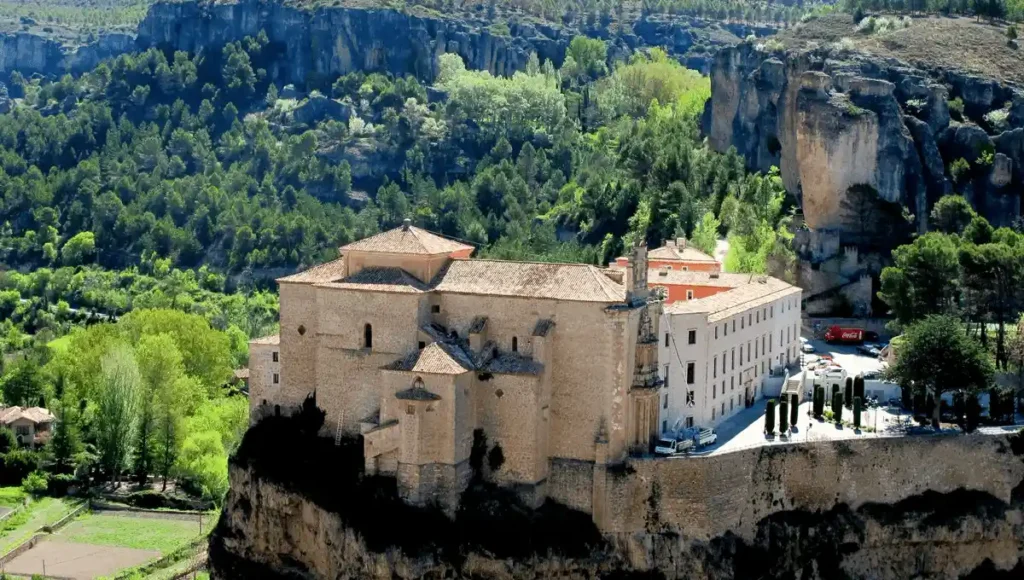
Parador de Cuenca converts the San Pablo Convent—a Dominican monastery founded in 1523—into a territorial command post suspended 100 meters above the Huécar Gorge. This isn’t adaptive reuse; it’s the continuation of a site selected for visual dominance over Cuenca’s canyon network and the fortified medieval city across the gorge. The original cloisters, vaulted refectory, and stone corridors remain intact, translating five centuries of monastic isolation into absolute privacy. Guests occupy the same elevated position that gave the Dominicans control over the valley’s spiritual and territorial authority.
Parador de Cuenca ★★★★
The San Pablo Convent was purpose-built in 1523 as a Dominican fortress of contemplation—engineered for isolation, not accessibility. The monks who commissioned this structure understood territorial psychology: by anchoring their monastery to the cliff face above the Huécar Gorge, they created a physical barrier between ecclesiastical authority and the common valley below.
Today, that vertical separation translates directly into guest privacy. The 63 rooms occupy the original monastic cells and dormitories, preserving the thick stone walls (often 1.5 meters deep) that once enforced silence and now guarantee acoustic isolation from the modern world.
Parador de Cuenca anchors its 16th-century monastic heritage onto the dramatic limestone precipices of the Huécar Gorge, serving as a historic vantage point over the famous “Hanging Houses” of Cuenca.
The architecture follows defensive monastic logic. The main cloister—a two-story Renaissance courtyard with stone arcades—served as the central circulation spine, controlling movement through the complex. Guests now move through these same vaulted corridors to access the former chapter house (converted to a reading salon) and the refectory (now the hotel restaurant, retaining its timber-beamed ceiling and Gothic arches).
The original stone-flagged floors remain underfoot, worn smooth by 500 years of footsteps. Every room maintains sightlines to either the gorge or the medieval Cuenca skyline—the same strategic viewpoints the Dominicans used to monitor their territorial domain.
The site’s power derives from its relationship to Cuenca’s hanging houses (Casas Colgadas)—the gravity-defying residences that cling to the opposite canyon wall. From the Parador’s cliffside terrace, guests face these 14th-century structures at eye level, inhabiting the same commanding perspective that allowed the monastery to function as the spiritual counterweight to the city’s secular authority. The stone footbridge connecting the convent to the old town (built in 1902, replacing a medieval crossing) reinforces this axis of control—you cross from one seat of power to another.
The San Pablo’s original Chapel of the Virgin remains consecrated, its baroque altarpiece and frescoed dome accessible to guests. The former monks’ library now houses the hotel’s reception, surrounded by original wooden bookcases that held theological texts used to train Dominican preachers.
The transformation is seamless because the building’s purpose has barely shifted: then, a retreat for the ecclesiastical elite; now, a sanctuary for guests who understand that true luxury requires separation from the masses—enforced by 100 vertical meters of limestone cliff.
The Parador’s dining program operates from the original monastic kitchen, updated with modern capacity but retaining the stone hearths and vaulted chambers where Dominican cooks prepared meals following strict liturgical schedules. The menu leans on Castilian mountain cuisine—roasted game, saffron-infused stews, Manchego cheeses—but the real authority comes from dining in a space where food once fueled five centuries of spiritual command.
Check Availability & Rates →The San Pablo Convent was never meant to integrate with Cuenca’s social life—it was built to preside over it from a position of unreachable elevation, converting spiritual authority into spatial dominance that guests now inherit as effortless territorial superiority.
FAQ: Parador de Cuenca
What historical significance does Parador de Cuenca hold?
Parador de Cuenca occupies the San Pablo Convent, a Dominican monastery founded in 1523 and constructed directly into the Huécar Gorge cliff face. The site functioned as an isolated religious command post overlooking medieval Cuenca, with its vertical positioning enforcing separation between ecclesiastical authority and the civilian population below. The building’s original cloisters, chapel, and monastic quarters remain architecturally intact.
What makes the location of Parador de Cuenca strategically significant?
The convent was engineered 100 meters above the Huécar River gorge to dominate sightlines across Cuenca’s canyon network. This elevation granted the Dominican order visual control over both the fortified medieval city and the valley approaches, translating spiritual authority into territorial surveillance. Guests inherit this commanding vertical position, with direct views to Cuenca’s 14th-century hanging houses suspended on the opposite cliff.
What original architectural features survive in Parador de Cuenca?
The San Pablo Convent retains its Renaissance stone cloister, vaulted refectory with Gothic timber beams, consecrated baroque chapel, and 1.5-meter-thick exterior walls. The monastic dormitories (now guest rooms) preserve original flagstone floors and narrow window embrasures designed for fortress-like privacy. The stone footbridge connecting the convent to the old city dates to 1902 but follows a medieval crossing route.
Why was the San Pablo Convent built on this specific site?
Dominican planners selected the cliff edge for its defensive isolation—the gorge created a natural moat separating the monastery from secular society. This vertical barrier allowed the order to enforce strict enclosure while maintaining visual dominance over Cuenca’s spiritual and civic life. The site’s inaccessibility was a feature, not a constraint, designed to elevate the monastery’s authority through physical remoteness.
The Elevated Authority of Castilian Monastic Command
The San Pablo Convent demonstrates how ecclesiastical power translated spatial isolation into territorial prestige—a principle Parador de Cuenca preserves for the modern guest. From this vertical command post, you inhabit the same elevated authority the Dominican order wielded for five centuries, suspended between canyon and sky where privacy isn’t purchased but engineered through limestone and elevation.
Continue exploring Spain’s heritage command posts at Parador de Santiago and Parador de Jaén.
For more curated itineraries and luxury-focused travel insights, visit Your Luxury Guide. For official travel information and destination updates, visit Spain tourism-info.
Your Luxury Guide — Where Exceptional Travel Begins.