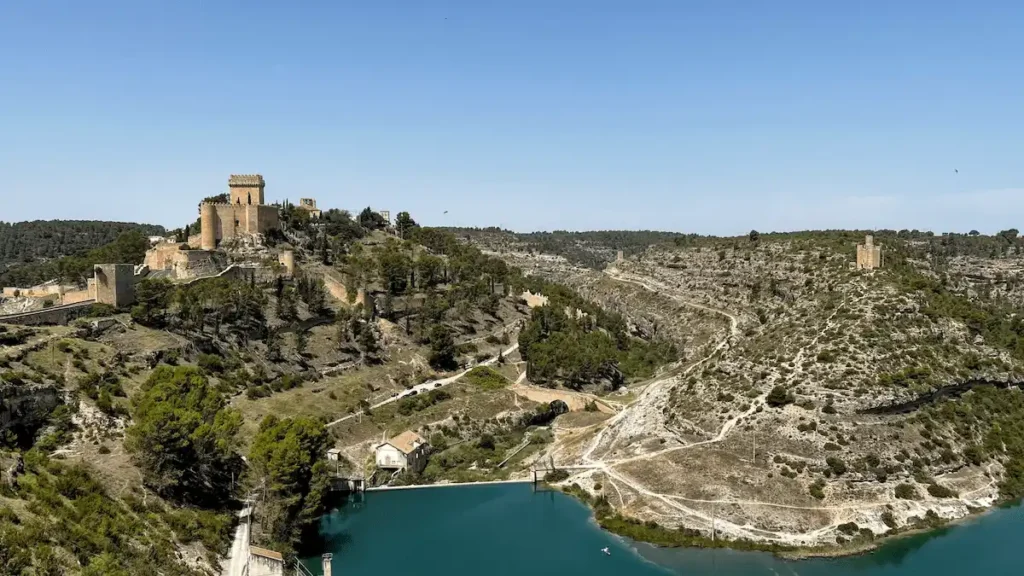
Parador de Alarcón rises from a limestone promontory encircled by the Júcar River—a defensive stronghold engineered by Arab rulers in the 8th century and seized during the Reconquista by Castilian forces in 1184. The fortress controlled the vital Castile-Aragón corridor, and its strategic dominance made occupation synonymous with territorial sovereignty.
Today, this 4-star parador translates military supremacy into modern exclusivity, where guests inhabit walls that once repelled sieges and housed the commanders who shaped medieval Spain’s power structure.
For travelers seeking accommodations where history defines hierarchy, explore the best castle stays across Spain.
Parador de Alarcón ★★★★
The Parador de Alarcón conversion retained the fortress’s original Arab masonry—triple-layered battlements with crenellated parapets that enforced total territorial surveillance. The castle’s promontory position, 90 meters above the Júcar gorge, created a natural moat that rendered assault virtually impossible.
When Ferdinand III’s armies conquered Alarcón in 1184, they inherited not just a fortress but an architectural declaration of impregnability. The Marquis of Villena later expanded the complex in the 15th century, adding Gothic arches and fortified towers that transformed the site into a noble residence without sacrificing its defensive authority.
Parador de Alarcón exemplifies over thirteen centuries of Moorish and Christian military history, occupying a high-density defensive position within a tight meander of the Júcar River.
The 14 guest rooms occupy these original stronghold chambers—stone walls averaging 1.2 meters thick, vaulted ceilings supported by Mudéjar woodwork, and arrow-slit windows that frame the same vista medieval commanders monitored for approaching forces. The Presidential Suite inhabits the Torre del Homenaje, the castle’s command tower where feudal lords received oaths of allegiance. Its private terrace overlooks the entire Alarcón plateau—a spatial relationship that physically positions you at the apex of territorial hierarchy.
The dining hall operates within the former armory, where Gothic ribbed vaults and heraldic shields establish the room’s lineage. The restaurant prioritizes Manchegan culinary tradition—game dishes and regional cheeses that reflect the castle’s agricultural dominion over surrounding estates.
The medieval courtyard, preserved with its original cobblestone and defensive archways, serves as the property’s ceremonial entrance—a spatial transition that separates guests from the common realm the moment they cross the threshold. The castle’s Chapel of San Juan Bautista, with 16th-century frescoes still intact, remains consecrated and available for private events.
The fortress’s underground cisterns, engineered to withstand siege conditions, have been converted into wine cellars that maintain the same strategic purpose: long-term resource security for extended occupancy.
This is not hospitality framed by modern convenience; it is occupation of a verified command post. The parador’s restoration preserved the military architecture that made surrender unthinkable. You sleep within walls that decided the fate of kingdoms, in rooms where territorial authority was absolute and physical dominance was the only currency that mattered.
Check Availability & Rates →Alarcón’s battlements rise from stone that bore witness to eight centuries of territorial command—the fortress’s limestone walls absorb the weight of conquest, and within them, the guest inherits not just history but the spatial authority of sovereignty itself.
FAQ: Parador de Alarcón
What makes Parador de Alarcón historically significant?
Parador de Alarcón was constructed as an 8th-century Arab fortress and seized by Castilian forces in 1184 during the Reconquista. Its strategic position above the Júcar gorge controlled the vital Castile-Aragón corridor, making it a key military asset during medieval territorial conflicts. The castle’s defensive architecture—triple-layered battlements and 1.2-meter-thick walls—ensured its impregnability for eight centuries.
What rooms offer the most authentic medieval experience?
The Presidential Suite occupies the Torre del Homenaje, the castle’s original command tower where feudal lords received oaths of allegiance. Its private terrace provides the same territorial surveillance vista medieval commanders utilized. All 14 guest rooms retain original Arab masonry, vaulted Mudéjar ceilings, and arrow-slit windows that frame the defensive landscape.
How does Parador de Alarcón preserve its fortress character?
The parador conversion retained all original military infrastructure—battlements, crenellated parapets, fortified towers, and underground cisterns. The medieval courtyard maintains its defensive cobblestone and archways. The dining hall operates within the former armory, preserving Gothic ribbed vaults and heraldic shields that establish the space’s martial lineage.
What distinguishes Alarcón’s location from other Spanish castle hotels?
Alarcón’s promontory position 90 meters above the Júcar River creates a natural moat encircling the fortress on three sides—a defensive feature that made siege virtually impossible. This geographic isolation enforced territorial exclusivity for eight centuries, and today translates into complete privacy from the surrounding modern landscape.
A Fortress Where Sovereignty Remains Absolute
Parador de Alarcón delivers what lesser properties only reference—physical occupation of verified territorial command. The fortress’s architecture enforces exclusivity not through amenities but through walls engineered to repel invasion, rooms designed for sovereign authority, and a position that ensures spatial dominance over the landscape. You do not visit this history; you inhabit it as the commanders once did, where every stone reinforces the hierarchy that made Alarcón unconquerable.
For further explorations of verified Spanish heritage estates, consider the Moorish palace authority of Parador de Granada or the Mediterranean coastal command of Castillo Hotel Son Vida.
More curated itineraries and luxury-focused travel insights at Your Luxury Guide. For official travel information and destination updates, visit Spain tourism-info.
Your Luxury Guide — Where Exceptional Travel Begins.